Received a Party Wall Notice? Here is What to Do Next

That formal letter from your neighbour isn't a legal threat; it's actually your strongest tool for property protection. If you've just received party wall notice what to do is likely the only question on your mind. It’s natural to feel a sense of unease when legal jargon arrives on your doorstep. You might worry about potential damage to your foundations or the fear of being landed with unexpected surveyor costs. You need clear, expert guidance to ensure your home remains safe during the works.

At Christopher Anthony Surveyors, we believe clarity is the antidote to anxiety. This guide will walk you through the exact steps to take to uphold your rights whilst ensuring your neighbour remains responsible for all professional fees. You'll discover how to respond effectively, why a Schedule of Condition is your best insurance policy, and how to navigate the process without the stress. We'll demystify the Party Wall etc. Act 1996 so you can move forward with total confidence. Let's turn this procedural hurdle into a robust safeguard for your property.

Key Takeaways

  • If you have received party wall notice what to do first is to note the 14-day statutory response deadline to ensure your legal rights remain intact.
  • Evaluate whether to consent or dissent, noting that even if you consent, you can still request a Schedule of Condition for added security.
  • Use a Schedule of Condition to create a definitive record of your property's state, which acts as your primary evidence if any damage occurs.
  • Benefit from the fact that your neighbour typically pays for your surveyor's fees, giving you access to expert protection without any personal financial burden.

Understanding Your Party Wall Notice and the 14-Day Deadline

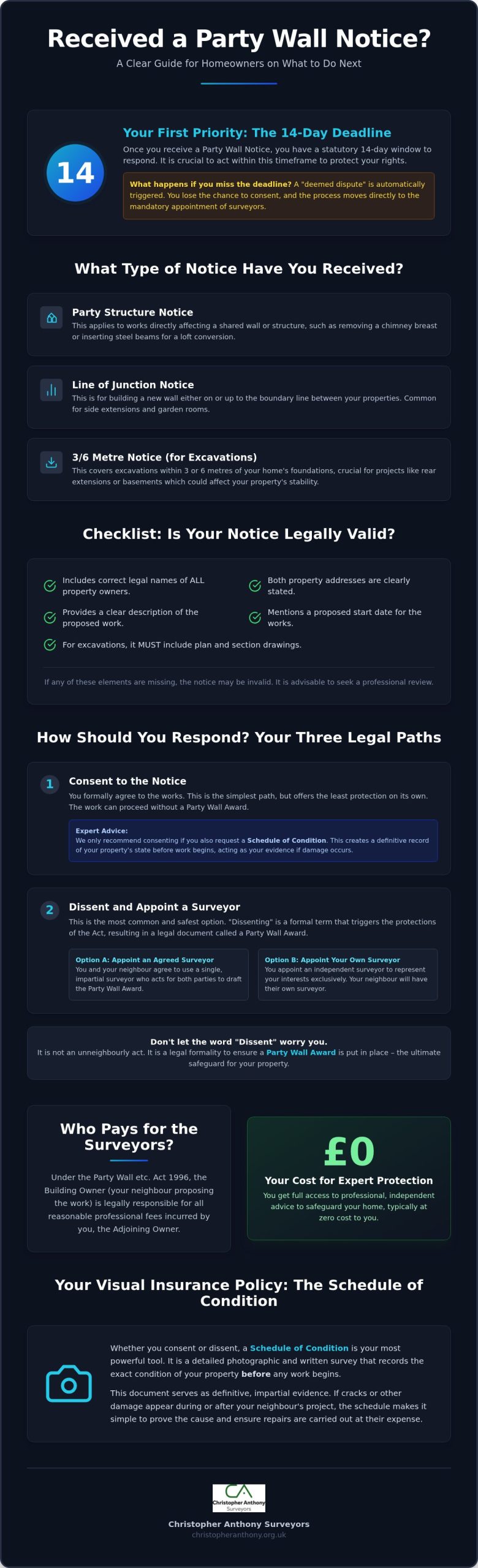
Under the Party Wall etc. Act 1996, your neighbour must notify you before starting specific works. This isn't a request for permission; it's a legal obligation to protect both properties. Once you've received party wall notice what to do is act quickly. You have a 14-day statutory window to respond. Missing this deadline doesn't stop the builders. Instead, it triggers a "deemed dispute" under the Act. This means you lose the opportunity to consent smoothly, and the process moves into a formal, mandatory surveyor appointment phase.

There are three primary notices you might see:

Is Your Notice Legally Valid?

Don't assume the document is correct just because it looks official. A valid notice must include the correct names of all legal owners, the property addresses, a clear description of the work, and a proposed start date. For excavation work, it must include a plan and section drawings showing the depth of the new foundations. If any of these are missing, the notice is technically invalid. A flawed notice can cause significant delays and legal headaches later. As an Adjoining Owner, you should seek a professional review immediately. In most cases, your neighbour will be responsible for the professional fees associated with these checks.

Once you've identified the notice type, you face a critical decision. If you've received party wall notice what to do involves choosing between three distinct legal paths. Your choice impacts your protection levels and the project's timeline. According to the official government guidance on the Party Wall Act, you have the right to protect your interests without incurring personal costs. The law ensures you aren't financially penalised for your neighbour's development.

Your response generally falls into three categories:

A common misconception is that professional protection is expensive. It isn't. The Building Owner (your neighbour) is typically responsible for all surveyor fees. You get expert representation for free. If you're unsure about the process, you can explore our fixed-fee transparency to see how we manage these appointments and protect your home.

Why Dissenting is Often the Safest Choice

Don't let the word "dissent" worry you. It isn't an unneighbourly act. It's a technical term meaning you want a formal agreement in place. This results in a Party Wall Award. This legal document outlines exactly how and when works happen. It provides a pre-agreed framework for repairs if damage occurs. You won't be left chasing a neighbour for compensation; the Award handles it. It's the ultimate safeguard for your home.
Received a Party Wall Notice? Here is What to Do Next

Protecting Your Property with a Schedule of Condition

Having received party wall notice what to do now involves creating a definitive baseline for your home. The most effective way to do this is through a Schedule of Condition survey. This document is a detailed photographic and written record of your property's interior and exterior state before any work begins. It acts as a visual insurance policy. By following RICS guidance on party wall procedures, we ensure the record is robust enough to stand up in a legal dispute.

The process is straightforward and non-invasive. A surveyor visits your home to inspect the areas closest to the proposed works. They document every pre-existing hairline crack, decorative blemish, and structural detail. This record is then formally agreed upon with your neighbour's surveyor. This level of precision prevents "denials" of damage from your neighbour later. It also protects them from "frivolous" claims for issues that were already there. It's a fair, transparent safeguard for both parties that removes guesswork from the equation.

Book your Schedule of Condition survey today

What Happens if Damage is Found?

If you notice a new crack or damp patch during the construction, don't worry. The surveyor will return to re-inspect your property against the original Schedule of Condition. If the evidence shows the work caused the issue, the Party Wall Award provides the solution. This legal document dictates exactly how the neighbour must organise and pay for repairs. You won't be left with a repair bill or a damaged home. The surveyor ensures all remedial work meets a professional standard, restoring your property to its original state without any financial burden on you.

Practical Advice from Christopher Anthony Surveyors

Communication is key. Whilst the legal notice feels formal, it shouldn't replace a friendly chat over the fence. Maintaining a good relationship with your neighbour helps the entire project run more smoothly. However, don't let a polite conversation lead to a rushed decision. We often see homeowners pressured into signing "Consent" on the doorstep without fully understanding the implications. Always take the document inside and review it. If you've received party wall notice what to do is seek professional advice before putting pen to paper.

Verification is your next step. Check if the notice accurately reflects the proposed works, such as a loft conversion or a rear extension. These specific projects require precise details regarding beam pockets or foundation depths. For a deeper dive into your legal protections, read our Adjoining Owner Pillar. It explains how to ensure your rights remain the priority throughout the construction programme.

Managing the Process Without Stress

Speed is essential once the 14-day clock starts. If you don't appoint a surveyor or consent within this timeframe, a "dispute" is deemed to have arisen. If you remain silent, your neighbour can eventually use the Section 10(4) appointment process. This allows them to choose a surveyor to act on your behalf. To maintain control and ensure your interests are truly protected, you should appoint your own Adjoining Owner Surveyor promptly.

Finally, avoid the temptation to use a generic online template for your response. These documents often lack the specific clauses needed to trigger your full rights under the Act. A bespoke response ensures your neighbour remains responsible for all professional fees and that a Schedule of Condition is mandatory. Professional representation ensures the process remains transparent and efficient from day one.

Secure Your Property with Expert Guidance

Managing the complexities of the Party Wall etc. Act 1996 doesn't have to be a source of stress. You can take control. If you've received party wall notice what to do next is to act decisively to secure your legal rights. Remember the 14-day deadline is your most critical milestone. By choosing to dissent and requesting a professional Schedule of Condition, you create a robust safety net. This ensures any damage is documented and repaired at your neighbour's expense.

As London and Hertfordshire experts, we specialise in protecting Adjoining Owners through fixed-fee transparency. You deserve a surveyor who acts as your proactive guide. We ensure every detail of the proposed work is scrutinised for your safety. Don't leave your property to chance. If you need advice about your project, we're here to help.

Request a fixed-fee quotation or use our Party Wall Assistant tool today.

Your peace of mind is our priority. We're here to ensure your rights are upheld and your home remains protected throughout your neighbour's project.

Frequently Asked Questions

Do I have to pay for a party wall surveyor if I received a notice?

No, you typically won't pay a penny. The Building Owner undertaking the work is responsible for all reasonable costs associated with your surveyor. This includes the time spent reviewing the notice, conducting a Schedule of Condition, and drafting the final Award. It's a statutory safeguard ensuring that Adjoining Owners aren't financially penalised or left without expert protection during a neighbour's construction project.

Can I stop my neighbour from carrying out the building work?

You cannot stop a neighbour from exercising their legal rights under the Act, such as building an extension. However, you can influence the timing and manner of the works. A surveyor ensures the proposed methods are safe and won't cause unnecessary damage. If they haven't followed the law or served a notice, you might have grounds for an injunction, but the Act itself facilitates development.

What happens if I ignore the party wall notice?

If you've received party wall notice what to do is respond promptly, because ignoring it triggers a "deemed dispute". After 14 days of silence, the law requires a surveyor to be appointed for you under Section 10(4). This means you lose the power to select your own representative. The project will still move forward, but you'll have less control over who protects your interests.

How long do I have to respond to a party wall notice?

You have a statutory period of 14 days to respond to the notice. If you don't reply within this timeframe, you are deemed to have dissented. At this point, the dispute resolution process begins automatically. It's best to use this window to appoint a surveyor you trust, ensuring your property is professionally recorded and protected before any heavy machinery arrives on site.

Is a party wall notice the same as planning permission?

No, these are two distinct legal requirements. Planning permission is granted by the local authority and focuses on land use and aesthetics. The Party Wall Act is a piece of civil legislation specifically concerned with structural safety and boundary rights. Even if your neighbour has planning permission, they cannot legally touch the shared wall or excavate near your home until the party wall process is complete.
Article by

Tony Neilson MRPSA MFPWS

The Party Wall Act 1996: A Guide for Homeowners

What if a simple home extension turned into a legal nightmare that cost you thousands in avoidable fees and halted your builders for months? For many homeowners in London and the Home Counties, this fear is a constant companion during the planning phase. You want to improve your home, not start a war with the people next door. We understand the anxiety that comes with project delays and the confusion surrounding surveyor costs. Having the party wall act 1996 explained clearly is the first step toward a successful build. This legislation isn't just a box to tick; it's an enabling framework that protects your investment and your neighbour's property simultaneously.

In this guide, we'll show you exactly how to navigate the legal requirements with speed and precision. Clear timelines. Legal security. Peace of mind. You'll discover the critical notice periods you must follow, exactly when to appoint a specialist surveyor, and how to maintain a positive relationship with your neighbours throughout the process. Let's secure your project's future and keep your build on track.

Key Takeaways

  • Understand that the Party Wall etc. Act 1996 is a mandatory legal framework designed to facilitate your building works whilst protecting your neighbour's property rights.
  • Get the party wall act 1996 explained in practical terms to help you identify adjoining owners and serve the correct legal notices within the required statutory timelines.
  • Learn why appointing a specialist surveyor ensures a fair Party Wall Award, providing a legally binding document that governs how and when your construction work is carried out.
  • Discover why early communication with neighbours and avoiding generic online templates are essential steps to preventing costly disputes and project delays.

What is the Party Wall Act 1996 and Why Does it Exist?

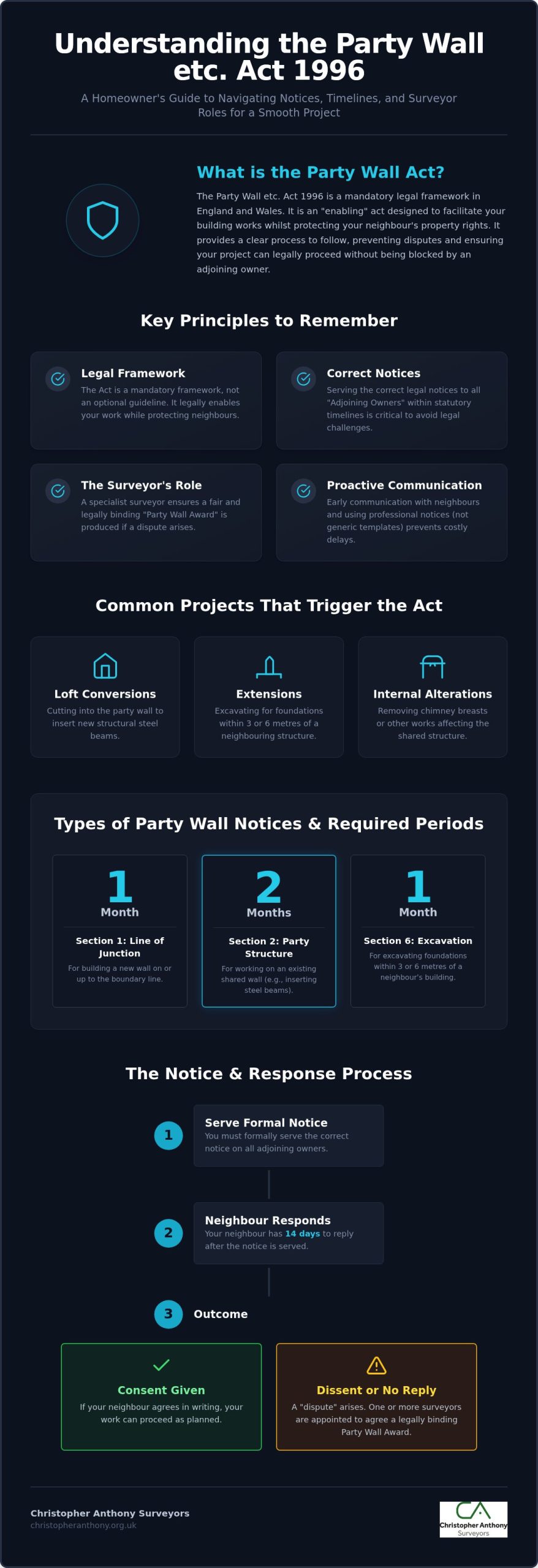
The Party Wall etc. Act 1996 is a mandatory legal framework governing construction work in England and Wales. It's often viewed with apprehension, yet its primary function is to facilitate building works while protecting the interests of all parties involved. Having the party wall act 1996 explained simply reveals a dual purpose: it grants building owners the legal right to carry out work and ensures adjoining owners aren't left with damaged property or unresolved disputes. This is an "enabling" Act. It means that as long as you follow the correct procedural steps, a neighbour cannot simply block your project. At Christopher Anthony Surveyors, we specialise in navigating these specific legal requirements, providing the professional authority needed to keep your project moving.

Common Projects That Trigger the Act

Many homeowners are surprised to learn that the Act applies to works that don't even touch the shared wall. It's about the impact of your construction on the boundary and neighbouring structures. We frequently assist clients with projects such as:

Whether you're planning a garden room in Hertfordshire or a basement in London, the Act provides a clear path forward. It replaces uncertainty with a structured process, ensuring that technical matters are handled with precision. We recommend seeking professional advice early to avoid the cold, detached disputes that often arise from poor communication and lack of transparency. Every project is unique, and protecting your property starts with understanding your legal obligations from the outset.

Understanding the Party Wall Process: Notices and Timelines

Identifying "Adjoining Owners" is your first hurdle. It's not just the person living next door. You must serve notice to every freeholder and leaseholder with an interest greater than a year. Having the party wall act 1996 explained correctly means understanding that multiple notices might be required for a single project. Accuracy here is non-negotiable. If you miss a single owner, you risk a legal injunction that could stop your builders in their tracks. Getting the party wall act 1996 explained by a professional ensures you don't miss these critical statutory windows. For a step-by-step approach to meeting every legal requirement, our party wall act compliance checklist for 2026 provides a practical roadmap to protect your project from start to finish.

The Different Types of Party Wall Notices

The nature of your construction work dictates which notice you must serve. The full text of the Party Wall Act specifies different timeframes to give your neighbours sufficient time to consider the impact on their property. Use the following table as a quick reference guide for your planning phase.

Notice Type Work Description Notice Period
Section 1: Line of Junction Building a new wall on or up to the boundary line. 1 Month
Section 2: Party Structure Working on an existing shared wall, such as inserting steel beams. 2 Months
Section 3: Excavation Excavating foundations within 3 or 6 metres of a neighbour. 1 Month

Once you serve the Party Wall Notice, your neighbour has 14 days to respond. If they agree in writing, you've obtained "consent" and can proceed. However, if they dissent or fail to reply, the Act deems a dispute to have arisen. This isn't a disaster; it simply moves you to the next stage of professional resolution. We recommend checking our fixed-fee notice services to ensure your project stays on schedule and your paperwork remains legally robust.

The Party Wall Act 1996: A Guide for Homeowners

The Role of the Party Wall Surveyor and the Award

When a dispute arises, the surveyor steps in as a statutory appointee. It's a common misconception that the surveyor acts as an advocate for the person paying them. In reality, their primary duty is to the Act itself. They ensure fairness for both parties. The result of this professional oversight is a Party Wall Award. This formal document details exactly how and when work will proceed. It covers working hours, access rights, and damage prevention measures. Having the party wall act 1996 explained by an expert ensures this document is robust and legally binding.

A vital component of this process is the Schedule of Condition Survey. We visit the neighbouring property to record its current state with detailed photographs and written notes. This protects everyone. If a neighbour claims your builders caused a crack, we check the record. If the crack was already there, you're protected. If it's new, the neighbour has undeniable proof. It's about transparency and avoiding the stress of "he said, she said" arguments during your build.

Contact Christopher Anthony Surveyors for a fixed-fee quotation

Agreed Surveyor vs Separate Surveyors

Appointing an Agreed Surveyor is often the most efficient path. This is a single, impartial professional acting for both the building owner and the neighbour. It significantly reduces costs and speeds up the timeline whilst maintaining legal integrity. This is a pragmatic choice for straightforward projects like loft conversions or extensions where both parties want a smooth process.

However, an Adjoining Owner has the legal right to appoint their own surveyor. This might be necessary for complex basement excavations or if a neighbour prefers independent representation. Generally, the Building Owner pays the fees for both surveyors. This ensures the neighbour isn't out of pocket due to your project. We provide clear, fixed-fee structures to keep these costs predictable and manageable for your budget.

Practical Advice from Christopher Anthony Surveyors

Having the party wall act 1996 explained by an expert is only half the battle; practical application is where most projects succeed or fail. We always advise clients to speak with their neighbours before any formal paperwork arrives. A friendly cup of coffee can prevent a knee-jerk dissent. It often leads to the appointment of an Agreed Surveyor, which keeps your costs down and the project moving whilst protecting your legal standing.

To ensure a smooth process, follow these professional standards:

Avoiding Common Compliance Pitfalls

A frequent mistake is failing to identify all "Adjoining Owners". If the neighbouring property is split into flats, you must serve notice to every leaseholder and the freeholder. Missing just one Adjoining Owner can lead to an injunction. Starting work without a Party Wall Award is a significant risk. It leaves you vulnerable to legal action and damage claims. The Schedule of Condition serves as the primary evidence in any damage dispute, protecting your reputation and budget. Ensuring full party wall act compliance from the outset is the most effective way to safeguard your project against costly legal challenges. By following this path, you ensure your project remains compliant. View our fixed-fee options to get started today.

Secure Your Building Project with Professional Guidance

Success in any home improvement hinges on proactive planning and clear communication. You now have the party wall act 1996 explained, from identifying adjoining owners to the finality of a robust Party Wall Award. Remember that a Schedule of Condition isn't just paperwork; it's your primary shield against future disputes. By addressing these legal requirements early, you protect your property and maintain vital neighbourly relationships.

Christopher Anthony Surveyors brings over 20 years of professional experience to your doorstep. We specialise in London and Hertfordshire residential projects, offering the personal touch of a boutique firm. Our fixed-fee transparency removes cost anxiety, ensuring your matters are handled with speed and precision. We don't just process notices; we act as your protective guide through the entire build.

Request a fixed-fee quotation for your project

Your project deserves a smooth start without the stress of legal uncertainty. We're here to keep your builders moving and your investment safe. Once the construction is complete, you can finally enjoy the creative process of decorating your new rooms with meaningful pieces; for instance, those who appreciate original oil paintings that capture nostalgic scenes and heritage can find inspiration at stevenhoward.gallery. Let's get your project underway today.

Frequently Asked Questions

What happens if my neighbour refuses to sign a party wall notice?

If your neighbour refuses to sign or ignores the notice, they're considered to have dissented after 14 days. This doesn't mean your project is blocked. It simply moves the process into a formal dispute, requiring the appointment of a surveyor to resolve matters. We then work to produce a Party Wall Award that sets out exactly how the work will be performed safely whilst protecting both properties.

Who pays for the party wall surveyor fees?

The Building Owner carrying out the work usually pays all surveyor fees. This includes the cost for your neighbour's surveyor if they choose to appoint their own. It ensures that adjoining owners aren't financially penalised by your construction. In rare cases, costs might be split if the work specifically repairs a shared wall that both parties are responsible for maintaining under the Act's provisions.

Can I serve a party wall notice myself?

You can legally serve a notice yourself, but it's often a false economy. Small errors in the documentation can invalidate the entire process, leading to project delays and potential legal action. Having the party wall act 1996 explained by a specialist ensures your paperwork is compliant from day one. Our fixed-fee notice services provide the professional authority needed to prevent avoidable complications during your build.

How long does a party wall award last once it is served?

A Party Wall Award generally remains valid for twelve months from the date it is served. You must commence the works within this one-year window to stay within the legal protections of the document. If your project is delayed significantly, you may need to re-serve notices. This makes timing your surveyor's appointment critical to ensure your Award doesn't expire before your builders arrive on site.

Do I need a party wall agreement for a simple loft conversion?

Most loft conversions require a party wall agreement because they involve structural changes to a shared wall. You'll likely need to insert steel beams or raise the party wall to support the new floor. These actions trigger the requirement for a Party Structure Notice. Even if your project seems minor, complying with the Act provides the legal framework to proceed without the threat of a neighbour's injunction.

Article by

Tony Neilson MRPSA MFPWS

Schedule of Condition Survey Cost: A 2026 Guide

In 2026, viewing a schedule of condition survey cost as a mere expense is a mistake that could cost you thousands in litigious disputes later. Whether you are planning a loft conversion in Hertfordshire or a basement excavation in London, you are likely already juggling complex budgets and tight timelines. It is perfectly natural to worry about hidden surveyor fees or the prospect of an adjoining owner blaming your project for pre-existing cracks in their masonry whilst your work is underway.

We agree that you shouldn't have to deal with the stress of "estimate creep" or the fear of unsubstantiated damage claims. You deserve a process that is transparent, efficient, and protective. This guide explains exactly what influences the price of these surveys and how a fixed-fee approach provides the certainty you need. We will break down who is responsible for the bill under the Party Wall etc. Act 1996 and how professional evidence serves as your best legal defence. You will gain the confidence to choose a surveyor who values your time and provides the robust protection your property requires.

Key Takeaways

  • Understand how a Schedule of Condition acts as a factual, photographic shield, protecting both parties from unfair damage claims during construction.
  • Learn how property size, age, and structural complexity in areas like London and Hertfordshire directly influence the total schedule of condition survey cost.
  • Discover why a fixed-fee pricing model is superior to hourly rates, providing budget certainty and eliminating the risk of "estimate creep."
  • See how a relatively small investment in a professional survey can save thousands of pounds in potential repair disputes and legal fees.
  • Gain the confidence to manage your Party Wall obligations efficiently, ensuring your project proceeds without unnecessary delays or friction with neighbours.

What is a Schedule of Condition and Why Does the Cost Matter?

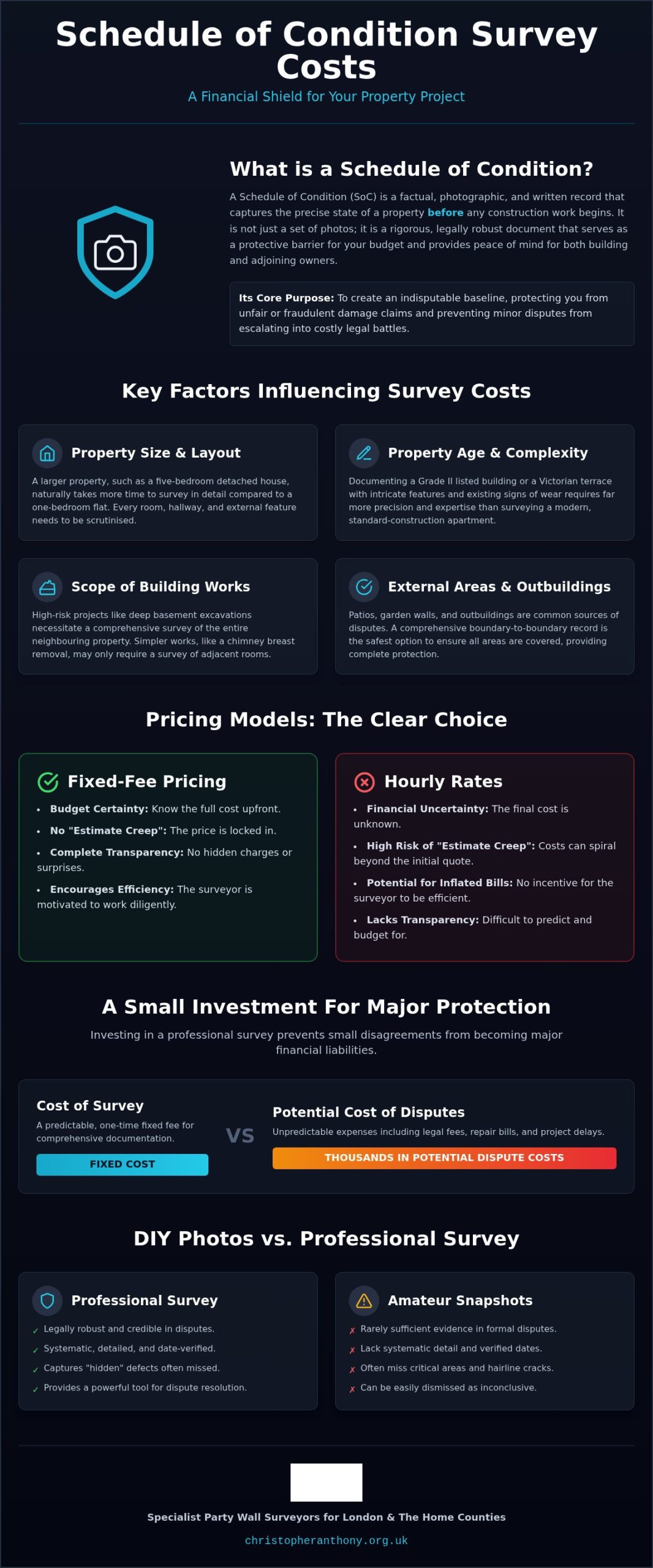
A Schedule of Condition (SoC) is a factual, photographic, and written record that captures the exact state of a property before any building work begins. It isn't a vague set of observations. It's a rigorous document that details every existing defect, from hairline cracks in plaster to the condition of external brickwork. Within the framework of the Party Wall etc. Act 1996, this survey provides the essential baseline for all parties involved in a project.

The schedule of condition survey cost is best viewed as a protective barrier for your budget. Without a professional record, you are vulnerable to "open-ended" damage claims that are impossible to disprove. It's much harder to argue that a crack was "already there" when you don't have the evidence to back it up. Investing in this survey provides genuine peace of mind for both building owners and adjoining owners alike. It keeps the process fair.

The Legal Necessity Under the Party Wall Act

In many cases, an adjoining owner party wall surveyor will insist on a Schedule of Condition to protect their client's property rights. It ensures that if damage occurs, there's no room for debate about the cause. Building owners should also demand a professional SoC. It prevents neighbours from making fraudulent claims or mistakenly attributing old wear and tear to your new extension or loft conversion. It's about factual clarity.

Why 'DIY' Photos Often Fail in Disputes

Amateur snapshots rarely suffice in a formal dispute. They often lack the systematic detail and date-verified evidence that a court or surveyor requires. In the commercial world, these documents are vital for avoiding breaches of lease covenants, but they are just as critical for residential projects in London and the Home Counties. A surveyor's record is legally robust. It captures the "hidden" areas that homeowners often miss. This level of evidential depth is what makes the document a powerful tool for dispute resolution in 2026.

Key Factors Influencing Your Schedule of Condition Survey Fee

Your schedule of condition survey cost isn't a random figure pulled from thin air. It's a direct reflection of the time and expertise required to document a specific property accurately. Several variables dictate how much time a surveyor spends on-site and how long the subsequent report takes to compile. We don't believe in one-size-fits-all pricing because every property in London and the Home Counties has its own story.

Property size is the most obvious driver. A large five-bedroom detached house in Hertfordshire takes significantly longer to record than a one-bedroom flat in Essex. Every room, hallway, and cupboard needs to be scrutinised. Complexity also plays a major role. Recording the intricate details of a Grade II listed building or a weathered Victorian terrace in London requires far more precision than a modern apartment. We follow the professional standards for a Schedule of Condition set by RICS to ensure every report is legally sound.

The scope of your building work also shifts the fee. A simple chimney breast removal might only require a survey of the immediate adjoining rooms. Conversely, a deep basement excavation is a high-risk project. It necessitates a comprehensive survey of the entire neighbouring property to mitigate the risk of structural claims. If you're unsure about the scope needed for your project, you can view our transparent pricing guide for more clarity.

Residential vs. Commercial Pricing Drivers

Commercial surveys are different. They often focus on "dilapidations" and future legal obligations for lease endings. These require a different level of legal scrutiny compared to standard Party Wall matters, and specialist firms like OMNIA Building Consultants Ltd can provide the necessary expertise for these complex professional requirements. The time spent on-site for a commercial unit is often higher due to the scale of the demise.

External Areas and Outbuildings

Don't overlook the exterior. Patios, garden walls, and outbuildings are frequently the subject of disputes. A comprehensive boundary-to-boundary record is the safest choice. While including external areas might slightly increase the total schedule of condition survey cost, it prevents "he said, she said" arguments about garden subsidence or cracked paving later on. It's about total protection.

Schedule of Condition Survey Cost: A 2026 Guide

Fixed Fees vs. Hourly Rates: Navigating Surveyor Pricing in 2026

Hourly billing is a common trap in the surveying industry. It often leads to "estimate creep", where the final bill for your project quietly exceeds the initial quote. We don't believe in this approach. Choosing a fixed fee party wall surveyor ensures your project budget remains intact from the start. You shouldn't have to guess your total schedule of condition survey cost while managing a complex build in London or Hertfordshire.

A transparent quote should cover everything: travel, site time, and the detailed drafting of the report. When you compare quotes, look beyond the bottom line. Consider the quality of the evidence provided. A cheap report that fails to stand up in a dispute is a poor investment. You are paying for the certainty that your property is protected by high-quality, professional documentation.

Practical Advice from Christopher Anthony Surveyors

View our fixed-fee pricing for schedule of condition surveys

Who Typically Pays the Survey Fee?

Under the Party Wall Act, the Building Owner is usually responsible for the cost of the schedule of condition survey for both properties. This is standard practice across the Home Counties. The person undertaking the work carries the legal burden to return the property to the state it was in before the project began. There are rare exceptions, such as when an adjoining owner requests an unnecessarily extensive survey, but these are handled on a case-by-case basis depending on the specific project requirements.

Protecting Your Investment: The ROI of a Professional Schedule of Condition

Beyond the financial protection, there is significant psychological value. Building works are inherently stressful for neighbours. Providing an objective, third-party record reduces friction and prevents the project from becoming a personal battleground. It sets a professional tone from day one. When the dust settles, having a professional SoC also speeds up the final "signing off" process. It allows both parties to agree that the property is in the same condition as when you started; this closes the file without lingering disputes.

At Christopher Anthony Surveyors, our approach is built on speed, precision, and the total removal of hidden complications. We don't believe in dragging out the process or using detached legal jargon. We provide the facts clearly and quickly so you can focus on your build.

Need Advice About Your Project?

Every project is unique. Whether you are planning a side extension in Essex or a basement excavation in London, you need advice tailored to your specific circumstances. We invite you to request a fixed-fee quotation that provides the budget certainty you need. You can also use the "Christopher Anthony Party Wall Assistant" tool for rapid guidance on your obligations. Don't leave your property protection to chance.

View our transparent pricing

About Christopher Anthony Surveyors

Christopher Anthony Surveyors is an independent specialist practice led by Tony, an expert with over 20 years of experience in the property industry. We serve clients across London, Hertfordshire, Essex, and Kent, providing a modern alternative to traditional, slow-moving firms. Our mission is to demystify the Party Wall etc. Act 1996 for homeowners and developers alike. We pride ourselves on professional authority, rapid results, and a personal touch that ensures your project stays on track without unnecessary stress.

Securing Your Project with Factual Certainty

Navigating a building project shouldn't feel like a gamble. We've explored how a professional record protects your budget and your relationship with neighbours. Choosing a fixed-fee model eliminates the risk of "estimate creep" and ensures you know your total schedule of condition survey cost from the very first day. It's about replacing uncertainty with objective evidence. This factual baseline is the only way to ensure that both parties are treated fairly if issues arise.

With over 20 years of specialist experience across London and the Home Counties, we understand that precision is non-negotiable. A high-quality survey is your most effective shield against unfair claims. It keeps your timeline moving and your peace of mind intact whilst you focus on the build itself. If you are undertaking a loft conversion in St Albans or a basement excavation in Watford, working with a party wall surveyor Hertfordshire specialists trust ensures your Schedule of Condition is handled with the local expertise your project demands. We guarantee transparency and local expertise to help you move forward with confidence. Professional documentation isn't just a requirement; it's your project's best defence.

Request your fixed-fee schedule of condition quote today

We're here to ensure your project starts on the right foot. Don't leave your property's safety to chance or amateur photos. Reach out to our team today for straightforward advice and the professional protection your investment deserves. We look forward to helping you secure your property's future.

Frequently Asked Questions

How much does a schedule of condition survey typically cost in London?

The price for a survey in London and the Home Counties varies depending on the property's size, age, and structural complexity. A large Victorian terrace with intricate period features requires more detailed recording than a modern apartment block. Rather than relying on generic estimates, we suggest requesting a fixed-fee quotation to ensure you have a precise figure tailored to your specific project and property type.

Is a schedule of condition survey mandatory under the Party Wall Act?

Whilst the Party Wall etc. Act 1996 doesn't explicitly state that a survey is mandatory, it's considered essential professional practice. Most surveyors will strongly advise it as part of the Party Wall Award process. Without this factual baseline, it's virtually impossible to settle damage disputes fairly, leaving both the building owner and the adjoining owner vulnerable to drawn-out legal arguments.

Who is responsible for paying the schedule of condition survey cost?

The building owner undertaking the construction work is typically responsible for the schedule of condition survey cost for both their own property and the neighbour's. This follows the general principle of the Act that the person benefiting from the works should cover the associated professional fees. This ensures the adjoining owner isn't financially penalised by your project's procedural requirements.

How long does a schedule of condition survey take to complete?

A standard residential site visit usually takes between one and three hours, depending on the scale of the property and the areas being inspected. Following the visit, the surveyor requires time to compile the photographic evidence and written descriptions into a formal report. We prioritise efficiency and typically aim to deliver the completed document within 24 to 48 hours of the site inspection.

Can I use my own photos instead of paying for a professional survey?

Using amateur photos is a significant risk that often fails to provide robust evidence in a formal dispute. Professional surveyors use a systematic, "room-by-room" methodology that ensures every defect is captured with high-resolution clarity and professional context. Amateur snapshots frequently lack the date-verification and comprehensive coverage needed to be legally persuasive if a neighbour makes a claim for damages later.

Article by

Tony Neilson MRPSA MFPWS

What Is a Party Wall? A Specialist Guide for Homeowners in 2026

Imagine your builder is ready to start your loft conversion, but a single shared boundary brings the entire project to a grinding halt. It's a common scenario for homeowners who haven't yet asked: what is a party wall? Understanding this legal definition is the difference between a seamless build and an expensive, stressful dispute. Accuracy matters. Speed is essential.

We know the anxiety that comes with construction. You worry about damaging your neighbour's property. You fear unexpected legal delays. It's a lot to manage. This specialist guide ensures you understand your obligations under the Party Wall etc. Act 1996 and how to safeguard your property's value. We'll explore the essential procedures, from serving valid notices to the importance of a Schedule of Condition, giving you a clear roadmap for a successful project. No jargon. Just practical advice.

Key Takeaways

  • Learn exactly what is a party wall, including shared building structures and garden boundary walls, to identify if your project requires legal notice.
  • Understand how the Party Wall etc. Act 1996 protects your property whilst facilitating your development, rather than acting as a barrier to construction.
  • Discover why formal Party Wall Notices are essential for loft conversions and extensions, providing legal certainty that informal agreements cannot offer.
  • Recognise the role of a Party Wall Award as a vital "legal rulebook" that manages potential disputes and protects your property's structural integrity.
  • Gain practical insights on how to navigate the process efficiently to avoid expensive delays and maintain positive relationships with your neighbours.

What is a Party Wall? Defining the Shared Boundary

At its most basic level, a party wall is a wall shared by two or more properties. It usually separates terraced or semi-detached houses. However, the legal reality is more nuanced. Correctly identifying What is a Party Wall? is the vital first step for any homeowner planning a renovation. Without this clarity, you risk starting unauthorised building works. This can lead to costly injunctions and damaged relationships. It's about more than just a surface; it's about legal boundaries.

Identifying what is a party wall involves looking at how the structure was built and how it's used today. If you're planning a loft conversion or a rear extension, you'll likely encounter one of these shared structures. Failing to recognise them early is a primary cause of project delays in London and the Home Counties.

Type A vs Type B Party Walls

The Act distinguishes between two main types of walls. A Type A party wall stands on the land of different owners to a greater or lesser extent. It straddles the boundary line. Think of the main dividing wall in a Victorian terrace or a shared chimney stack. These are the most common examples we see.

A Type B wall is slightly different. It stands wholly on one owner's land but is used by two owners to separate their buildings. For instance, if your neighbour built their garage right up to your existing house wall and "leant" their structure against it, that wall becomes a party wall. Even though it sits on your land, the shared use brings it under the Act. It's a subtle distinction that often requires a Building Owner Party Wall Surveyor to verify.

Party Fence Walls and Party Structures

Don't let the name confuse you. A "party fence wall" isn't a timber fence. In the eyes of the law, it must be a masonry structure, like a brick garden wall that sits on the boundary line. If you plan to raise or rebuild a shared garden wall, you must follow the correct procedures. Timber fences are excluded from the Act entirely.

Then there are "party structures". This term is crucial for owners of flats or converted houses. It covers horizontal divisions, such as the floors and ceilings between properties. If you're removing a chimney breast in a ground-floor flat, you're working on a party structure that supports the neighbour above. The "etc" in the Party Wall etc. Act 1996 is equally important. It extends the law's reach to excavations within 3 or 6 metres of a neighbouring building. This ensures your foundations don't compromise the stability of the property next door.

Legislation shouldn't be viewed as a hurdle. It's a facilitator. The Party Wall etc. Act 1996 provides a clear, statutory framework for homeowners in England and Wales to carry out building works whilst protecting the interests of their neighbours. It isn't a tool for an adjoining owner to stop your project. Rather, it's a process designed to ensure that works are performed safely and that any damage is correctly rectified. Understanding what is a party wall in a legal context allows you to move forward with confidence.

The Act covers three primary categories of work. These include alterations to an existing party wall, building a new wall at the boundary line, and excavating near a neighbour's structure. For many homeowners in London and Hertfordshire, budget certainty is a top priority. Appointing a fixed fee party wall surveyor ensures that professional costs remain transparent and predictable from the outset. This "no-nonsense" approach prevents the financial surprises that often plague complex construction projects.

Rights of the Building Owner

If you are the one initiating the work, the Act grants you specific rights that might otherwise be restricted by common law. You have the legal right to cut into a party wall to insert steel beams for a loft conversion. You can demolish and rebuild a ruinous or defective shared wall. Crucially, you have the right to excavate for foundations within 3 or 6 metres of a neighbour's building, provided you follow the correct notice procedures. These rights are essential for modern urban development where space is at a premium. For a detailed breakdown of every right and obligation the legislation confers, our comprehensive guide to the party wall act 1996 covers the full statutory framework in depth.

Protections for the Adjoining Owner

The law is balanced. Neighbours have significant protections to ensure their property value and structural integrity aren't compromised. Every adjoining owner has the right to be served a formal notice in writing before any work begins. They also have the right to appoint their own surveyor to oversee the process, with the building owner typically covering all reasonable costs. A vital part of this protection is the schedule of condition survey. This creates a detailed photographic and written record of the neighbour's property before works start. It acts as a baseline, preventing false damage claims whilst ensuring genuine issues are repaired promptly. If you're planning a project soon, reviewing our transparent pricing can help you factor these essential protections into your budget.

What Is a Party Wall? A Specialist Guide for Homeowners in 2026

Practical Advice from Christopher Anthony Surveyors

Every project we handle across London and the Home Counties, from Hackney to Watford, carries its own set of structural challenges. Generic online templates often miss the specific nuances of your building's history. Relying on them is a gamble. We've seen many homeowners assume that a friendly "over the fence" chat with a neighbour is enough. It's a great starting point for maintaining goodwill, but it doesn't replace a formal Party Wall Notice. Without that legal paperwork, you're effectively performing unauthorised works.

Unauthorised works can haunt you years later. When you decide to sell your property, a buyer's solicitor will ask for the Party Wall Award. If you can't provide it, the sale could collapse or require expensive indemnity insurance. To keep your project on track and your budget intact, we recommend checking party wall surveyor prices as early as possible. Knowing your costs upfront prevents stressful surprises when the skips arrive.

Common Scenarios: Lofts and Extensions

Loft conversions almost always involve inserting steel beams into shared walls. This is a clear trigger for the Act. Even if you're only cutting in a few inches, you must notify your neighbour. For rear extensions or garden rooms, the "3-metre rule" is the primary factor. If your new foundations are deeper than the neighbour's and within three metres, the Act applies. Chimney breast removals are another frequent flashpoint. In older London terraces, these breasts often provide vital structural support. Removing them without a professional assessment is a recipe for a dispute. If you're unsure how the legislation applies to your specific project, having the party wall act 1996 explained in plain terms can help you identify your obligations before your builder arrives on site.

Request a fixed-fee quotation for your project

Avoiding Construction Delays

Timing is everything in construction. If you serve your notices too late, your contractor might be standing on-site with nothing to do whilst you wait for legal periods to expire. You must serve notices at least two months before starting work on a shared wall and one month for new boundary walls or excavations. Accuracy is equally vital. Ensure your architectural drawings clearly show the relationship between your work and the boundary line.

Efficiency is often found in collaboration. Appointing an agreed party wall surveyor can save significant time and money for both parties. One impartial professional manages the process for both you and your neighbour, ensuring the Award is served quickly and fairly. Understanding what is a party wall and its associated timelines is the best way to prevent your renovation from becoming a legal headache. Early engagement protects your timeline and your peace of mind.

The journey towards a successful renovation begins the moment you serve a formal notice. This isn't a mere formality. It's a statutory requirement. If your neighbour dissents or simply ignores the notice for 14 days, the law deems a dispute to have arisen. This doesn't mean you're in a personal argument. It's a procedural status that triggers the need for professional surveyors to step in. Understanding what is a party wall and the obligations it carries is your best defence against project stoppages.

A Party Wall Award serves as the resolution to this dispute. Think of it as the "legal rulebook" for your construction. This document outlines how and when the works will be carried out, providing a clear path forward for both parties. It allows the build to proceed whilst ensuring the neighbouring property is protected. Professional guidance is essential here. A building owner party wall surveyor ensures your project complies with the Act from day one. If you're the neighbour, an adjoining owner party wall surveyor acts as your safeguard, ensuring your rights are upheld and your property is respected.

The Party Wall etc. Act 1996 is mandatory. It's not an optional extra or a "nice to have" for your project. Compliance is your legal duty. Skipping this step can lead to expensive legal injunctions that could halt your builders mid-flow. Proactive management is the only way to ensure a smooth, delay-free construction process.

Need Advice About Your Project?

Don't leave your project to chance. We encourage a proactive approach to prevent legal headaches before they even begin. You can request a fixed-fee quotation directly through our website to get your budget in order. For quick guidance on your specific situation, use the "Christopher Anthony Party Wall Assistant" tool. It's designed to give you clarity when you're unsure of the next steps. We're here to help you move from confusion to a clear, actionable plan.

About Christopher Anthony Surveyors

Christopher Anthony Surveyors is an independent specialist practice led by Tony (Christopher Anthony). We provide expert party wall services across London, Hertfordshire, Essex, and Kent. Our team brings over 20 years of experience to every project, specialising in the unique structural challenges of London loft conversions and extensions. We value transparency, speed, and protecting our clients' peace of mind above all else. By choosing us, you're choosing a no-nonsense partner dedicated to keeping your project moving forward without hidden complications.

Secure Your Project's Success

Navigating shared boundaries doesn't have to be a source of anxiety. Understanding what is a party wall and your legal obligations under the 1996 Act is the foundation of a successful renovation. By identifying shared structures early and prioritising clear, formal communication, you protect your property's structural integrity whilst maintaining positive relationships with your neighbours. Proactive steps today prevent expensive legal headaches tomorrow.

Request a Fixed-Fee Party Wall Quotation Today

With over 20 years of experience serving London and Hertfordshire, our team provides the expert advice you need to keep your build on track. We offer fixed-fee transparency so you're never caught out by hidden costs mid-project. Every home is unique, and we pride ourselves on providing a personal touch that larger firms often lack. You don't have to manage these complex procedures alone. Let's ensure your project moves forward with speed, precision, and total peace of mind.

Frequently Asked Questions

Do I need a party wall agreement for a garden fence?

You don't need a party wall agreement for a standard timber garden fence. The Act only applies to "party fence walls," which are shared masonry structures like brick or stone walls sitting on the boundary. If you're replacing a wooden fence with another wooden one, the legislation doesn't apply. However, if you're building a new brick wall on the boundary line, you'll need to serve a formal notice.

Can my neighbour stop me from carrying out building works?

Your neighbour cannot stop you from exercising your legal rights to build, provided your project is lawful. Whilst they can "dissent" to your notice, this simply triggers a dispute resolution process rather than a project veto. The resulting Party Wall Award ensures your work proceeds whilst protecting their property from damage. It's a mechanism to enable development, not to block it.

Who pays the surveyor fees for a party wall agreement?

The Building Owner initiating the work typically pays all reasonable fees. This includes the costs for their own surveyor and the surveyor appointed by the neighbour. This ensures the adjoining owner isn't financially disadvantaged by your development. In rare cases where work is required due to shared defects, costs might be split, but this depends on the surveyor's professional assessment.

What happens if I start work without serving a party wall notice?

Starting work without serving notice is a serious risk that can lead to a court injunction. If you proceed without following the Act, your neighbour can legally stop your project, leaving you liable for their legal costs. It also creates a "headache" during future property sales. Solicitors will look for evidence of compliance, and a lack of paperwork can cause a sale to collapse; ensuring all legal details are handled by professionals like Eagle Haus Conveyancing Consultants can help prevent such issues during a residential transaction.

How long does a party wall award last once it is served?

A Party Wall Award is generally valid for 12 months from the date it's served. If you haven't started the works within this year, you may need to seek professional advice on re-serving notices. This time limit ensures that the Schedule of Condition remains an accurate reflection of the property's state before the construction activity begins.

Is a party wall agreement the same as planning permission?

No, they are entirely separate legal requirements. Planning permission deals with the use and appearance of land, whilst the party wall act 1996 manages the structural relationship between shared boundaries. You must still identify what is a party wall and follow the correct procedures even if you already have full planning approval and building regulations consent. Having one doesn't exempt you from the other.

Article by

Tony Neilson MRPSA MFPWS

Neighbour Refuses to Sign Party Wall Notice: What Happens Next?

What if a neighbour's "no" was actually the best way to protect your home renovation? It's a common fear that when a neighbour refuses to sign party wall notice documents, your project is effectively dead in the water. We understand the frustration of silence or the anxiety of a strained relationship with those next door. You're likely worried about indefinite delays and the potential for rising surveyor fees. It feels like a roadblock; in reality, it's just a change of lane.

A refusal to sign isn't a veto; it's a statutory trigger for the professional protections of the Party Wall etc. Act 1996. This guide will demystify the "dissent" process and explain why formalising the agreement is often the safest route for everyone involved. You'll learn exactly how the dispute resolution mechanism works, the role of an appointed surveyor, and the realistic timeline for when your contractors can finally get to work. Let's replace that uncertainty with a clear, professional roadmap to your build, with expert guidance from Christopher Anthony Surveyors.

Key Takeaways

  • Learn why a neighbour's refusal is legally defined as a "dissent" and how the Act actually authorises your work to proceed.
  • Discover the three essential steps to take when a neighbour refuses to sign party wall notice documents to keep your timeline on track.
  • Understand how the "Agreed Surveyor" model can significantly reduce your professional fees whilst maintaining full legal compliance.
  • Gain practical insights on using transparency to manage neighbour relations and prevent unnecessary project delays.
  • Recognise how a Party Wall Award protects you from future spurious damage claims and provides total peace of mind.

Understanding "Dissent": Why a Refusal is Not a Project Stop Sign

It's a common misconception that a building project stops the moment a neighbour refuses to sign party wall notice documents. In reality, the law is on your side. The Party Wall etc. Act 1996 is "enabling" legislation. This means its primary purpose is to facilitate your right to build whilst ensuring your neighbour's property remains protected. When a neighbour says "no", they aren't exercising a veto; they're simply choosing a formal route over an informal one.

Legally, this refusal is recorded as a "dissent". It doesn't mean your loft conversion or extension is cancelled. It just shifts the process from a simple exchange of letters to a professional, legal framework. This framework eventually leads to a Party Wall Award. This is a legally binding document that outlines exactly how and when the work will take place, providing a clear set of rules for both parties to follow.

The Difference Between Consenting and Dissenting

Consenting is the simplest path. If your neighbour agrees in writing, you can usually start work once the notice period expires without further surveyor involvement. Dissenting, however, triggers the dispute resolution procedure under Section 10 of the Act. Don't let the word "dispute" alarm you. In this context, it's a legal term meaning the parties haven't reached an informal agreement. You should also be aware of "Deemed Dissent". If your neighbour fails to respond to your notice within 14 days, the law automatically assumes they've dissented to the works. This ensures the process keeps moving forward even if a neighbour is unresponsive.

Common Reasons Neighbours Refuse to Sign

Most refusals aren't born out of malice. Often, it's a genuine fear of structural damage during complex works like chimney breast removals or rear extensions. Some homeowners wrongly believe that if a neighbour refuses to sign party wall notice paperwork, the project must stop entirely. Others simply want the peace of mind that comes with a professional schedule of condition survey. This survey records the state of their property before you start, providing a clear benchmark if any damage is claimed later. Understanding these motivations helps you manage the relationship without unnecessary anxiety. If your neighbour has received a party wall notice and is unsure what to do next, pointing them toward expert guidance can often resolve hesitation before it escalates into a formal dissent.

The Statutory Process: 3 Steps to Take When a Neighbour Refuses

Once the 14-day response period expires, or if your neighbour explicitly declines your proposal, the process shifts from informal to statutory. It's a transition, not a dead end. You aren't stuck; you just need to follow the sequence laid out in the official government guidance. Three steps. One goal. Legal certainty.

If your neighbor refuses to sign party wall notice documents, your first move is a formal acknowledgement of the dispute. You must then request that they appoint a surveyor. This is the point where transparency pays off. Clearly explain that the Act is there to protect their property just as much as your right to build. Keeping a meticulous paper trail of all correspondence is vital for legal compliance if matters escalate later.

The 10-Day Rule and Section 10(4)

The Act has teeth to prevent projects from being stalled by silence. If your neighbour fails to appoint a surveyor within 10 days of your formal request, you can invoke Section 10(4). This allows you to appoint a surveyor on their behalf. Don't worry; this isn't a conflict of interest. The surveyor you appoint for them must act impartially and cannot be the same person acting for you. It ensures the process moves forward whilst maintaining fair, independent oversight for both homes. If you're struggling with the wording of this notice, professional guidance can ensure your follow-up is legally watertight.

Choosing Between an Agreed Surveyor or Separate Surveyors

Efficiency often comes down to the choice of surveyor. You should always offer the option of an Agreed Party Wall Surveyor. This is a single, neutral professional who acts for both parties. It's faster, simpler, and significantly more cost-effective since the building owner usually pays all surveyor fees. However, for high-risk projects like deep basement excavations or complex structural work in London terraces, separate surveyors might be more appropriate. This provides each owner with their own dedicated expert to scrutinise the structural designs and method statements.

Neighbour Refuses to Sign Party Wall Notice: What Happens Next?

Practical Advice from Christopher Anthony Surveyors: Navigating Neighbour Objections

In our experience across London's Victorian terraces and Hertfordshire's semi-detached extensions, initial resistance is rarely about the bricks and mortar. It's about the unknown. If a neighbor refuses to sign party wall notice documents, it usually signals a lack of trust rather than a desire to block your build. Transparency is your most effective tool here. Share your structural details and method statements early. Showing exactly how you'll protect the shared wall often defuses anxiety before it turns into a formal dispute.

We often suggest offering a Schedule of Condition even if it isn't strictly required. It's a powerful gesture of good faith. It tells your neighbour you respect their property and are prepared to be held accountable. Avoid using generic DIY templates. These often contain errors that make homeowners look unprofessional or suspicious. A correctly served notice, backed by professional expertise, sets a tone of competence that naturally encourages cooperation.

Handling the "Difficult" Neighbour

Personal history can sometimes cloud a professional process. If relations are strained, stop the "over the fence" negotiations. They rarely end well. Instead, opt for a surveyor-led informal chat. We act as neutral experts, explaining the "Building Owner" rights under the Act without the emotional baggage. We often point owners toward the Official Government Guidance on the Party Wall Act to provide a neutral, third-party perspective on their rights and obligations.

Minimising Delays in London and Hertfordshire

Efficiency requires foresight. If you suspect a dissent, build it into your project timeline immediately. Allow at least 4 to 6 weeks for the Award process to reach completion. Getting your notices right the first time is non-negotiable; a single mistake can force you to restart the statutory clock, costing you weeks of construction time. To manage your budget effectively during a dissent, consider our fixed-fee services. This provides total clarity on costs, regardless of how many letters need to be exchanged. If you are unsure about your neighbour's likely reaction, request a professional assessment from our team today.

The "no" from your neighbour isn't a dead end. It's a redirection toward the most robust legal protection available: the Party Wall Award. When a neighbor refuses to sign party wall notice papers, the resulting Award becomes the definitive rulebook for your project. It's a formal document, drafted by professional surveyors, that provides the legal indemnity you need to start construction with total confidence.

Think of the Award as a shield. It doesn't just permit the work; it sets clear boundaries that prevent future conflict. If a neighbour later claims your loft conversion caused a crack in their ceiling, you have a professional schedule of condition survey as evidence. This prevents spurious claims from draining your budget or stalling your progress. To keep your finances predictable during this formal phase, we offer fixed-fee Party Wall services. This ensures that a dissent doesn't lead to spiralling costs.

What Does a Party Wall Award Actually Cover?

The Award is incredibly specific. It leaves nothing to chance. It details exactly how your contractor will dig foundations or remove chimney breasts. It also secures your access rights; if your builders need to put up scaffolding on the neighbour's land to finish an extension, the Award can grant that legal right. Key inclusions typically involve:

The Final Steps and Starting Work

Once the surveyors agree on the terms, the Award is served to both parties. This marks the start of a 14-day statutory appeal period. It's a final window for either side to raise legitimate legal concerns, though successful appeals are rare when the process is handled by experts. You've followed the law, and the law now provides the green light.

The most important takeaway is this: once the Award is served and the appeal period passes, you have the absolute legal right to proceed. You don't need your neighbour's signature or their permission. The law has spoken, the protections are in place, and your project can move forward. If you're facing a dissent, get a professional quote for an Award to ensure your project remains on firm legal ground.

Move Your Project Forward with Confidence

A neighbour's refusal is a procedural shift, not a project stop sign. It moves your build from an informal agreement into the robust, professional framework of the Party Wall etc. Act 1996. If your neighbor refuses to sign party wall notice documents, the law provides a clear path forward through the dissent process. This ensures your loft conversion or extension can proceed whilst both properties remain fully protected by a legally binding Party Wall Award.

With over 20 years of experience serving London and Hertfordshire, we specialise in resolving these complex situations with speed and precision. We focus on transparency and specialist expertise to de-escalate tensions and secure your project's legal indemnity. Don't let procedural uncertainty stall your construction timeline or lead to unpredictable costs. Our transparent, fixed-fee pricing provides the clarity and value you need to build with total peace of mind.

Take the next step toward your build today. Request a Fixed-Fee Party Wall Quotation from Christopher Anthony Surveyors and let our experts handle the statutory details for you. Your project is our priority.

Frequently Asked Questions

Can a neighbour stop me from building an extension?

No, a neighbour cannot permanently stop you from building a legitimate extension. The Party Wall etc. Act 1996 is enabling legislation designed to facilitate construction whilst protecting adjoining properties. If a neighbor refuses to sign party wall notice documents, they are simply triggering a formal legal framework rather than exercising a veto. You will eventually need a Party Wall Award to proceed, but the work itself cannot be blocked if it complies with the law.

How long does a party wall award take if a neighbour dissents?

You should allow a minimum of 2 to 4 months for the resolution process once a neighbour dissents. This timeline accounts for the formal appointment of surveyors, the completion of a Schedule of Condition, and the drafting of the final Award. Whilst some simple cases are resolved faster, planning for this duration prevents construction delays and ensures all legal requirements are met before your contractors arrive on site.

Who pays the surveyor fees if the neighbour refuses to sign?

The Building Owner carrying out the work is almost always responsible for paying all reasonable surveyor fees. This includes the costs for your own surveyor and the fees for any surveyor appointed by your neighbour. This rule applies even if the neighbor refuses to sign party wall notice paperwork initially. Costs only shift in rare circumstances, such as when a neighbour acts vexatiously or the dispute relates to the repair of a shared structure.

What happens if my neighbour ignores the party wall notice entirely?

If a neighbour ignores your notice for 14 days, the law treats this as a "deemed dissent". You cannot take silence as permission to start work. Instead, you must follow a statutory procedure by issuing a follow-up letter giving them a further 10 days to appoint a surveyor. If they continue to ignore the process, you have the legal right to appoint a surveyor on their behalf to ensure the project moves forward without their active cooperation.

Do I need a party wall agreement for a loft conversion?

Yes, most loft conversions require a party wall agreement because they involve structural interventions in the shared wall. This usually includes cutting into the masonry to insert steel beams or the removal of chimney breasts. You must serve a formal notice at least two months before these specific works begin. Getting this right early prevents legal challenges that could stall your project mid-build.

Can I appeal a party wall award if I am unhappy with the terms?

Yes, you can appeal a Party Wall Award through the County Court within 14 days of the document being served. However, appeals are expensive and should only be pursued if the surveyors have acted outside their legal jurisdiction or made a significant error. It's a complex process that requires specialist legal advice. Most disagreements are better resolved during the drafting stage through clear communication between the appointed surveyors.

Article by

Tony Neilson MRPSA MFPWS