The Party Wall etc. Act 1996: A Comprehensive Guide for 2026

A boundary dispute is the quickest way to turn your dream home renovation into a legal nightmare. Most homeowners feel a genuine sense of dread when they realise their project triggers the party wall act 1996. It's understandable. You're likely worried about spiralling surveyor fees, awkward conversations over the garden fence, and the fear that a single objection could stall your builders for months. You want progress, not paperwork.

We agree that the legal side of building can feel like a minefield. However, the Act isn't a hurdle designed to stop your work; it's a statutory framework created to protect everyone's property rights. This guide will help you master the legal requirements to ensure your building project remains compliant and avoids costly neighbour disputes. We'll preview the essential notice periods, explain how to manage surveyor appointments, and provide a clear roadmap for a successful project in 2026.

Key Takeaways

  • Learn why the party wall act 1996 is an enabling framework that allows you to lawfully carry out work that might otherwise be considered a trespass.
  • Identify the specific triggers for residential projects, including cutting into shared walls for loft conversions or excavating near neighbouring structures.
  • Master the statutory notice periods to ensure your project timeline remains on track and you avoid the common pitfalls of "deemed dissent" responses.
  • Understand the risks of using generic online templates and why bespoke, professional advice is essential for maintaining legal compliance.
  • Discover how early informal engagement and fixed-fee surveying services can help you avoid expensive disputes and keep your project moving.

Understanding the Party Wall etc. Act 1996

The party wall act 1996 is often viewed as a bureaucratic hurdle, but its true purpose is the exact opposite. It's an enabling piece of legislation. In England and Wales, this law provides a legal framework that allows you to carry out essential building works that would otherwise constitute a trespass on your neighbour's property. It balances your right to improve your home with your neighbour's right to protect their property investment.

Compliance isn't optional. Regardless of how well you get along with the people next door, the Act is a mandatory statutory requirement. It's a proactive safeguard rather than a suggestion. It covers three primary areas:

If your project triggers any of these conditions, you must follow the formal process to remain legally compliant and protected.

What is a Party Wall in Plain English?

Understanding the terminology is the first step toward a smooth project. A 'party wall' is a structure that stands on the land of two or more owners. This is most common in terraced or semi-detached houses. It's distinct from a 'party fence wall', which is a shared wall that isn't part of a building, such as a brick garden wall. In London flats, the definition extends to 'party structures'. This includes the horizontal floors and ceilings separating different dwellings. Identifying these shared boundaries early prevents legal complications later.

The Core Objectives of the Legislation

The Act exists to provide a clear, structured path for construction whilst minimising the risk of conflict. One of its primary goals is to prevent physical damage to neighbouring properties. If damage does occur, the Act provides a mechanism for resolution that avoids the astronomical costs of the court system. A vital part of this protection is a formal Schedule of Condition Survey. This document records the state of the neighbouring property before work begins. It acts as a factual baseline that protects both the building owner and the adjoining owner from unfair claims or disputes.

When is the Act Triggered? Common Residential Projects

Not every home improvement requires professional surveying oversight. However, most significant residential projects in London and the Home Counties involve shared boundaries. The party wall act 1996 is triggered by specific actions rather than the general scale of the build. Whether you are adding a bedroom in the roof or extending into the garden, you must identify these triggers before your contractors arrive on site.

If you are unsure whether your specific plans fall under the legislation, reviewing our fixed-fee services can provide the clarity you need to proceed with confidence.

Section 6 Excavations: The 3-Metre and 6-Metre Rules

This is the most frequently overlooked trigger in suburban extensions. If you dig foundations within 3 metres of a neighbour's structure and your new foundations are deeper than theirs, the Act applies. There is also a 6-metre rule. This applies if your excavation falls within a 45-degree plane from the bottom of their foundations. It sounds technical because it is. Many homeowners assume that because they aren't touching the shared wall, they are exempt. This is a costly mistake that can lead to legal injunctions.

Building on the Line of Junction

Section 1 of the Act covers building a new wall exactly on the boundary line. This often happens with side-return extensions. You have the right to place footings and foundations on your neighbour's land if necessary, but you must follow the correct procedure. The necessity of serving a formal Party Wall Notice is essential here. It ensures your neighbour is informed and their property rights are respected whilst you exercise your right to build.

The Statutory Procedure: Notices, Responses, and Awards

The statutory procedure follows a strict timeline. Under the party wall act 1996, you must serve notice either one or two months before work starts. Building a new wall on the boundary or excavating nearby requires one month's notice. Cutting into a shared wall for a loft conversion requires two. Timing is everything. You cannot legally start work until the notice period has expired or you have received written consent.

Your neighbour has 14 days to respond. They can consent, which allows you to proceed immediately. They can dissent, which creates a formal "dispute". Or they can ignore the notice entirely. This is "deemed dissent". If they don't respond, you must serve a follow-up 10-day notice before you can appoint a surveyor on their behalf. You don't have the right to proceed if they stay silent; you must follow the appointment process to remain compliant.

Request a fixed-fee quote for your Building Owner Surveyor appointment

What Happens if Your Neighbour Dissents?

A dissent isn't a "no" to your project. It's a legal mechanism to ensure professional oversight. You'll need a Building Owner Surveyor, and your neighbour can appoint their own Adjoining Owner Surveyor. To keep costs down, both parties can appoint a single Agreed Surveyor. This is the most efficient route. It ensures a neutral expert handles the Award without doubling the fees or the paperwork. The final Award is a legal document that sets the rules for how, when, and where the work is carried out.

Schedule of Condition: Your Insurance Policy

Think of this as your construction insurance. A surveyor records the state of the neighbouring property with photos and detailed notes before work begins. It's a factual baseline. If a neighbour later claims your work caused a crack, you refer to the Schedule. If the crack was already there, you're protected. If it's new, the neighbour is protected. It's a vital step that prevents fraudulent claims and maintains neighbourly relations throughout the build.

Practical Advice from Christopher Anthony Surveyors

Don't wait for the contractors to load the van before you start thinking about the neighbours. The most successful projects begin with a knock on the door and an informal chat. Early engagement reduces friction and often prevents a defensive "dissent" response. We recommend having these conversations several weeks before you intend to serve the formal paperwork required by the party wall act 1996.

Avoid the temptation to use generic online templates. These DIY forms are often legally invalid because they fail to describe the proposed works with the necessary precision. An invalid notice can lead to significant project delays or even a court injunction. It's also vital to budget for professional fees early. Understanding Party Wall Surveyor Costs is essential. In the vast majority of cases, the Building Owner is responsible for paying the fees of both surveyors.

Navigating Party Wall Matters in London and the Home Counties

Building in high-density areas like Hackney or the historic centres of St Albans and Watford brings unique logistical hurdles. Space is a premium. Often, your project will require access to a neighbour's land for scaffolding or specific construction tasks. A robust Party Wall Award handles these access rights explicitly, protecting you from claims of trespass. If an Adjoining Owner is non-responsive, we use Section 10(4) of the Act to appoint a surveyor on their behalf. This ensures your project timeline doesn't stall just because the neighbour refuses to engage.

Summary: Key Takeaways for Property Owners

The party wall act 1996 is a protective shield, not a weapon. It provides a clear legal path for your home improvements whilst safeguarding your neighbour's property rights. Compliance is always the most cost-effective route. It's far cheaper than facing a legal injunction that stops your builders mid-flow. By appointing professional surveyors, you ensure the law is followed to the letter, allowing you to focus on your build with total peace of mind.

Secure Your Building Project with Professional Guidance

Managing the legal requirements of the party wall act 1996 doesn't have to be a source of anxiety. Identifying your project triggers early and serving valid notices sets the foundation for a successful build. Professional oversight is an investment in your project's security. It protects you from inflated damage claims and ensures your contractors have the access rights they need to work efficiently. Clear communication is the most effective tool in your kit for maintaining neighbourly relations.

Our team brings over 20 years of specialist experience to residential projects across London, Hertfordshire, Essex, and Kent. We believe in transparency. By choosing a fixed-fee model, you remove the financial uncertainty that often surrounds property law. You can focus on the renovation whilst we handle the procedural complexities. We're here to act as your protective guide, handling your matters with speed and precision.

Need Advice About Your Project?

If you are planning building work or have received a notice, contact us today for a fixed-fee party wall quotation or use our Christopher Anthony Party Wall Assistant for instant guidance.

Request your fixed-fee party wall quotation

Take the first step toward a compliant renovation. With the right support, you'll navigate these statutory requirements with total confidence and peace of mind.

Frequently Asked Questions

Can my neighbour refuse to let me carry out work under the Party Wall Act?

No, your neighbour cannot permanently block work that you have a statutory right to perform under the party wall act 1996. Whilst they can dissent to your notice, this simply triggers the dispute resolution process where surveyors are appointed to protect both parties' interests. The resulting Party Wall Award will determine the time and manner in which the works are executed, ensuring your project proceeds whilst safeguarding their property rights.

Who pays for the party wall surveyor fees in London?

In almost all residential cases, the Building Owner carrying out the work is responsible for the surveyor fees for both sides. This includes the costs for the Building Owner Surveyor and the Adjoining Owner Surveyor. The only common exception is if the work is required due to shared repair issues, where costs might be split. We recommend using a fixed-fee service to maintain budget certainty throughout this process.

How long does a party wall notice remain valid?

A party wall notice remains valid for one year from the date it was served. If you haven't started the specific works mentioned in the notice within those 12 months, the notice lapses and you'll need to start the statutory process again. It's vital to coordinate your legal paperwork with your contractor's schedule to avoid the need for re-serving notices and incurring additional administrative costs.

Do I need a party wall agreement for a simple rear extension?

Yes, most rear extensions trigger the Act because they involve digging foundations within 3 metres of a neighbour's structure. Even a "simple" extension usually requires deeper footings than the existing neighbouring property. If your excavation meets the criteria for Section 6 of the party wall act 1996, you must serve notice. Failing to do so can result in your neighbours seeking a legal injunction to halt your builders immediately.

What happens if I start work without serving a party wall notice?

Starting work without a valid notice is a high-risk strategy that can lead to a court injunction. Your neighbours have the legal right to stop your project mid-flow, which often results in significant contractor standby costs and legal fees. Without a Schedule of Condition, you also leave yourself vulnerable to unproven claims of damage. It is always faster and more cost-effective to follow the statutory procedure before the first spade hits the ground.
Article by

Tony Neilson MRPSA MFPWS

Expert Party Wall Surveyor in Camden: Protecting Your Property and Project

A single overlooked notice can halt a Camden building project for months and trigger a bitter dispute with your neighbours. In a borough defined by its stunning but delicate period architecture, one wrong move can lead to significant delays and legal complications. Finding a reliable party wall surveyor Camden is the first step in safeguarding your home and your sanity. We understand the anxiety that comes with structural work in such a high-density area. It's stressful. It's complex. But it doesn't have to be a gamble.

This guide will show you how to navigate the Party Wall etc. Act 1996 with precision and fixed-fee transparency. You'll learn how a robust Party Wall Award and a professional Schedule of Condition act as your project's insurance policy. We'll explain how to keep your build moving forward without the friction of unexpected disputes or damage claims, providing the clarity you need to build with confidence.

Key Takeaways

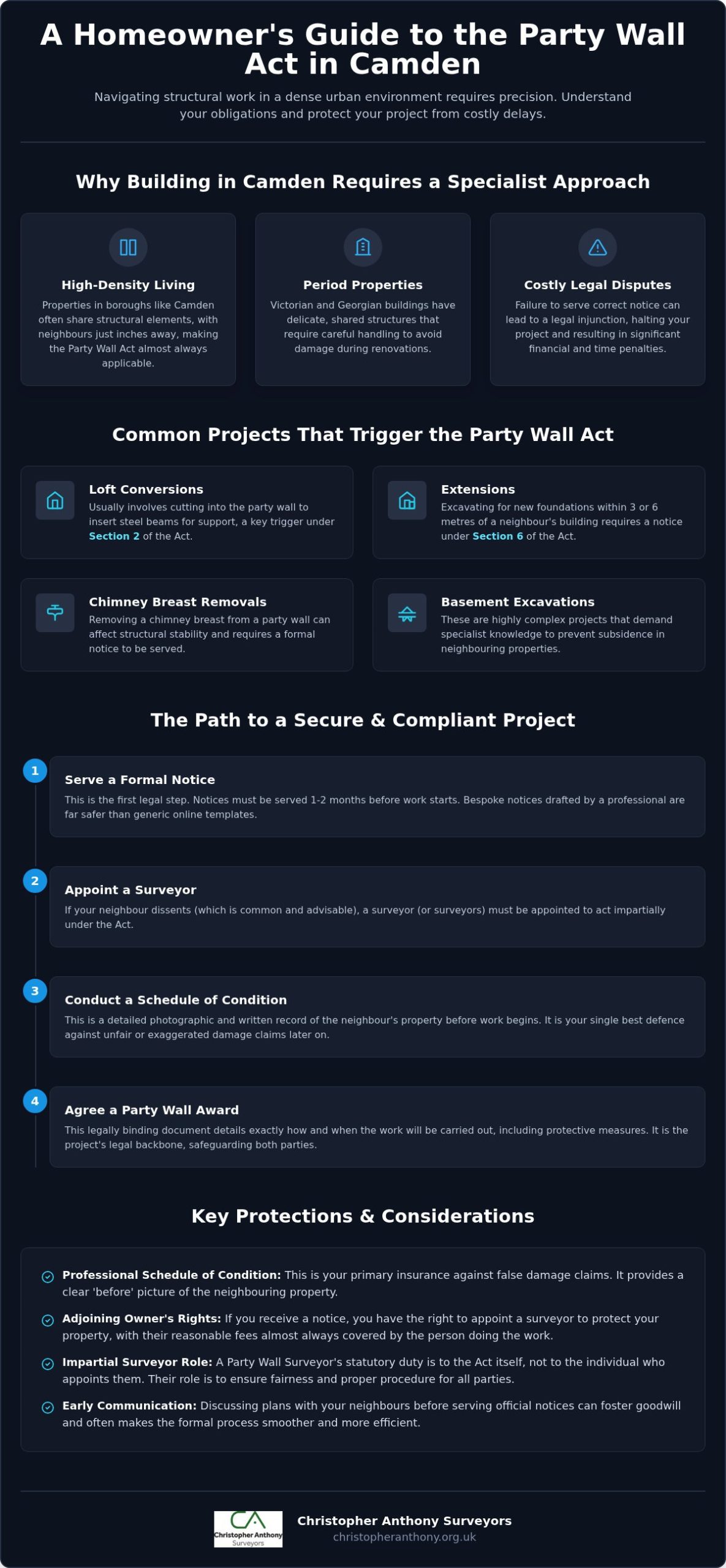
  • Understand why Camden's dense urban landscape and period properties require a specialist approach to remain compliant with the Party Wall etc. Act 1996.
  • Learn how to manage the specific legal requirements for common projects like loft conversions and extensions without risking structural damage.
  • Discover why a professional Schedule of Condition is your best defence against unfair damage claims from neighbouring properties.
  • Gain practical insights on why early communication and bespoke notices are far more effective than relying on generic online templates.
  • Find out how to secure expert guidance from a party wall surveyor Camden to keep your project moving forward with fixed-fee transparency.

Why You Need a Specialist Party Wall Surveyor in Camden

Camden projects are high-stakes. Whether you are in NW1 or NW3, the density of the borough means your neighbours are literally inches away. Appointing a party wall surveyor Camden isn't just a legal hoop to jump through; it's a strategic move to prevent your project from grinding to a halt. Failing to comply with the Party Wall etc. Act 1996 can lead to costly legal injunctions. This isn't just about paperwork. It's about protecting your investment and your reputation on the street.

What is a Party Wall Surveyor?

A surveyor isn't your traditional advocate. Unlike an architect or a lawyer, our statutory duty is to the Act itself. We ensure the process remains fair and transparent for both sides. As a Building Owner Party Wall Surveyor, we facilitate your right to build whilst ensuring the Adjoining Owner's property is protected. It's about balance. We resolve disputes before they escalate into expensive legal battles.

Camden Property Challenges: From NW1 to NW5

Camden presents a unique architectural puzzle. You've got the iconic Victorian terraces of Kentish Town and the grand Georgian properties in Hampstead. These buildings often share delicate structural elements. In Belsize Park, you might be dealing with large mansion blocks where a single project requires notices to multiple leaseholders and the freeholder. Local knowledge is vital here. We understand how these specific building types behave during structural changes. Working as a party wall surveyor Camden requires an intimate understanding of the borough's high-density layout and planning landscape, ensuring your party wall matters don't conflict with other permissions.

Camden's architectural heritage means most homes are terraced or semi-detached. Renovations aren't just internal; they often impact shared structures. Whether you're planning a loft conversion or a rear extension, you'll likely need a party wall surveyor Camden to ensure the official text of the Party Wall etc. Act 1996 is followed correctly. Every project is unique. A chimney breast removal in a Kentish Town terrace requires a different approach than a basement dig in Primrose Hill.

Loft Conversions and Extensions

Loft projects usually involve cutting into the party wall to insert steel beams. This falls under Section 2 of the Act. For extensions, Section 6 is often the trigger. If you're excavating for foundations within 3 or 6 metres of a neighbour’s building, you must serve notice. These are the most common triggers in London. We see this daily. It's routine, but it requires precision to avoid delays. Internal alterations, like removing a chimney breast, are equally critical. These period features often provide structural support to the shared wall. For those in Primrose Hill considering basement excavations, the complexity increases significantly. These projects demand specialist knowledge of deep foundations and soil stability to prevent subsidence in neighbouring properties.

Adjoining Owner Rights in Camden

If you've received a notice from a neighbour, don't panic. You have rights. As an Adjoining Owner Party Wall Surveyor, we ensure your property isn't compromised. It's essential to understand that in most cases, the Building Owner is responsible for all reasonable surveyor fees. You can find more detail in our guide on being an Adjoining Owner Party Wall Surveyor: Protecting Your Rights in 2026. If you are unsure about a notice you've received, requesting a fixed-fee quotation for professional advice is a sensible first step to protect your home.

Understanding the Costs and Process of a Party Wall Award

The legal process behind the Party Wall etc. Act 1996 doesn't have to be a headache. It begins with a formal notice. Depending on your project, this must be served one or two months before work starts. Getting this right is vital. A party wall surveyor Camden ensures your notices are legally sound to prevent neighbours from halting your progress. If a dispute arises, we move to the Party Wall Award. This document is your project's legal backbone. It details exactly how the work will be executed and how any potential issues will be resolved. It's about creating a clear path forward for everyone involved.

Fixed Fees vs Hourly Rates

Budgeting for a Camden build is stressful. Many surveyors bill by the hour, which often leads to "fee creep" and unexpected invoices that arrive long after the work has finished. We don't believe in hidden costs. Christopher Anthony Surveyors provides fixed-fee quotations to give you total budget certainty from the outset. We believe in transparency and efficiency. You can find our current Party Wall Surveyor Prices online to help plan your project finances. We also provide a comprehensive guide to finding a Fixed Fee Party Wall Surveyor to help you understand why this model is the most professional choice for residential projects in the capital.

The Importance of a Schedule of Condition

A Schedule of Condition Survey is your best insurance policy. Before work begins, we record the exact state of the adjoining property with high-resolution photos and detailed notes. It's a must-have for any structural work in Camden. This document protects you from mistaken or fraudulent damage claims that can arise months after the scaffolding comes down. It also reassures your neighbour that you're taking their property's safety seriously. When we act as your party wall surveyor Camden, we ensure this document is exhaustive and legally robust. If a dispute happens later, the schedule provides the objective facts needed for a quick, fair resolution without the need for expensive litigation.

Get a fixed-fee quote for your Camden project

Expert Party Wall Surveyor in Camden: Protecting Your Property and Project

Practical Advice from Christopher Anthony Surveyors

Camden builds are personal. Whilst the legal side is rigid, the human side requires a softer touch to keep things moving. We always recommend speaking to your neighbours early. An informal conversation over a coffee can prevent a "dispute" status before a formal notice even lands on their doormat. It builds trust. When neighbours feel informed, they're far less likely to appoint their own separate surveyor, which can save you significant time and money.

Don't be tempted by generic online templates. We see these fail constantly. A small error in a DIY notice can render it invalid, potentially forcing you to restart the statutory notice period just as your builder is ready to start. It's a risk that isn't worth taking. You need a party wall surveyor Camden who understands the specific nuances of the borough's housing stock. Whether it's a Victorian terrace in Kentish Town or a converted flat in Belsize Park, local expertise ensures technical oversights don't creep into your Award. Once the Award is served, keep a clear line of communication with your builder. They must adhere to the specific working hours and methods outlined in the document to remain compliant.

Need Advice About Your Project?

Every project has its own set of challenges. We invite you to request a fixed-fee quotation for your Camden project to get total cost certainty. If you're just starting out, try our "Christopher Anthony Party Wall Assistant" tool for quick guidance on your next steps. We also offer no-obligation consultations to discuss your specific project details and help you understand how the Act applies to your home. We're here to make the process as smooth as possible.

About Christopher Anthony Surveyors

Christopher Anthony Surveyors is a specialist practice with over 20 years of experience serving London, Hertfordshire, Essex, and the Home Counties. Led by Tony (Christopher Anthony), we provide a boutique, personal service that balances professional authority with a reassuring, friendly approach. We specialise in residential party wall matters, from straightforward loft conversions to complex basement excavations. Our goal is simple: to provide an efficient, transparent service that protects your property and keeps your project on track. When you need a party wall surveyor Camden, you can rely on our deep local knowledge and commitment to fast-paced, precise results.

Secure Your Camden Project Today

Camden's dense urban landscape and unique architectural heritage require a precise approach to the Party Wall etc. Act 1996. We've explored how specialist local knowledge is vital for avoiding project delays and why a professional Schedule of Condition serves as your ultimate structural insurance. By prioritising early communication and expert guidance, you can maintain positive neighbourly relations whilst ensuring your build remains legally robust. Finding a seasoned party wall surveyor Camden is the most effective way to manage these complexities and protect your investment.

Fixed-fee transparency and over 20 years of London experience mean you can focus on your build instead of worrying about fee creep or legal disputes. We understand the pressure of a major renovation and we're committed to providing the clarity you need to move forward with confidence. Every project is different, but the need for reliable, professional oversight remains constant.

Request a Fixed-Fee Party Wall Quotation for Your Camden Project

Your project deserves the expertise of a team that knows Camden's streets as well as the law. We're here to help you navigate every step of the process with precision and care. Let's get your project moving safely.

Frequently Asked Questions

Who pays for the party wall surveyor in Camden?

The Building Owner undertaking the construction work is typically responsible for all reasonable fees, including those of the Adjoining Owner's surveyor. This is a statutory requirement under the Party Wall etc. Act 1996. Exceptions only occur in rare cases where works are for the benefit of both parties, such as repairing a shared wall that has fallen into disrepair through mutual neglect.

How much does a party wall surveyor cost in Camden?

Costs depend entirely on the scope and complexity of your specific project. Factors like the number of adjoining owners and whether you appoint an Agreed Surveyor will influence the final figure. Whilst industry rates in London are often higher due to the complexity of period properties, we provide fixed-fee quotations to ensure you have complete budget certainty before any work begins on your home.

Can I ignore a party wall notice from my neighbour?

You cannot simply ignore a notice as doing so will automatically trigger a "dispute" status after 14 days. If you don't respond, the law requires a surveyor to be appointed to protect your interests and the process will move forward regardless. It is always better to engage early to protect your rights and ensure a professional Schedule of Condition is recorded before any structural work commences.

How long does the party wall process take in London?

The process generally takes between one and three months from the point of serving the initial notice to the service of the Award. This timeline can be shorter if your neighbour consents immediately or longer if complex structural issues require detailed negotiation. Appointing an experienced party wall surveyor Camden early in the planning phase is the best way to prevent your project from being delayed by procedural errors.

Do I need a party wall surveyor for a chimney breast removal in Camden?

Yes, removing a chimney breast that is attached to a shared wall is a common trigger for the Act in Camden's period homes. This work involves cutting into the party structure and requires structural support to be inserted to maintain the wall's integrity. You must serve a formal notice at least two months before starting, as these works can significantly impact the stability and fire safety of the shared wall.

Article by

Tony Neilson MRPSA MFPWS

What Is a Party Wall? A Specialist Guide for Homeowners in 2026

Imagine your builder is ready to start your loft conversion, but a single shared boundary brings the entire project to a grinding halt. It's a common scenario for homeowners who haven't yet asked: what is a party wall? Understanding this legal definition is the difference between a seamless build and an expensive, stressful dispute. Accuracy matters. Speed is essential.

We know the anxiety that comes with construction. You worry about damaging your neighbour's property. You fear unexpected legal delays. It's a lot to manage. This specialist guide ensures you understand your obligations under the Party Wall etc. Act 1996 and how to safeguard your property's value. We'll explore the essential procedures, from serving valid notices to the importance of a Schedule of Condition, giving you a clear roadmap for a successful project. No jargon. Just practical advice.

Key Takeaways

  • Learn exactly what is a party wall, including shared building structures and garden boundary walls, to identify if your project requires legal notice.
  • Understand how the Party Wall etc. Act 1996 protects your property whilst facilitating your development, rather than acting as a barrier to construction.
  • Discover why formal Party Wall Notices are essential for loft conversions and extensions, providing legal certainty that informal agreements cannot offer.
  • Recognise the role of a Party Wall Award as a vital "legal rulebook" that manages potential disputes and protects your property's structural integrity.
  • Gain practical insights on how to navigate the process efficiently to avoid expensive delays and maintain positive relationships with your neighbours.

What is a Party Wall? Defining the Shared Boundary

At its most basic level, a party wall is a wall shared by two or more properties. It usually separates terraced or semi-detached houses. However, the legal reality is more nuanced. Correctly identifying What is a Party Wall? is the vital first step for any homeowner planning a renovation. Without this clarity, you risk starting unauthorised building works. This can lead to costly injunctions and damaged relationships. It's about more than just a surface; it's about legal boundaries.

Identifying what is a party wall involves looking at how the structure was built and how it's used today. If you're planning a loft conversion or a rear extension, you'll likely encounter one of these shared structures. Failing to recognise them early is a primary cause of project delays in London and the Home Counties.

Type A vs Type B Party Walls

The Act distinguishes between two main types of walls. A Type A party wall stands on the land of different owners to a greater or lesser extent. It straddles the boundary line. Think of the main dividing wall in a Victorian terrace or a shared chimney stack. These are the most common examples we see.

A Type B wall is slightly different. It stands wholly on one owner's land but is used by two owners to separate their buildings. For instance, if your neighbour built their garage right up to your existing house wall and "leant" their structure against it, that wall becomes a party wall. Even though it sits on your land, the shared use brings it under the Act. It's a subtle distinction that often requires a Building Owner Party Wall Surveyor to verify.

Party Fence Walls and Party Structures

Don't let the name confuse you. A "party fence wall" isn't a timber fence. In the eyes of the law, it must be a masonry structure, like a brick garden wall that sits on the boundary line. If you plan to raise or rebuild a shared garden wall, you must follow the correct procedures. Timber fences are excluded from the Act entirely.

Then there are "party structures". This term is crucial for owners of flats or converted houses. It covers horizontal divisions, such as the floors and ceilings between properties. If you're removing a chimney breast in a ground-floor flat, you're working on a party structure that supports the neighbour above. The "etc" in the Party Wall etc. Act 1996 is equally important. It extends the law's reach to excavations within 3 or 6 metres of a neighbouring building. This ensures your foundations don't compromise the stability of the property next door.

Legislation shouldn't be viewed as a hurdle. It's a facilitator. The Party Wall etc. Act 1996 provides a clear, statutory framework for homeowners in England and Wales to carry out building works whilst protecting the interests of their neighbours. It isn't a tool for an adjoining owner to stop your project. Rather, it's a process designed to ensure that works are performed safely and that any damage is correctly rectified. Understanding what is a party wall in a legal context allows you to move forward with confidence.

The Act covers three primary categories of work. These include alterations to an existing party wall, building a new wall at the boundary line, and excavating near a neighbour's structure. For many homeowners in London and Hertfordshire, budget certainty is a top priority. Appointing a fixed fee party wall surveyor ensures that professional costs remain transparent and predictable from the outset. This "no-nonsense" approach prevents the financial surprises that often plague complex construction projects.

Rights of the Building Owner

If you are the one initiating the work, the Act grants you specific rights that might otherwise be restricted by common law. You have the legal right to cut into a party wall to insert steel beams for a loft conversion. You can demolish and rebuild a ruinous or defective shared wall. Crucially, you have the right to excavate for foundations within 3 or 6 metres of a neighbour's building, provided you follow the correct notice procedures. These rights are essential for modern urban development where space is at a premium. For a detailed breakdown of every right and obligation the legislation confers, our comprehensive guide to the party wall act 1996 covers the full statutory framework in depth.

Protections for the Adjoining Owner

The law is balanced. Neighbours have significant protections to ensure their property value and structural integrity aren't compromised. Every adjoining owner has the right to be served a formal notice in writing before any work begins. They also have the right to appoint their own surveyor to oversee the process, with the building owner typically covering all reasonable costs. A vital part of this protection is the schedule of condition survey. This creates a detailed photographic and written record of the neighbour's property before works start. It acts as a baseline, preventing false damage claims whilst ensuring genuine issues are repaired promptly. If you're planning a project soon, reviewing our transparent pricing can help you factor these essential protections into your budget.

What Is a Party Wall? A Specialist Guide for Homeowners in 2026

Practical Advice from Christopher Anthony Surveyors

Every project we handle across London and the Home Counties, from Hackney to Watford, carries its own set of structural challenges. Generic online templates often miss the specific nuances of your building's history. Relying on them is a gamble. We've seen many homeowners assume that a friendly "over the fence" chat with a neighbour is enough. It's a great starting point for maintaining goodwill, but it doesn't replace a formal Party Wall Notice. Without that legal paperwork, you're effectively performing unauthorised works.

Unauthorised works can haunt you years later. When you decide to sell your property, a buyer's solicitor will ask for the Party Wall Award. If you can't provide it, the sale could collapse or require expensive indemnity insurance. To keep your project on track and your budget intact, we recommend checking party wall surveyor prices as early as possible. Knowing your costs upfront prevents stressful surprises when the skips arrive.

Common Scenarios: Lofts and Extensions

Loft conversions almost always involve inserting steel beams into shared walls. This is a clear trigger for the Act. Even if you're only cutting in a few inches, you must notify your neighbour. For rear extensions or garden rooms, the "3-metre rule" is the primary factor. If your new foundations are deeper than the neighbour's and within three metres, the Act applies. Chimney breast removals are another frequent flashpoint. In older London terraces, these breasts often provide vital structural support. Removing them without a professional assessment is a recipe for a dispute.

Request a fixed-fee quotation for your project

Avoiding Construction Delays

Timing is everything in construction. If you serve your notices too late, your contractor might be standing on-site with nothing to do whilst you wait for legal periods to expire. You must serve notices at least two months before starting work on a shared wall and one month for new boundary walls or excavations. Accuracy is equally vital. Ensure your architectural drawings clearly show the relationship between your work and the boundary line.

Efficiency is often found in collaboration. Appointing an agreed party wall surveyor can save significant time and money for both parties. One impartial professional manages the process for both you and your neighbour, ensuring the Award is served quickly and fairly. Understanding what is a party wall and its associated timelines is the best way to prevent your renovation from becoming a legal headache. Early engagement protects your timeline and your peace of mind.

The journey towards a successful renovation begins the moment you serve a formal notice. This isn't a mere formality. It's a statutory requirement. If your neighbour dissents or simply ignores the notice for 14 days, the law deems a dispute to have arisen. This doesn't mean you're in a personal argument. It's a procedural status that triggers the need for professional surveyors to step in. Understanding what is a party wall and the obligations it carries is your best defence against project stoppages.

A Party Wall Award serves as the resolution to this dispute. Think of it as the "legal rulebook" for your construction. This document outlines how and when the works will be carried out, providing a clear path forward for both parties. It allows the build to proceed whilst ensuring the neighbouring property is protected. Professional guidance is essential here. A building owner party wall surveyor ensures your project complies with the Act from day one. If you're the neighbour, an adjoining owner party wall surveyor acts as your safeguard, ensuring your rights are upheld and your property is respected.

The Party Wall etc. Act 1996 is mandatory. It's not an optional extra or a "nice to have" for your project. Compliance is your legal duty. Skipping this step can lead to expensive legal injunctions that could halt your builders mid-flow. Proactive management is the only way to ensure a smooth, delay-free construction process.

Need Advice About Your Project?

Don't leave your project to chance. We encourage a proactive approach to prevent legal headaches before they even begin. You can request a fixed-fee quotation directly through our website to get your budget in order. For quick guidance on your specific situation, use the "Christopher Anthony Party Wall Assistant" tool. It's designed to give you clarity when you're unsure of the next steps. We're here to help you move from confusion to a clear, actionable plan.

About Christopher Anthony Surveyors

Christopher Anthony Surveyors is an independent specialist practice led by Tony (Christopher Anthony). We provide expert party wall services across London, Hertfordshire, Essex, and Kent. Our team brings over 20 years of experience to every project, specialising in the unique structural challenges of London loft conversions and extensions. We value transparency, speed, and protecting our clients' peace of mind above all else. By choosing us, you're choosing a no-nonsense partner dedicated to keeping your project moving forward without hidden complications.

Secure Your Project's Success

Navigating shared boundaries doesn't have to be a source of anxiety. Understanding what is a party wall and your legal obligations under the 1996 Act is the foundation of a successful renovation. By identifying shared structures early and prioritising clear, formal communication, you protect your property's structural integrity whilst maintaining positive relationships with your neighbours. Proactive steps today prevent expensive legal headaches tomorrow.

Request a Fixed-Fee Party Wall Quotation Today

With over 20 years of experience serving London and Hertfordshire, our team provides the expert advice you need to keep your build on track. We offer fixed-fee transparency so you're never caught out by hidden costs mid-project. Every home is unique, and we pride ourselves on providing a personal touch that larger firms often lack. You don't have to manage these complex procedures alone. Let's ensure your project moves forward with speed, precision, and total peace of mind.

Frequently Asked Questions

Do I need a party wall agreement for a garden fence?

You don't need a party wall agreement for a standard timber garden fence. The Act only applies to "party fence walls," which are shared masonry structures like brick or stone walls sitting on the boundary. If you're replacing a wooden fence with another wooden one, the legislation doesn't apply. However, if you're building a new brick wall on the boundary line, you'll need to serve a formal notice.

Can my neighbour stop me from carrying out building works?

Your neighbour cannot stop you from exercising your legal rights to build, provided your project is lawful. Whilst they can "dissent" to your notice, this simply triggers a dispute resolution process rather than a project veto. The resulting Party Wall Award ensures your work proceeds whilst protecting their property from damage. It's a mechanism to enable development, not to block it.

Who pays the surveyor fees for a party wall agreement?

The Building Owner initiating the work typically pays all reasonable fees. This includes the costs for their own surveyor and the surveyor appointed by the neighbour. This ensures the adjoining owner isn't financially disadvantaged by your development. In rare cases where work is required due to shared defects, costs might be split, but this depends on the surveyor's professional assessment.

What happens if I start work without serving a party wall notice?

Starting work without serving notice is a serious risk that can lead to a court injunction. If you proceed without following the Act, your neighbour can legally stop your project, leaving you liable for their legal costs. It also creates a "headache" during future property sales. Solicitors will look for evidence of compliance, and a lack of paperwork can cause a sale to collapse.

How long does a party wall award last once it is served?

A Party Wall Award is generally valid for 12 months from the date it's served. If you haven't started the works within this year, you may need to seek professional advice on re-serving notices. This time limit ensures that the Schedule of Condition remains an accurate reflection of the property's state before the construction activity begins.

Is a party wall agreement the same as planning permission?

No, they are entirely separate legal requirements. Planning permission deals with the use and appearance of land, whilst the party wall act 1996 manages the structural relationship between shared boundaries. You must still identify what is a party wall and follow the correct procedures even if you already have full planning approval and building regulations consent. Having one doesn't exempt you from the other.

Article by

Tony Neilson MRPSA MFPWS

How to Serve a Party Wall Notice: A Professional Step-by-Step Guide for 2026

Did you know that nearly half of all building owners could avoid the stress and expense of a party wall dispute simply by getting the initial paperwork right? It's natural to feel anxious about approaching your neighbours with legal documents. You want your extension or loft conversion to run smoothly, yet the fear of project delays and hidden costs often looms large.

Mastering how to serve a party wall notice is your best defence against these frustrations. This professional guide for 2026 provides the clarity you need to handle the legal process with confidence; ensuring your building project remains compliant and legally protected. We'll walk you through the essential steps to ensure your notice is validly served, from understanding statutory timelines to securing that vital neighbour consent. By following this methodical approach, you can protect your project from future claims and keep your construction programme moving forward without unnecessary friction.

Key Takeaways

  • Understand the statutory requirements of the Party Wall etc. Act 1996 and how to serve a party wall notice that stands up to legal scrutiny.
  • Recognise why using a professional fixed-fee notice is safer than a generic template for documenting mandatory project details and start dates.
  • Master the essential one-month and two-month notice periods to ensure your build stays on track and avoids unnecessary delays.
  • Learn how to correctly identify and serve the legal owners of a property to prevent your notice from being invalidated.
  • Navigate the response phase effectively, including how to handle a neighbour's silence with the mandatory 10-day follow-up notice.

Understanding the Party Wall Notice: When and Why it is Legally Required

A party wall notice is a formal document required by the Party Wall etc. Act 1996. It isn't a request for permission to build. Instead, it's a "notice of intent" that informs your neighbour of your plans. This distinction is vital. You aren't asking if you can proceed; you're fulfilling a statutory duty to ensure both properties remain safe. For homeowners in London and Hertfordshire, where terrace houses share structural bones, understanding how to serve a party wall notice correctly is the first step toward a successful build. It creates a framework for communication and prevents disputes before they start. The primary goal is protection. It shields you from unfounded damage claims and ensures your neighbour's property isn't compromised.

Identifying Trigger Works Under the 1996 Act

Not every hammer blow requires a notice. However, specific works under the Act will trigger the need for formal documentation. This includes cutting into a party wall for steel beams, which is a staple of loft conversions. It also applies to thickening or raising a shared wall. If you're building a new wall exactly on the boundary line, known as the Line of Junction, you must notify your neighbour. Most commonly, excavation for foundations within 3 or 6 metres of a neighbour's structure triggers the Act. This is almost always the case for rear extensions or garden rooms in densely populated areas like Essex and the Home Counties.

The Risks of Commencing Work Without a Valid Notice

Proceeding without a valid notice is a high-stakes gamble. Your neighbour could apply for a legal injunction, which would halt your project mid-build. This leads to mounting contractor costs and severely strained relationships. You also lose specific rights granted by the Act, such as the legal right to access a neighbour's land to carry out necessary works. Perhaps most importantly, failing to comply can haunt you during a future sale. Savvy buyers and solicitors look for proof of compliance; without it, your property value could suffer. Understanding how to serve a party wall notice protects your investment and provides peace of mind. Check our fixed-fee transparency to see how professional help can safeguard your project.

Accuracy is the foundation of any successful build. A poorly drafted notice is effectively a ticking time bomb for your project timeline. Whilst generic templates are available online, they often lack the technical precision required to be legally binding. Opting for a professional fixed fee party wall notice ensures that your description of work is clear enough for a layman to understand whilst remaining legally robust. Precision here prevents neighbours from claiming they didn't understand the scope of the works later on.

Learning how to serve a party wall notice correctly starts with the mandatory information. You must include the names and addresses of all owners, a detailed description of the proposed works, and a specific start date. It is a common misconception that a brief note will suffice. The official government guidance clarifies that these components are statutory requirements. If you're undertaking excavation work, you'll also need to provide professional drawings showing the depth and location of the new foundations to satisfy Section 6 of the Act.

Section 1, 3, and 6 Notices: Which One Do You Need?

Understanding which section of the Act applies to your project is critical. Section 1 covers the Line of Junction, typically for new walls built on a boundary. Section 3 handles Party Structure notices, which are essential for internal alterations and loft conversions. Finally, Section 6 covers Adjacent Excavation, the standard requirement for rear extensions and basements. If you're unsure which category your project falls into, our Building Owner Party Wall Surveyor services can identify the correct notices for you.

Identifying All Adjoining Owners: Freeholders and Leaseholders

One of the biggest pitfalls is failing to identify every "Adjoining Owner". Under the Act, this includes anyone with an interest in the property greater than a yearly tenancy. If you are working next to a block of flats, you may need to serve notice to both the individual leaseholders and the overarching freeholder. In London and Hertfordshire, we frequently use Land Registry searches to verify these details. It's a small step that prevents huge delays. Serving notice only to "the occupier" is a common mistake that will instantly invalidate your legal standing. For a deeper understanding of the specific compliance requirements in the capital, our guide to party wall notice London procedures in 2026 covers the unique challenges posed by the city's dense Victorian and Edwardian terraces.

The Step-by-Step Process: How to Serve a Party Wall Notice Correctly

Serving a notice is a strategic communication process. It isn't just about ticking a legal box; it's about setting the pace for your entire construction phase. The step-by-step reality of how to serve a party wall notice ensures you avoid the procedural errors that often lead to project-halting injunctions. A specialist Building Owner Party Wall Surveyor can manage this flow, ensuring every statutory requirement is met with precision. To keep your project moving, follow this methodical sequence:

  1. Informal Engagement: Speak with your neighbours before any paperwork arrives. This reduces friction and can often lead to a faster consent.
  2. Calculate Deadlines: Review the party wall notice deadline relative to your start date. Remember, you need one month for excavations and two months for party structure works.
  3. Legal Identification: Verify that you are serving the correct legal entity. This must be the property owner, not just "the occupier" or a short-term tenant.
  4. Execute Service: Deliver the notice using a valid method, such as first-class post or hand delivery, to ensure it is legally "served".
  5. Monitor Response: Track the 14-day statutory response window. If no reply is received, you must be ready to issue the follow-up 10-day notice.

Get a fixed-fee quotation for your party wall notices

The Pre-Notice Consultation: Why an Informal Chat Matters

Receiving a legal notice can be intimidating. An informal chat allows you to explain the "why" behind the works, such as your need for more space or a safer loft structure. It's the ideal time to discuss practicalities like working hours and site safety. This proactive approach often prevents a neighbour from feeling the need to appoint their own surveyor immediately, potentially saving you significant costs whilst maintaining a positive relationship.

Methods of Service: Post, In-Person, and Electronic Delivery

The method of delivery is just as important as the content. First-class post is generally preferred as it is reliable and recognised by the courts. Whilst hand delivery is acceptable, it requires careful documentation to prove service. Electronic delivery via email is only valid if the neighbour has explicitly agreed in writing to receive notices this way. Avoiding recorded delivery is often wise; if a neighbour isn't home to sign, the notice isn't considered served, which can lead to frustrating project delays.

How to Serve a Party Wall Notice: A Professional Step-by-Step Guide for 2026

Once you have navigated the complexities of how to serve a party wall notice, the process moves into the response phase. Your neighbour has three distinct legal pathways under the Act. They may provide written consent, allowing your project to proceed immediately. Alternatively, they may dissent and appoint an Agreed Surveyor to act impartially for both properties. The third option involves each party appointing their own professional to negotiate the terms. This ensures that technical details, such as foundation depths or the placement of steel beams, are professionally scrutinised for safety.

Silence from a neighbour is not a green light to begin work. If you receive no reply within the initial 14-day window, a "deemed dispute" arises. You must then serve a follow-up 10-day notice under Section 10(4) of the Act. This is a final statutory request for them to appoint a surveyor. If they still don't respond, you have the legal right to appoint an Adjoining Owner Party Wall Surveyor on their behalf. This prevents your project from being held hostage by inaction whilst ensuring the neighbour's property rights remain protected.

The final legal document is the Party Wall Award, which governs how and when the works are carried out. A vital component of this stage is the Schedule of Condition survey. By documenting the state of the neighbouring property before your builders arrive, you create an objective baseline. This is your best defence against unfounded claims of damage once the project is complete.

Practical Advice from Christopher Anthony Surveyors

In our 20 years of experience across London and Hertfordshire, we've seen many projects derailed by "Ambulance Chasers". These firms monitor planning portals and send aggressive letters to neighbours to encourage a dissent for their own financial gain. Transparency is your best weapon here. We recommend being proactive; if your neighbour receives one of these letters, explain that you have already engaged a professional surveyor to handle the process fairly.

Even if your neighbour consents to the works, we strongly advise offering to pay for a professional Schedule of Condition. It is a small investment for the significant legal protection it offers you. Finally, ensure your surveyor is proactive. Delays in the Award process are rarely due to the complexity of the extension or loft conversion; they are usually the result of poor communication between the professionals involved. Choosing a firm that values your timeline is just as important as their technical expertise.

Key Takeaways: Summary of the Serving Process

Secure Your Project Success Today

Understanding how to serve a party wall notice is about more than just legal compliance; it's about protecting your investment and maintaining neighbourly harmony. By identifying all relevant owners through Land Registry and respecting the statutory one and two month notice periods, you eliminate the risk of costly injunctions. Moving away from generic templates in favour of professional, project-specific documentation ensures your legal standing is unshakeable from day one.

Christopher Anthony Surveyors brings over 20 years of professional expertise to every project across London, Hertfordshire, and the Home Counties. Our transparent, fixed-fee approach means you can budget with total confidence while we handle the technical heavy lifting. We focus on efficiency and clear communication so you can focus on your build.

Get a Fixed-Fee Party Wall Quote from Christopher Anthony Surveyors

Your building project is a significant milestone. Handling the party wall process correctly today sets the stage for a smooth, dispute-free construction phase tomorrow. We're here to guide you through every step with precision and care.

Frequently Asked Questions

Can I serve a party wall notice myself without a surveyor?

You can legally serve a party wall notice yourself, but it's a path filled with potential pitfalls. Whilst many homeowners attempt this using generic online templates, any technical error in the description of works or the identification of owners can render the notice invalid. This often leads to builders being turned away on their first day or expensive legal challenges mid-build. Professional service ensures your project starts on a firm legal footing.

How much does it cost to serve a party wall notice in London?

The cost varies based on the number of adjoining owners and the complexity of your specific building works. London projects are often more involved because terrace houses and flats require notices for multiple leaseholders and freeholders. We focus on fixed-fee transparency at Christopher Anthony Surveyors, providing you with a clear, upfront cost rather than unpredictable hourly rates. This allows you to manage your renovation budget without any hidden surprises. For a full overview of the compliance steps specific to the capital, see our dedicated guide on party wall notice London compliance and procedures.

What happens if my neighbour refuses to sign or ignores the notice?

If your neighbour ignores the notice for 14 days, the law automatically treats this as a "deemed dissent," meaning a dispute has arisen. You cannot simply proceed with the works. You must serve a follow-up 10-day notice under Section 10(4) of the Act. If they continue to remain silent, you have the right to appoint a surveyor to act on their behalf, ensuring your project isn't indefinitely delayed by their inaction.

Do I need a party wall notice for a simple rear extension?

Yes, most rear extensions require a notice because they involve excavating foundations within 3 or 6 metres of a neighbouring structure. Even if you aren't physically touching the shared wall, the ground works are enough to trigger the Act. Understanding how to serve a party wall notice for these excavations is vital to prevent your neighbours from halting your extension once the diggers arrive on site.

How long is a party wall notice valid for once served?

A party wall notice remains valid for 12 months from the date it was originally served. If your project is delayed and you don't commence the specific works covered by the notice within that year, the document will expire. In such cases, you would generally need to restart the process and serve fresh notices to ensure you remain compliant with the Party Wall etc. Act 1996.

Can I serve a party wall notice by email to my neighbour?

You can only serve a notice by email if your neighbour has previously stated in writing that they are willing to accept statutory notices via that specific email address. Without this prior written consent, an emailed notice is not legally valid. To avoid any risk of invalidation, we typically recommend first-class post or hand delivery as the most secure methods for how to serve a party wall notice correctly.

Article by

Tony Neilson MRPSA MFPWS

Party Wall Notice Deadline: Statutory Timelines and Response Windows Explained

A single missed party wall notice deadline can freeze your construction project and lead to a costly legal injunction before the first skip even arrives. Whether you are planning a London loft conversion or a rear extension, the timing of your paperwork is just as critical as the quality of your build. You likely feel that the Party Wall etc. Act 1996 is a complex maze of red tape designed to slow you down; it is a sentiment we hear often from homeowners and developers across the Home Counties.

We're here to show you that mastering these statutory timelines is actually your best defence against project delays and fractured neighbourly relations. This guide provides total clarity on the 1-month and 2-month notice rules, the vital 14-day response window, and the "deemed dissent" process that occurs if your neighbour stays silent. You will gain a clear, actionable roadmap to ensure your project remains legally compliant whilst keeping your construction schedule moving forward with confidence and precision.

Key Takeaways

  • Distinguish between one-month and two-month statutory periods to align your construction programme with legal requirements from the outset.
  • Understand the critical 14-day response window and how to navigate a "deemed dissent" should your neighbour fail to reply to your party wall notice deadline.
  • Ensure your project remains compliant by learning the 12-month validity rule and what specific actions constitute a formal "commencement" of works.
  • Avoid costly resets by identifying common administrative errors that can invalidate your notice and force you to restart the statutory waiting period.
  • Gain professional insight into the strategic benefits of serving notices early to minimise overall project lead times and protect your build schedule.

Understanding the One-Month and Two-Month Statutory Notice Periods

Many homeowners assume they can hand a letter to their neighbour on Friday and have the builders arrive on Monday. This is a common misconception that leads to project-stopping legal trouble. The Party Wall etc. Act 1996 mandates specific lead times to protect adjoining owners and their property. If you ignore your party wall notice deadline, you risk an injunction that could halt your site for months. You cannot simply bypass these windows because your contractor has a gap in their diary.

When Does the Two-Month Deadline Apply?

This longer window typically applies to works that directly interfere with the shared fabric of a building. In surveying terms, these are Section 2 works. If you're planning a loft conversion, you'll likely need to cut into the party wall to insert steel beams. Other common triggers include removing chimney breasts that form part of the shared structure or raising the height of the wall for a new extension. Because these works carry a higher risk of structural impact, the law gives your neighbour two full months to prepare and seek advice. It's a protection that ensures no one's home is compromised without fair warning.

The One-Month Deadline for Excavations

For works that don't touch the wall itself but involve digging nearby, the party wall notice deadline is usually one month. This falls under Section 6 of the Act. If you're excavating for a rear extension or a garden room within 3 metres of your neighbour's property, you must serve notice. For deeper basement excavations in London, the 6-metre rule often applies. This requires a notice if your new foundations will be deeper than theirs within that radius. Piling work is a frequent trigger here. Even if your wall is entirely separate, the vibration and soil movement from piling require statutory notice to ensure the neighbouring building stays safe. Building a new wall directly on the line of junction also falls into this one-month category.

Accuracy is vital when determining which deadline applies to your project. A flawed notice that cites the wrong section or timeframe will reset your deadline clock to zero. We've seen projects delayed by weeks because a building owner served a one-month notice for work that legally required two. Getting it right the first time is the only way to keep your project on schedule. Understanding how to serve a party wall notice correctly from the outset is therefore essential to avoiding these costly administrative errors.

The 14-Day Response Window: What Happens When the Clock Starts Ticking

Once your notice is served, the 14-day statutory clock begins. It's vital to understand that "Day 0" is the date the neighbour actually receives the document, not the day you signed it. If you're sending notices by post, you must factor in delivery times to ensure you don't jump the gun on your party wall notice deadline. This fortnight is the first major milestone in your project's legal timeline.

If that period passes without a written response, the law assumes a dispute has arisen. This is a "deemed dissent". You cannot simply start building if your neighbour ignores you. Instead, you must issue a formal 10-day follow-up letter under Section 10(4) of the Act. This is a final warning. If they still don't respond after those ten days, you gain the legal authority to appoint a surveyor on their behalf. This prevents a silent neighbour from blocking your project indefinitely. Following RICS professional guidance ensures this sensitive process is handled with the necessary impartiality.

Option 1: Consent with or without a Schedule of Condition

Written consent is the fastest route to your start date. If your neighbour signs the consent form, you can often bypass the remainder of the one or two-month notice periods. We strongly advise pairing this with a Schedule of Condition survey. This provides a photographic and descriptive record of their property before you begin. It's a protective shield for both sides. It ensures you aren't blamed for pre-existing cracks whilst giving your neighbour confidence that any genuine damage will be identified and rectified.

Option 2: Dissent and the Appointment of Surveyors

A dissent doesn't mean your project is over. It simply means the process becomes more formal. Your neighbour has the right to appoint an Adjoining Owner Party Wall Surveyor to review your plans and protect their interests. To keep your timeline on track, you might propose an Agreed Party Wall Surveyor. This is a single, neutral expert who acts for both parties. It's a streamlined approach that often leads to a quicker resolution and a faster Party Wall Award. If you're currently facing a non-responsive neighbour, you can consult our specialist team to manage these delicate timelines for you.

Party Wall Notice Deadline: Statutory Timelines and Response Windows Explained

Notice Validity and Expiration: The 12-Month Rule

The law doesn't allow a notice to hang over a neighbour's head indefinitely. Once you've served your paperwork, you enter a "use it or lose it" phase. Every notice issued under the Act has a strict lifespan of 12 months. If you haven't commenced the specific works described in your notice by the time this party wall notice deadline expires, the notice becomes void. You cannot simply pick up where you left off; you'll need to restart the entire statutory process from scratch.

Commencing work means more than just putting up a fence or clearing some garden waste. To keep the notice valid, you must begin the actual structural work authorised by the Act, such as digging the foundations or inserting steel beams. If you stop work for a significant period and the 12-month anniversary passes, you may find yourself in a legal grey area. Re-serving notices isn't just an administrative headache; it can involve fresh surveyor fees and further delays to your build schedule.

Request a fixed-fee quotation for your party wall notices

Managing Your Project Timeline in London and Hertfordshire

Coordinating your party wall notice deadline with planning permission is a delicate balancing act. In London, basement excavations often face complex engineering hurdles or planning revisions that can easily consume six to nine months of your notice's validity. We often suggest serving notices once you're confident that planning is imminent but before the final decision notice arrives. This allows the statutory periods to run concurrently with the final stages of design, ensuring you're ready to break ground the moment permission is granted. For a comprehensive overview of the unique compliance challenges facing capital homeowners, our detailed guide to party wall notice London procedures in 2026 covers the specific timelines and dispute resolution processes relevant to the city's dense urban environment.

Can You Shorten the Statutory Notice Period?

The only legal way to bypass the one or two-month waiting period is through written consent from your neighbour. If they agree in writing to let you start earlier, the statutory lead time is effectively waived. However, you must never start work before the notice period ends without this explicit agreement. Doing so leaves you vulnerable to a court injunction. A "stop-work" order can be devastating, resulting in significant legal costs and a total halt to your construction project until the matter is resolved by surveyors.

Practical Advice from Christopher Anthony Surveyors

Experience has taught us that the most successful projects begin with a proactive approach to the party wall notice deadline. Don't wait for your contractor to arrive on-site with a digger before you think about the Act. We recommend serving notices as soon as your plans are finalised, ideally alongside your planning application. This strategy allows the statutory waiting periods to run whilst you wait for council approval, effectively neutralising potential delays to your construction programme.

Professionalism is your best tool for securing a quick response. A notice served on our firm's letterhead carries a level of authority that generic letters lack. It signals to your neighbour that you're taking your legal obligations seriously and that their property is being protected by experts. Whilst it's a formal process, a friendly chat before the envelope arrives can work wonders. Explaining the project over a cup of tea often prevents the anxiety that leads to an immediate dissent.

Avoiding Common Deadline Pitfalls

Accuracy is everything in this process. A single administrative error can invalidate your paperwork and reset your party wall notice deadline clock to zero. Many homeowners rely on party wall notice templates found online, but these often lack the technical precision required for complex Section 6 excavation works. If you want to understand the full procedural requirements before drafting your documents, our detailed walkthrough on how to serve a party wall notice correctly in 2026 covers every step in depth. Common mistakes that cause project-stopping delays include:

Need Advice About Your Project?

Every property is unique. A basement excavation in a London terrace requires a different strategic approach than a simple garden room extension in Hertfordshire. Generic timelines don't always account for the nuances of complex urban builds or the specific concerns of your neighbours. Relying on assumptions can lead to expensive legal disputes that far outweigh the cost of professional guidance.

We provide clear, no-nonsense expertise to keep your project moving. You can request a fixed-fee quotation to secure your project's legal compliance from the very start. For an instant steer on your specific obligations and the timelines involved, we encourage you to use the Christopher Anthony Party Wall Assistant tool on our website. It's designed to demystify the process and give you the confidence to proceed with your build schedule.

Secure Your Build Schedule with Expert Timing

Mastering these statutory windows ensures your project stays on track. We have explored how the one and two-month notice periods dictate your start date. We also covered why the 14-day response window requires active management to avoid a "deemed dissent" situation. Accurate paperwork is your best defence against delays. Don't let your party wall notice deadline expire after 12 months; ensure your structural works begin within the legal validity period to avoid costly resets.

Request a Fixed-Fee Party Wall Quotation Today

Our team brings over 20 years of experience to London and Hertfordshire projects, offering fixed-fee transparency for both building owners and adjoining owners. We handle the procedural heavy lifting so you can focus on the build itself. Take the first step toward a compliant and stress-free construction project today.

Frequently Asked Questions

How long is a party wall notice valid for once served?

A party wall notice remains valid for exactly 12 months from the date it is served. If the structural works described in your notice have not commenced within this one-year window, the notice expires. In such cases, you must restart the statutory process by serving fresh notices and waiting for the relevant notice periods to elapse before you can legally begin your build.

Can I start building work before the two-month notice period ends?

You can only start work before the two-month period expires if you obtain explicit written consent from your neighbour. If they agree to the works and sign a consent form, the statutory waiting period is effectively waived. However, without this written agreement, you must wait for the full notice period to pass to avoid the risk of a project-stopping legal injunction.

What happens if my neighbour ignores the 14-day notice deadline?

If your neighbour fails to respond by the 14-day party wall notice deadline, the law assumes a "deemed dissent" has occurred. This means a dispute is officially considered to have arisen. You must then issue a formal 10-day follow-up letter. If they still remain silent after this second window, you gain the legal right to appoint a surveyor on their behalf to resolve the dispute.

Do I need to serve a new notice if I change my building plans?

Significant changes to your design, such as deepening foundations or moving a new wall's position, typically require a new notice. Minor tweaks might be managed through a surveyor's addendum, but substantial deviations from the original notice can make it invalid. Serving a fresh notice ensures your party wall notice deadline is legally sound and protects you from claims that the work is unauthorised.

Is there a deadline for my neighbour to appoint their own surveyor?

Yes, once the initial 14-day response window passes and a dissent is recorded, your neighbour has a further 10 days to appoint their own surveyor. If they do not make an appointment within this secondary timeframe, the Building Owner has the statutory power to appoint a surveyor on their behalf. This prevents a non-responsive neighbour from stalling your construction schedule indefinitely.

Does the 12-month expiration rule apply if I have already started the work?

The 12-month rule specifically applies to the commencement of the works. As long as you have physically started the structural work authorised by the notice within the first year, the notice remains valid until those specific tasks are finished. You don't need to complete the entire construction project within twelve months; you simply need to have broken ground or begun the party wall works.

Article by

Tony Neilson MRPSA MFPWS

Loft Conversion Party Wall Agreement: A Professional Buying Guide for 2026

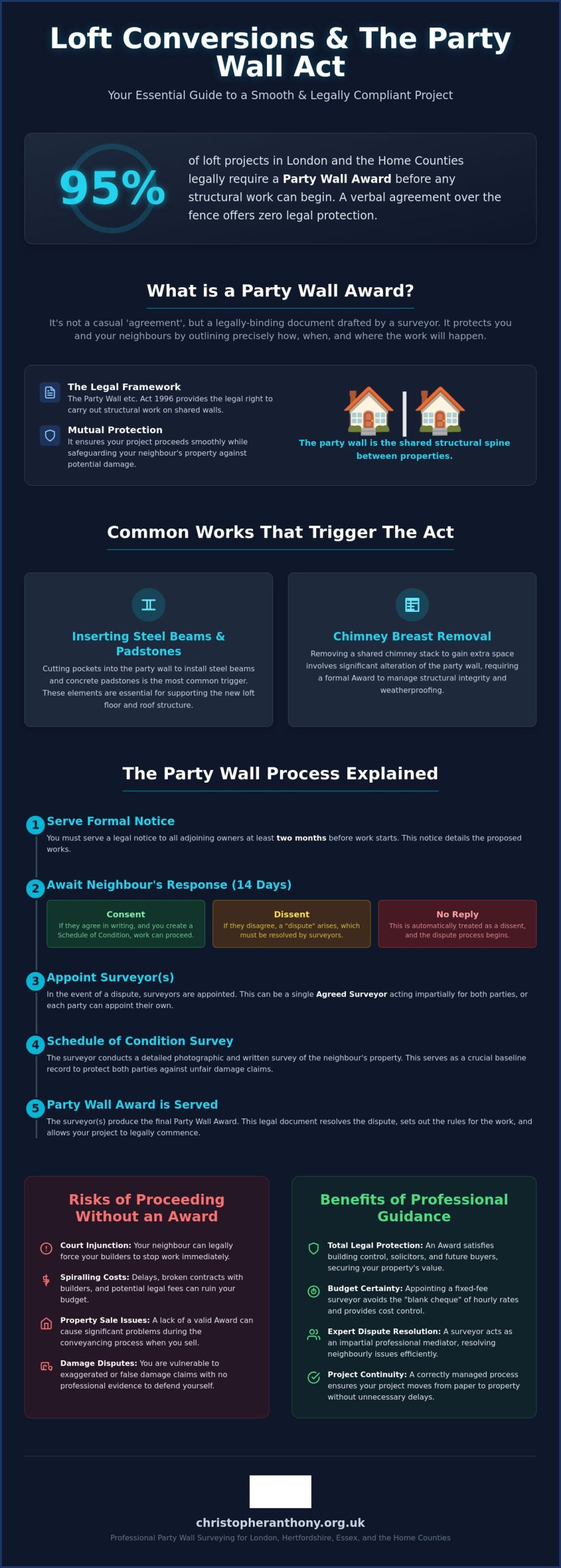
Did you know that approximately 95% of loft projects in London and Hertfordshire legally require a loft conversion party wall agreement before a single steel beam is installed? It's a staggering figure that many homeowners overlook until their builder is actually ready to start. You've likely spent months perfecting your architectural drawings; the last thing you need is a legal injunction or a disgruntled neighbour halting your progress. It's natural to worry about structural liability or the "blank cheque" nature of hourly-rate surveyors.

We believe that professional surveying should be a catalyst for your build, not a bureaucratic hurdle. This guide provides the expert clarity you need to navigate the Party Wall etc. Act 1996 with total confidence. We'll show you how to manage notices, secure a robust Award, and use fixed-fee services to keep your budget under control. You'll gain the legal protection necessary to satisfy building control and future buyers, ensuring your project moves from paper to property without a single day of unnecessary delay.

Key Takeaways

  • Identify the specific structural triggers, such as inserting steel beams into a shared wall, that legally require a loft conversion party wall agreement.
  • Learn why serving a formal notice at least two months in advance is essential for keeping your construction timeline on track and avoiding legal injunctions.
  • Understand the vital role of a Schedule of Condition in protecting you against unfair damage claims from adjoining owners during and after the build.
  • Discover how appointing a fixed-fee surveyor provides budget certainty and acts as a professional mediator to resolve neighbour disputes efficiently.
  • Recognise the three ways a neighbour can respond to your notice and the necessary legal steps to take if they dissent or fail to reply within 14 days.

Why Most Loft Conversions Require a Party Wall Agreement

A loft conversion is rarely a self-contained project. In most UK homes, particularly terraced or semi-detached properties, your roof space is supported by a shared spine. The Party Wall etc. Act 1996 provides the legal framework for these works. It grants you the statutory right to carry out structural changes whilst protecting your neighbour's property from potential damage. While many homeowners search for a loft conversion party wall agreement, the formal legal document you actually need is called a Party Wall Award. This document, prepared by a professional surveyor, outlines exactly how, when, and where the work will happen.

At Christopher Anthony Surveyors, we often see projects stalled because of a simple handshake deal. A verbal agreement over the garden fence offers zero legal protection. If a crack appears in your neighbour's ceiling six months later, you have no baseline evidence to prove whether your builders caused it. A formal Award secures your property value and your peace of mind. It acts as a professional insurance policy for your most valuable asset, ensuring that disputes are resolved by experts rather than through expensive litigation.

Identifying Shared Structures in Your Loft

In a typical residential project, the party wall is the vertical divide between two houses. However, loft works often involve cutting into shared chimney stacks or internal partitions that support the roof. You must notify all Adjoining Owners. This includes freeholders and any leaseholders with an interest longer than a year. If you are in a mid-terrace house, you'll likely need to serve notice to neighbours on both sides. Identifying these stakeholders early prevents eleventh-hour delays that can derail your construction schedule.

The Risks of Proceeding Without an Award

Skipping the legal process is a gamble with high stakes. A neighbour can apply for a court injunction to halt your builders immediately. This leads to spiralling costs and broken construction contracts. Beyond the immediate build, selling your home becomes difficult without a valid Award. Solicitors now routinely check for these documents during the conveyancing process to ensure no outstanding liabilities exist. Without one, you leave yourself wide open to exaggerated damage claims that are impossible to disprove without a professional Schedule of Condition Survey.

Common Loft Works That Trigger the Party Wall Act

Loft conversions are more than just aesthetic upgrades; they are structural interventions. Most projects involve "structural surgery" on the shared spine of the building. Under the full text of the Party Wall etc. Act 1996, specific actions require you to notify your neighbour formally. This legal requirement ensures that any work affecting the shared boundary is documented and agreed upon. At Christopher Anthony Surveyors, we meticulously review architectural drawings to identify hidden triggers. Often, a small detail in a structural calculation can be the difference between a simple project and one that requires a comprehensive loft conversion party wall agreement.

Before any high-impact work begins, a Schedule of Condition Survey is vital. This is a photographic and written record of the neighbour's property. It serves as an essential baseline. If your neighbour claims that your builders caused a crack in their plaster, this document proves whether that damage was pre-existing. It protects you from opportunistic claims and protects the neighbour from genuine damage. The Act also grants your builders a right of access to the neighbour's land if the work cannot be reasonably completed otherwise, though this must be managed with professional care.

Inserting Steel Beams and Padstones

Most loft conversions require heavy steel beams to support the new floor and roof. To install these, your builders must cut into the party wall. They then place padstones, dense concrete blocks that distribute the weight of the steel, into the shared structure. This is a clear trigger for the Act. Your Building Owner Party Wall Surveyor ensures that these beams are positioned correctly and that the structural integrity of the shared wall remains uncompromised during the installation.

Chimney Breast Removal and Weatherproofing

Removing a redundant chimney breast is a common way to gain extra space, but it's technically complex when the stack is shared. You're effectively removing a portion of the shared wall. This process creates significant vibration and dust, which must be managed to avoid disturbing the adjoining property. Additionally, when a new dormer is built, "cutting in" flashings to the party wall for weatherproofing is also a trigger. These details might seem minor, but they are essential for preventing damp and maintaining a good relationship with your neighbour. If you're unsure if your plans trigger the Act, checking our fixed-fee rates is a great place to start.

Timing is everything when planning your build. The law requires you to serve notice at least two months before you intend to start structural work on a shared wall. If you miss this window, your entire construction programme could be delayed. At Christopher Anthony Surveyors, we always recommend a "pre-notice" chat. Knock on your neighbour's door with a copy of your plans and a friendly explanation. This simple gesture often prevents the anxiety that a formal legal document can cause. It sets the stage for a smoother loft conversion party wall agreement process by addressing concerns before they become formal disputes.

Once the notice is served, your neighbour has 14 days to respond. There are three possible outcomes: they consent, they dissent, or they don't respond at least. Under the Act, no response is automatically treated as a dissent. It's important to understand that "dissenting" isn't a declaration of war. In many cases, it's the safest option for an Adjoining Owner. It ensures that a professional surveyor oversees the works and that a formal Award is in place to protect their property interests. This professional oversight provides a safety net for both parties, ensuring the build proceeds under agreed terms. For a detailed breakdown of every statutory deadline you need to track, our guide on the party wall notice deadline and response windows provides a comprehensive roadmap.

Serving a Valid Party Wall Notice

A valid notice is the foundation of your legal protection. It must include the names and addresses of all owners, a clear description of the intended work, and a proposed start date. Many homeowners make the mistake of using generic internet templates. These often lack the project-specific details required by the Act. An invalid notice is a significant risk; it can reset your entire statutory timeline and lead to legal challenges. Our professional step-by-step guide on how to serve a party wall notice ensures that every legal box is ticked from day one. Having Party Wall Notices served by professionals ensures that every legal box is ticked from day one.

What Happens if Your Neighbour Dissents?

If your neighbour dissents or fails to reply within the 14-day window, a "dispute" is deemed to have arisen. This is a technical term rather than an argument. To resolve it, surveyors must be appointed to draft the Party Wall Award. You can both agree to use an Agreed Surveyor, which is often the most efficient route. This single professional acts impartially for both sides, significantly reducing costs and administrative delays. If you're ready to secure your build date, get a fixed-fee quote today to keep your project moving forward.

Loft Conversion Party Wall Agreement: A Professional Buying Guide for 2026

Why Fixed-Fee Professional Guidance Secures Your Project

Uncertainty is the enemy of any successful renovation. When you're managing a £40,000 loft conversion, the last thing you need is a professional fee that grows every time your neighbour picks up the phone. Many firms still operate on hourly rates; this leaves homeowners facing a "blank cheque" scenario that can quickly spiral. By choosing a fixed-fee party wall surveyor, you eliminate cost creep. You get total transparency from the start. This allows you to focus your budget on the build itself rather than administrative surprises.

A professional surveyor also acts as a vital emotional buffer. Tensions often run high when structural work begins near a shared boundary. We step in as impartial experts to handle the technical dialogue. This prevents small misunderstandings from escalating into project-stopping arguments. It's a common mistake to hunt for the lowest possible price. However, the cheapest surveyor often proves most expensive if their lack of experience causes months of delay. Speed and precision are what keep your loft conversion party wall agreement on track and your builders on-site.

The Protective Value of a Schedule of Condition

A Schedule of Condition survey is your best defence against spurious claims. It involves a meticulous photographic and written record of the neighbouring property's state before work begins. If a neighbour points to a crack in their bedroom ceiling mid-build, we refer to this document. It either confirms your liability or proves the defect was pre-existing. It's a fair, transparent way to protect everyone involved. Adjoining owners should always insist on this survey to ensure their home is respected throughout the process.

Choosing Your Surveyor: Building Owner vs Adjoining Owner

The person doing the work (the Building Owner) is responsible for all reasonable costs. This includes the fees for the Adjoining Owner's surveyor. While neighbours have the right to appoint their own professional, we strive for transparency to ensure fees remain proportionate. At Christopher Anthony Surveyors, we manage these relationships with over 20 years of experience. We ensure that both parties feel heard and protected without unnecessary inflation of costs or timelines. Our goal is a smooth start to your construction, backed by legal compliance and mutual respect.

Secure Your Build with Professional Certainty

Securing your home's future starts with legal clarity. You now know that structural work on shared walls is more than just a building task; it's a regulated legal process. Serving your notices early and ensuring a comprehensive Schedule of Condition is in place provides the essential protection you need against delays and disputes. Achieving a valid loft conversion party wall agreement is the final piece of the puzzle for your home's transformation. To ensure the actual construction matches the quality of your legal preparation, you can discover DJH Property Services for specialist residential extensions. It ensures your project is compliant, your neighbours are respected, and your property value is protected for years to come.

With over two decades of expertise specialising in London and Hertfordshire residential projects, we provide the efficiency you deserve. We offer fixed-fee transparency with no hidden costs to keep your budget on track. Our goal is to move you through the legal requirements quickly so your builders can get to work. We act as your protective guide, managing every technical detail so you don't have to.

Need Advice About Your Project?

Contact us today for a fixed-fee party wall quotation or use our 'Christopher Anthony Party Wall Assistant' tool at christopheranthony.org.uk to see how the Act applies to your loft conversion. Your dream space is within reach; let's ensure the legal foundations are just as strong as the structural ones.

Frequently Asked Questions

Do I need a party wall agreement if I am only doing an internal loft conversion?

Yes, you almost certainly do if your project involves structural changes to the shared boundary. Even if all work happens inside your home, actions like inserting steel beams into the shared wall or removing chimney breasts affect the wall's integrity. These interventions trigger the legal requirement for a loft conversion party wall agreement to ensure the shared structure remains safe and stable for both properties.

How long does a party wall agreement for a loft conversion take to complete?

The process typically takes between two and four months from the date you serve the initial notice. This timeline accounts for the statutory two-month notice period required by the Act for works on an existing party wall. If your neighbour dissents or fails to respond within 14 days, the time needed to appoint surveyors and draft the final Award will extend the schedule. It's vital to start this process well before your builders are due on-site. Understanding the precise party wall notice deadline and statutory timelines involved will help you plan your construction programme with confidence.

What happens if my neighbour refuses to sign the party wall notice for my loft?

If your neighbour refuses to sign or ignores the notice, the law treats this as a dissent. It doesn't mean your project is cancelled; it simply moves the process into a formal dispute resolution phase. At this point, surveyors must be appointed to prepare a Party Wall Award. This document sets out the rights and responsibilities of both parties, allowing your project to proceed whilst protecting your neighbour's property interests.

Can I start my loft conversion before the party wall award is signed?

No, you shouldn't start any structural work covered by the Act until the Award is signed and served. Proceeding without the necessary legal paperwork is a significant risk that can lead to a court injunction. This would stop your construction immediately and could result in substantial legal fees and delay costs. Always ensure the Award is finalised to provide a clear legal path for your contractors.

Who pays the surveyor fees for a loft conversion party wall agreement?

The Building Owner, who is the person carrying out the work, is usually responsible for all reasonable costs associated with the agreement. This includes your own surveyor's fees and the reasonable fees of the surveyor appointed by your neighbour. It's a standard legal obligation under the Act. Opting for a fixed-fee service is the most effective way to keep these costs predictable and avoid the "blank cheque" worry of hourly rates.

Is a party wall agreement required for a dormer extension that doesn't touch the neighbour?

It is still likely required because most dormers involve "cutting in" flashings or weatherproofing to the shared party wall. Even if the main body of the dormer appears independent, these minor structural interventions are enough to trigger the Act. If your project relies on the shared wall for weather-tightness or structural support, you must follow the formal notice process for serving a party wall notice correctly to remain legally compliant.

Article by

Tony Neilson MRPSA MFPWS

Party Wall Agreement Guide for London & Hertfordshire

Did you know that approximately 95% of home extension projects in London require a formal party wall agreement? It is a staggering figure that often catches homeowners by surprise. You are likely feeling a sense of anxiety about how the Party Wall etc. Act 1996 will impact your timeline or your relationship with the neighbours. It is perfectly normal to worry about spiralling surveyor fees or the fear that a simple loft conversion might lead to a stressful dispute.

We understand these pressures and believe that procedural compliance should never be a barrier to your home's potential. This guide will help you master the complexities of the process, providing expert guidance on notices and awards to ensure your property rights remain fully protected. We will walk you through the essential steps to achieve legal compliance with fixed-fee transparency. From understanding the role of an agreed surveyor to securing a schedule of condition, you will gain the clarity needed to move your project forward with confidence and precision.

Key Takeaways

  • Understand why a formal party wall agreement, legally known as a Party Wall Award, is a vital protective document for both you and your neighbour.
  • Identify which specific works, such as cutting into a wall for steel beams or excavating near foundations, trigger your legal obligations under the 1996 Act.
  • Learn how to serve a valid Party Wall Notice correctly to prevent project delays and ensure your construction programme remains on track.
  • Discover the benefits of the Agreed Surveyor route as a neutral, efficient, and cost-effective way to resolve potential disputes.
  • Gain practical insights into navigating surveyor fees and procedures with the clarity of fixed-fee transparency and professional guidance.

Understanding the Party Wall Agreement: What It Is and Why It Matters

Many homeowners use the term party wall agreement as a catch-all phrase for the legal paperwork required when building near a neighbour. In reality, this usually refers to a formal Party Wall Award. The distinction is vital. The Party Wall etc. Act 1996 was designed to facilitate construction whilst protecting the interests of all parties involved. It's a balancing act. It gives you the legal right to carry out necessary works, but it also gives your neighbour the right to ensure their property isn't damaged in the process.

When you plan a project, there are two primary paths. If your neighbour provides written consent to your notice, they "assent". This is the simplest route. However, if they do not respond within 14 days or they explicitly disagree, a "dispute" is deemed to have arisen. This doesn't mean you're at war. It simply means you need a formal Award to move forward legally. This document acts as a vital insurance policy for both properties.

What exactly is a Party Wall?

A party wall is more than just the brickwork between two terraced houses. It includes any wall that straddles the boundary line between two properties. It also covers "party structures", which are the horizontal dividers like floors and ceilings in a block of flats. You might also encounter a party fence wall. This is a masonry garden wall that sits on the boundary. It's important to recognise that wooden fences are not covered by the Act. If you're only replacing a fence, these specific rules don't apply.

The difference between a Notice and an Award

Precision matters here. A Party Wall Notice is your starting point. It's the document that informs your neighbour of your intentions. It must include specific details, drawings, and dates. A Party Wall Award is the final legal document drafted by a Building Owner Party Wall Surveyor or an agreed surveyor. This document outlines exactly how the work will be done and usually includes a schedule of condition survey. Relying on a verbal "handshake" is a common pitfall. Without a written party wall agreement or Award, you have zero legal protection if things go wrong later.

Moving from a conceptual understanding to practical action requires a methodical approach. The process isn't just about paperwork. It's about setting the legal framework for your build. First, you must identify if your work triggers the Act. This typically includes excavating within three or six metres of a neighbour's structure, cutting into a shared wall for steel beams, or building a new wall directly on the boundary line. Each of these actions requires formal notification.

Precision at this stage prevents project delays later. A mistake in the initial stages can invalidate the entire process, forcing you to start from scratch. This is why many property professionals prefer a structured approach over DIY attempts.

Serving a valid Party Wall Notice

Accuracy is everything. Many homeowners try to use generic templates found online, but these often lack the specific details required to be legally valid. An invalid notice can halt your project weeks after you thought you'd started. Notice periods vary based on the work type. You must give at least two months' notice for work on an existing structure and one month for new boundary walls or excavations. For absolute certainty, our Party Wall Notice Services ensure your documentation meets every legal requirement from day one. You can find more detail on statutory requirements in the official government explanatory booklet.

The three possible responses from your neighbour

Once served, your neighbour has 14 days to respond. Their choice dictates your next steps:

Don't let a "deemed dispute" cause panic. It's a standard procedural step that ensures the project remains legally compliant. If you're concerned about the potential costs of a dispute, you can review our fixed-fee prices for professional guidance that keeps your project moving without hidden surprises.

Party Wall Agreement Guide for London & Hertfordshire

Practical Advice from Christopher Anthony Surveyors: Common Projects and Pitfalls

London and Hertfordshire properties often share more than just a boundary. They share structural DNA. In these densely populated areas, a party wall agreement is almost inevitable for most home improvements. Loft conversions, for instance, nearly always involve cutting into the shared wall to insert steel beams for floor support. Similarly, rear extensions often trigger the Act due to the "3-metre rule". If your new foundations are deeper than your neighbour's and sit within three metres of their structure, you must serve notice. It's a common trigger that many homeowners overlook until the last minute.

Chimney breast removals are another frequent source of confusion. Whilst the work feels internal, the stack itself is often a shared structure. Removing your side can compromise the structural integrity of the neighbour's side if not handled with professional precision. For high-risk projects like basement excavations, the stakes are significantly higher. These require meticulous planning and specialist Schedule of Condition Surveys to manage the increased risk of soil movement or structural settlement.

The critical role of a Schedule of Condition

A Schedule of Condition is your best defence against project friction. It is a detailed photographic and written record of the neighbouring property's state before any work begins. We ensure every survey is thorough, capturing every existing crack, blemish, or damp patch with absolute clarity. This prevents fraudulent or mistaken damage claims once the project completes. Without this baseline, proving that a crack was pre-existing becomes an expensive and stressful argument. For a broader perspective on your rights and responsibilities, the RICS consumer guide on Party Walls offers excellent professional context.

Avoiding common delays in London and Hertfordshire

Timing is everything in construction. Waiting until your contractor is on-site to address your party wall agreement is a recipe for delays and spiralling costs. We recommend engaging a surveyor as soon as your architectural plans are finalised. Early intervention allows us to manage your neighbour's expectations and facilitate a smooth project flow. It turns a potential conflict into a managed, professional process. If you want to avoid hidden complications and keep your build on track, you can view our transparent pricing to get started with expert guidance today.

Resolving Disputes and Finalising Your Party Wall Award

When a neighbour dissents or fails to respond to your notice, the process moves into the dispute resolution phase. This is where professional expertise becomes essential. Traditionally, you will appoint a Building Owner’s Surveyor, and your neighbour will appoint an Adjoining Owner’s Surveyor. Whilst these professionals are appointed by different parties, their duty is to the Party Wall etc. Act 1996, not to the individuals paying them. They work together to agree on the terms of the Award, ensuring the work is fair and the risks are managed.

A more streamlined alternative is the Agreed Surveyor route. In this scenario, both owners agree to use a single, neutral surveyor to act for both properties. It is a cost-effective solution that reduces administrative delays and fee duplication. For an Agreed Surveyor to be appointed, they must be completely impartial. This route is often the fastest way to secure your party wall agreement and get your project started.

The resulting document, the Party Wall Award, is a legally binding blueprint for your construction. It covers more than just structural details. It dictates permitted working hours to minimise noise, outlines access rights for your contractors, and provides a clear framework for repairing any accidental damage. Under the Act, the Building Owner typically pays all surveying fees for both parties. This ensures the neighbour isn't financially penalised for your construction project. Securing a professional party wall agreement protects your property value and maintains long-term harmony with your neighbours.

Need Advice About Your Project?

Every construction project is unique, and navigating the legal requirements can feel overwhelming. We offer professional, fixed-fee quotations to provide you with total financial transparency from the outset. If you are unsure where to start, you can use our Christopher Anthony Party Wall Assistant tool for rapid, tailored guidance. Don't leave your property rights to chance. Contact Christopher Anthony Surveyors today to discuss your plans with an expert.

About Christopher Anthony Surveyors

Christopher Anthony Surveyors is a specialist practice providing expert party wall services across London, Hertfordshire, Essex, and Kent. Led by Tony (Christopher Anthony), who brings over 20 years of industry experience, our firm is built on a foundation of speed, precision, and reliability. We pride ourselves on being a modern, boutique consultancy that values your time. Whether you are planning a loft conversion or a complex basement excavation, we provide the regulated guidance you need to avoid project delays and protect your investment.

Securing Your Project’s Future with Confidence

You now have the roadmap to handle the 1996 Act with precision. Remember that serving a valid notice is your first line of defence against construction delays. A comprehensive schedule of condition is equally vital. It provides the clear evidence needed to protect your property value and resolve any future claims without fuss. Navigating the path to a party wall agreement is a structured process that, when handled correctly, ensures your build proceeds smoothly whilst maintaining healthy relationships with your neighbours.

At Christopher Anthony Surveyors, we specialise in providing this clarity across London and the Home Counties. With over 20 years of experience and our fixed-fee guarantee, we remove the guesswork from surveyor costs. We act as your protective guide, ensuring every procedural step is handled with speed and professional authority. Your peace of mind and the protection of your property are our absolute priorities.

If you are ready to move forward, we are here to help. Request a Fixed-Fee Party Wall Quotation today and let us take the complexity out of your project. We look forward to helping you build with confidence and total legal security.

Frequently Asked Questions

Who pays for the party wall agreement and the surveyor fees?

The building owner carrying out the construction work is usually responsible for all costs associated with the party wall agreement. This includes their own surveyor's fees and the reasonable fees of the adjoining owner's surveyor. This rule ensures that neighbours aren't financially penalised because of your project. In rare cases, if a neighbour requests unnecessary extra works, a surveyor might apportion some costs to them, but this is the exception rather than the rule.

Can I start my building work before the party wall award is finalised?

You cannot legally commence any works covered by the Act until you have received written consent or a finalised Party Wall Award. Starting early is a breach of statutory duty and could lead to your neighbour seeking a court injunction to halt your project. It's vital to wait for the legal paperwork to be signed and served. This ensures both properties are fully protected before any structural changes begin on-site.

What happens if my neighbour refuses to sign the party wall notice?

If your neighbour refuses to sign or ignores the notice for 14 days, a dispute is "deemed" to have arisen under the law. This doesn't stop your project; it simply moves it into the formal dispute resolution phase. You will then need to appoint a surveyor to draft a formal Award. This document sets out exactly how the work will proceed whilst safeguarding your neighbour's property rights and your right to build.

Do I need a party wall agreement for a loft conversion or rear extension?

Most loft conversions and rear extensions in London and Hertfordshire require a formal party wall agreement. For lofts, you are typically cutting into a shared wall to support new steel beams. For extensions, you are likely excavating foundations within three metres of your neighbour's house. You should always have your architectural plans reviewed by a professional surveyor to confirm your specific legal obligations before work starts.

What is the "3-metre rule" in the Party Wall Act?

The 3-metre rule applies when you are excavating for new foundations within three horizontal metres of a neighbour's structure. If your new foundations will be deeper than theirs, you must serve a formal notice under Section 6 of the Act. This is a common requirement for kitchen extensions and garden rooms. It ensures that your digging doesn't undermine the structural stability of the adjoining property's existing footings.

Can I serve a party wall notice myself using a template?

Whilst you can technically serve a notice yourself using a template, it's often a risky strategy. Generic templates frequently lack the precise technical details or the specific drawings required to be legally valid. If a notice is found to be invalid weeks into the process, it can void your entire progress and cause significant project delays. Professional serving ensures total accuracy and legal compliance from the very outset.

Article by

Tony Neilson MRPSA MFPWS

Who Pays for a Party Wall Survey in London & Essex?

Who Pays for a Party Wall Survey? The Simple Answer

When you undertake building work that falls under the Party Wall etc. Act 1996, one of the most common questions we hear is: "Who is responsible for the surveyor's fees?" The answer is straightforward and can be found in the legislation itself.

In almost all circumstances, the ‘Building Owner’ – the person or party carrying out the construction work – pays for all professional fees associated with the Party Wall process.

This isn't just a convention; it's a legal principle. The Act is designed to protect the ‘Adjoining Owner’ (your neighbour) from financial loss or inconvenience caused by work they did not initiate. Because your project is for your benefit, the responsibility falls on you to ensure your neighbour is properly protected by independent, professional advice at no cost to them. This includes covering the fees for your own surveyor and, if they choose to appoint one, your neighbour’s surveyor too.

This principle is enshrined in Section 11 of the Act, which states that the Building Owner shall pay all reasonable costs of the process. This ensures fairness and prevents a situation where a neighbour might feel pressured to consent to potentially risky works simply to avoid a hefty professional bill.

What Do These Surveyor Fees Actually Cover?

It's a common misconception that a Party Wall Surveyor just "signs off" on a document. In reality, the fees cover a detailed and legally robust process designed to safeguard both properties. As the Building Owner, the fees you pay cover several critical stages:

What Are "Reasonable" Surveyor Fees? (And What to Expect to Pay)

The Act specifies that the Building Owner is liable for all reasonable costs. This is a crucial word. It means an Adjoining Owner's surveyor cannot simply present an open-ended bill. The fees must be proportionate to the complexity of the work and the time reasonably required to fulfil their statutory duties.

How "Reasonableness" is Determined in Practice

As surveyors, we determine if a colleague's proposed fee is reasonable by assessing several factors:

If your surveyor believes the Adjoining Owner's surveyor's fee is excessive, they have a duty to challenge it on your behalf. If they cannot reach an agreement, the matter is referred to a neutral 'Third Surveyor' who will adjudicate and determine a reasonable fee.

Typical Party Wall Surveyor Fee Ranges

Costs can vary significantly based on the project and location, but to give you a practical idea, here are some typical fee ranges we see. Please note these are estimates for professional services and exclude VAT.

Who Pays for a Party Wall Survey in London & Essex?

Who Pays? Real-Life Project Scenarios

To make this clearer, let's look at three common residential projects and break down who pays for what.

Scenario 1: A Loft Conversion

Scenario 2: A Rear Extension

Scenario 3: A Basement Excavation

Are There Exceptions? When the Adjoining Owner Might Pay

While the Building Owner pays in over 99% of cases, there are a few rare exceptions where an Adjoining Owner may be asked to contribute to the costs.

  1. Requesting Additional Work: If, during your project, your neighbour asks for extra work to be done for their sole benefit (e.g., "While you're repointing the wall on your side, could you do mine too?"), they would be expected to pay for that additional work. This would be formally documented in the Party Wall Award.
  2. Correcting Existing Defects: If the party wall itself is in a poor state of repair due to the Adjoining Owner's neglect (e.g., a leaking gutter on their side has caused damp), and this needs to be fixed before your work can proceed, they may be required to contribute to the cost of those specific repairs.
  3. Unnecessary Surveyor Involvement: If an Adjoining Owner appoints a surveyor vexatiously or for works that clearly do not fall under the Act, a Building Owner could argue they are not liable for those fees. This is a complex and unusual situation that often requires the intervention of a Third Surveyor to resolve.

In our experience, these situations are uncommon. The default position is always that the person doing the building work pays the price.

Practical Advice from Christopher Anthony Surveyors

Navigating the Party Wall Act can feel daunting, but a few proactive steps can make the process smoother and more cost-effective. Here is our advice based on over 20 years of experience in London and the Home Counties.

How to Minimise Your Party Wall Expenses

Frequently Asked Questions

Do I have to pay for my neighbour’s party wall surveyor?
Yes. As the Building Owner undertaking the work, the Party Wall etc. Act 1996 makes you responsible for all reasonable professional fees incurred by your neighbour to protect their property. This includes their surveyor's fees.
Can my neighbour choose any surveyor they want?
Yes, they can appoint any party wall surveyor they wish, provided that person is not themselves. They are not obliged to accept your suggestion of an Agreed Surveyor. They might choose a surveyor they know, one who is local, or one recommended to them.
What happens if I cannot afford the party wall surveyor fees?
The party wall process is a legal requirement. The surveyor fees are a necessary cost of your building project. If you cannot afford them, you cannot legally proceed with the works covered by the Act. It's essential to budget for these professional fees alongside your construction costs.
Can I act as my own party wall surveyor to save money?
No. The Act explicitly states that an individual cannot act as their own surveyor. You must appoint an impartial professional to represent your interests.
How much does a party wall surveyor cost?
Costs vary by location and project complexity. A simple project with an Agreed Surveyor might cost around £800-£1,200, while a complex basement project with multiple surveyors could exceed £7,000. We offer fixed-fee quotations for transparency.
What is the difference between an Agreed Surveyor and a Two-Surveyor appointment?
An Agreed Surveyor is a single, impartial professional who acts for both the Building Owner and the Adjoining Owner. A two-surveyor appointment (or 'dual appointment') is where each party appoints their own surveyor to represent their interests. The Agreed Surveyor route is typically faster and more cost-effective.

Need Advice About Your Project? Send Us Your Plans for a Free Review

Understanding whether the Act applies to your project and budgeting for the costs can be complex. To help you get clarity, we offer a free, no-obligation review of your plans.

Send your architectural and structural drawings to us, and one of our experienced surveyors will personally review them. We will confirm:

This initial advice is completely free and will give you the certainty you need to move forward with your project. Request your free plans review and fixed-fee quotation today.

About Christopher Anthony Surveyors

Christopher Anthony Surveyors is a specialist party wall surveying practice providing clear, professional advice to homeowners, developers, and architects across London, Hertfordshire, Essex, and the surrounding Home Counties. With over 20 years of experience, we focus on making the party wall process straightforward and efficient. We pride ourselves on offering fixed-fee quotations for transparency and a proactive approach that helps get building projects started without unnecessary delays.

Article by

Tony Neilson MRPSA MFPWS

Expert Party Wall Surveyor in Hackney | Protect Your Home

You have spent months planning your Hackney kitchen extension, but a single "dissenting" notice from a neighbour could halt your progress before the first brick is laid. In the tightly packed streets of Stoke Newington and Dalston, where Victorian terraces share more than just a postcode, structural concerns are a valid reality. Engaging a specialist party wall surveyor Hackney residents trust is the most effective way to protect your property and your peace of mind.

We understand that the legalities of the Party Wall etc. Act 1996 can feel like a minefield of deadlines and jargon. It's completely normal to worry about accidental damage to a period building or the strain a dispute might put on your relationship with your neighbours. This article will provide a clear roadmap through the process, offering professional, fixed-fee guidance tailored to the unique challenges of London developments. You will learn how to serve notices correctly, the benefits of a Schedule of Condition, and how to resolve disputes with efficiency and transparency.

Key Takeaways

  • Learn why the Party Wall etc. Act 1996 is essential for protecting Hackney’s period properties during structural renovations.
  • Understand the specific requirements for loft conversions and rear extensions, including the critical three-metre excavation rule.
  • See how an expert party wall surveyor Hackney homeowners trust ensures legal notices are served correctly to avoid costly project restarts.
  • Gain practical strategies for managing neighbour relations, including why informal conversations should always precede formal legal paperwork.

The Party Wall etc. Act 1996 is a mandatory legal framework. It governs how you carry out building works that affect shared structures or boundaries. In Hackney, where Victorian and Edwardian terraces dominate the landscape, this legislation is vital. These properties are often over a century old. They share delicate structural footprints. A specialist party wall surveyor Hackney residents can rely on understands that a simple loft conversion in a Dalston terrace isn't the same as a modern build. It requires a nuanced approach to ensure the structural integrity of both homes remains intact.

Our role isn't to take sides. A surveyor acts as an impartial expert, ensuring the Act is followed to the letter. We protect the rights of both the person building and the neighbour living next door. Transparency is at the heart of our service. We offer fixed-fee guidance to ensure Hackney homeowners aren't met with unexpected costs mid-project. Efficiency matters when construction timelines are tight. We focus on moving the process forward without unnecessary delays.

When Does the Act Apply to Your Hackney Property?

The Act is triggered by specific types of construction. You'll likely need a Building Owner Party Wall Surveyor if your project involves:

The Risks of Proceeding Without an Agreement

Starting work without a formal agreement is a gamble. If a neighbour objects, they can seek a legal injunction. This halts construction immediately. The costs of a stopped site can escalate into thousands of pounds per week. Beyond the build, a lack of compliance creates a "paperwork gap" when you come to sell. Future buyers’ solicitors will look for the Party Wall Award. Without it, your sale could fall through. You also face unprotected liability. Without a Schedule of Condition Survey, it's your word against theirs if a crack appears in their hallway. Professional oversight prevents these disputes before they start.

Common Building Projects in Hackney Covered by the Act

Hackney's architectural heritage, primarily its dense Victorian terraces, means almost any significant home improvement project will trigger the need for a party wall surveyor Hackney property owners can trust. Whether you're in Stoke Newington or London Fields, your renovation likely shares more than just a postcode with your neighbours. You can find the specific legal requirements in the official text of the Party Wall Act, but applying these rules to a 140-year-old wall requires practical experience rather than just a theoretical understanding.

Every project is unique. A chimney breast removal in a Hackney Central flat presents different risks compared to a basement excavation in De Beauvoir. We focus on identifying these risks early to prevent disputes. If you're planning any of the following, the Act is almost certainly relevant to your build.

Loft Conversions and Shared Structures

Loft conversions are the most frequent project we handle in the borough. They almost always involve inserting heavy steel beams into the shared party wall to support new floor joists. You might also need to raise the height of the party wall to accommodate a dormer extension. These tasks are not just simple building works; they are structural alterations that require a Building Owner Party Wall Surveyor to ensure the period brickwork isn't compromised or overloaded.

Extensions and Excavation Challenges

Rear and side-return extensions are popular for creating open-plan living spaces. However, the '3-Metre Rule' is a common stumbling block for homeowners. If your new foundations are deeper than your neighbour’s and within three metres of their property, the Act applies. In Hackney's narrow plots, this is almost a certainty. Chimney breast removals also fall under the Act's remit as they often provide structural stability to the shared wall. For more complex projects, like basement excavations, the '6-Metre Rule' comes into play, requiring even more rigorous oversight and deeper foundation analysis.

Before the first spade hits the ground, it's vital to protect yourself. A Schedule of Condition Survey provides a detailed photographic record of the neighbouring property's state. This prevents unfair claims for pre-existing cracks. If you're unsure if your project qualifies, checking our fixed-fee options can provide the clarity you need to proceed with confidence.

Expert Party Wall Surveyor in Hackney | Protect Your Home

The Party Wall Process: From Initial Notice to Final Award

The process begins with a formal notice. If you're the one building, you must inform your neighbours of your intentions well in advance. Engaging an expert party wall surveyor Hackney clients trust ensures these notices are valid from the outset. An invalid notice is a common cause of project delays. The procedure follows RICS professional standards for party wall surveyors, which dictate how we manage everything from initial contact to the final legal document.

Once the notice is served, your neighbour has three options. They can consent, which allows work to proceed immediately. They can dissent, which triggers the need for a surveyor to resolve the dispute. Finally, if they don't respond within 14 days, the law deems this a "dissent." In cases of dissent, a Schedule of Condition Survey becomes essential. This photographic and written record captures the property's state before work starts. It acts as a protective shield for both parties, ensuring no one is blamed for damage they didn't cause.

Responding to a Party Wall Notice

If you've received a notice from your neighbour, don't panic. You have the right to appoint an Adjoining Owner Party Wall Surveyor to protect your interests. In almost all cases, the Building Owner is responsible for paying all professional fees. This means you get expert protection at no cost to yourself. To keep things moving quickly, both parties can appoint an Agreed Party Wall Surveyor. This single, impartial expert acts for both sides, significantly reducing costs and administrative friction.

Timelines and Deadlines to Remember

Timing is everything in London construction. Navigating these timelines is critical, as obtaining a full agreement typically takes a minimum of 2 to 4 months. Starting early is the only way to avoid construction delays.

The final outcome is the Party Wall Award. This legal document authorises the works whilst setting out exactly how and when they will be carried out. If you need help drafting or responding to a notice, view our fixed-fee options to get your project moving with professional support.

Practical Advice from Christopher Anthony Surveyors for Hackney Residents

Success in any renovation project depends on more than just good builders. While companies like Horns Construction provide high-quality building services across London, a successful project also requires a proactive approach to legal obligations. As an experienced party wall surveyor Hackney residents trust, we've seen how early preparation transforms a potentially stressful process into a smooth one. Period properties in E5, E8, and N16 have unique structural quirks. Navigating these requires a combination of technical expertise and clear communication.

Managing Neighbourly Relations

A professional, friendly approach prevents disputes from escalating into expensive legal battles. Transparency about your build schedule helps maintain neighbourly harmony during the noisy phases of construction. We recommend a Schedule of Condition for every project. It provides peace of mind for both parties by documenting the existing state of the adjoining property. This transparency removes the fear of the unknown, which is often the root cause of neighbourly anxiety.

Once the dust has settled and you are ready to celebrate your new space with those same neighbours, you can learn more about Chris Dodd Magic to find the perfect entertainment for your housewarming event.

Why Choose Christopher Anthony Surveyors?

We bring over 20 years of experience to every instruction across London and the Home Counties. Our team is intimately familiar with Hackney's specific terraced housing stock and the structural challenges they present. We don't believe in hidden costs or spiralling hourly rates. Our fixed-fee approach ensures you know exactly what you're paying for from the start. We offer a modern, efficient service designed to keep your project moving forward without unnecessary delay. Your peace of mind is our priority.

Secure Your Hackney Renovation Today

Building in the heart of East London requires a precise understanding of shared structures and strict legal timelines. We've seen how a valid notice protects your project from costly injunctions and how a detailed Schedule of Condition guards against unfair damage claims. Whether you're planning a Stoke Newington loft conversion or a side-return extension in Dalston, professional oversight is the key to maintaining neighbourly goodwill. Finding a specialist party wall surveyor Hackney residents can depend on ensures your home remains protected throughout the construction phase.

Christopher Anthony Surveyors brings over 20 years of professional experience to your doorstep. We combine deep knowledge of Hackney's Victorian housing stock with a commitment to fixed-fee transparency. You won't face hidden costs or unexpected delays with our modern, efficient approach. It's time to move your project from the planning stage to reality with absolute confidence in your legal standing.

Ready to take the next step? Request a Fixed-Fee Quotation for Your Hackney Project today. Let's get your build started on the right track.

Frequently Asked Questions

Who pays for the party wall surveyor in Hackney?

The person carrying out the works, known as the Building Owner, usually pays the fees for all surveyors involved. This includes the fees for an Adjoining Owner Party Wall Surveyor if your neighbour decides to appoint their own professional. There are rare exceptions where a neighbour might contribute if the work is for their benefit too, but the vast majority of Hackney projects follow this standard cost structure.

Can I start my building work without a party wall agreement in place?

You shouldn't start any notifiable work until the notice period has expired or a formal agreement is reached. Proceeding without an Award is a breach of statutory duty. Your neighbour could seek a court injunction to halt your project immediately. This often leads to significant site delays and increased costs. It's much safer to ensure your party wall surveyor Hackney has finalised the paperwork before the contractors arrive.

What happens if my Hackney neighbour refuses to sign the party wall notice?

If a neighbour refuses to sign or simply ignores the notice for 14 days, a dispute is "deemed" to have arisen. This doesn't mean your project is cancelled. Instead, it triggers the requirement for surveyors to be appointed to resolve the matter through a Party Wall Award. You can still move forward, but you'll need professional intervention to document the protections required for the shared structure.

How much does a party wall surveyor cost for a Hackney loft conversion?

Costs depend entirely on the complexity of your project and whether your neighbour consents or dissents. For a standard loft conversion in a Victorian terrace, fees usually cover the serving of notices, the Schedule of Condition, and the final Award. We recommend looking for fixed-fee options to keep your budget predictable. Every project is unique, so it's best to request a tailored quote based on your specific architectural drawings.

Is a party wall award the same as planning permission?

No, these are two completely separate legal requirements. Planning permission is granted by Hackney Council and deals with the usage and appearance of a building. A Party Wall Award is a statutory requirement under the Party Wall etc. Act 1996 and deals with the structural relationship between shared properties. You might have planning permission but still be legally blocked from building if you haven't followed the Party Wall process correctly.

Can one surveyor act for both me and my neighbour in Hackney?

Yes, you can appoint an Agreed Party Wall Surveyor to act impartially for both parties. This is a very common choice for straightforward residential projects like extensions or loft conversions. It's often the most efficient route as it halves the professional fees and streamlines communication. The surveyor remains neutral and ensures the interests of both the Building Owner and the Adjoining Owner are protected.

Article by

Tony Neilson MRPSA MFPWS

Party Wall Surveys in London, Hertfordshire & Essex

Did you know that approximately 95% of home extension projects in London require a formal party wall agreement? It is a staggering figure that highlights just how likely you are to encounter the Party Wall etc. Act 1996 during your build. We understand the anxiety this causes. You have likely spent months planning your loft conversion or rear extension, and the fear of a legal dispute or a project delay can be overwhelming.

At Christopher Anthony Surveyors, we believe a party wall survey shouldn't be a hurdle; it should be a tool for peace of mind. Our expert team provides the clarity you need to navigate notices and awards without the stress of hidden costs or confusing jargon. We are here to protect your property and ensure your relationship with the person next door remains intact. In this article, we'll explain your legal obligations, the importance of a Schedule of Condition, and how to keep your construction moving forward with confidence.

Key Takeaways

  • Understand when your project triggers the Party Wall etc. Act 1996 and why a professional party wall survey is a legal necessity for most London extensions.
  • Learn the critical deadlines for serving notices and the three specific ways your neighbour can respond to your proposed works.
  • Discover how a Schedule of Condition acts as your ultimate safeguard against spurious damage claims from adjoining owners.
  • Find out why an informal conversation with your neighbour before serving notice is the most effective way to prevent project delays.
  • Gain expert insight into technical requirements for specialist projects, such as managing steel insertions during loft conversions.

What is a Party Wall Survey and When is it Legally Required?

A party wall survey is a formal legal procedure designed to manage construction work that affects shared boundaries or nearby structures. It's governed by the Party Wall etc. Act 1996. This legislation provides a clear framework to prevent and resolve disputes between neighbours. If you're planning work that touches a shared wall, you can't rely on a "handshake deal" over the garden fence. Whilst a friendly chat is a great starting point, verbal agreements offer zero legal protection if cracks appear or structural issues arise later. Without a formal agreement, you leave yourself vulnerable to injunctions or expensive compensation claims.

The Act applies to three specific types of structures. A party wall sits on the land of two or more owners and forms part of a building. A party structure is a broader term that includes horizontal partitions, such as the floors or ceilings between flats. Finally, a party fence wall is a masonry wall that sits astride the boundary line but isn't part of a building, like a shared garden wall. Understanding these distinctions is vital for determining your responsibilities before the first brick is laid.

Common Projects that Require a Party Wall Survey

Most residential renovations in London and the Home Counties trigger the need for professional oversight. Loft conversions are a prime example. These almost always involve cutting into the shared wall to insert heavy steel beams. Rear or side extensions are equally common. If you're digging foundations within three or six metres of a neighbour's property, you'll likely need a party wall survey to ensure those foundations don't compromise their soil stability. To ensure your project starts on a solid footing, you may wish to explore Groundworks experts who specialise in site preparation. Internal changes matter, too. Removing a chimney breast that's attached to a party wall is a notifiable task that requires a specialist to assess the impact on the shared structure.

The Three Pillars of the Party Wall etc. Act 1996

The legislation is divided into three core sections that dictate when you must serve notice to your neighbour:

The Party Wall Process: A Step-by-Step Guide to Compliance

Compliance begins with clarity. Once you've identified that your project falls under the Act, the first formal step is serving a Party Wall Notice. This isn't a request for permission; it's a legal obligation to inform your neighbours of your intentions. Getting this right is vital. If a notice is technically flawed, it can be declared invalid, potentially halting your project just as the builders arrive. To help you plan your timeline, the following table outlines the statutory notice periods required for different types of work.

Type of Work Relevant Section of the Act Notice Period Required
Work on an existing shared wall or structure Section 2 Two Months
Building a new wall on the boundary line Section 1 One Month
Excavating within 3m or 6m of a neighbour Section 6 One Month

Serving Notice: Getting the Paperwork Right

Timing is everything. Your neighbour has exactly 14 days to respond to your notice. They can consent, which allows work to proceed without further formality, or they can dissent. If they ignore the notice entirely, the law treats this as a "deemed dispute" after the 14-day window closes. In these instances, a formal party wall survey becomes a mandatory requirement to move the project forward. If you're unsure about the correct forms, we can help you prepare and serve valid notices to keep your project on track.

Appointing a Surveyor: Your Options

When a dispute arises, surveyors must be appointed to resolve it through a Party Wall Award. You can appoint your own Building Owner’s Surveyor, whilst your neighbour selects an Adjoining Owner’s Surveyor. Alternatively, both parties can appoint an Agreed Party Wall Surveyor. This single professional acts for both sides, which is often the most efficient route for residential projects in London and Essex.

It's vital to remember that surveyors follow RICS professional guidance, which mandates absolute impartiality. Even though the building owner typically pays the fees, the surveyor's duty is to the Act itself, not to the person signing the cheque. Their role is to ensure the work is carried out safely and that the interests of both properties are balanced fairly. This statutory duty provides a level of security that protects everyone involved from unreasonable demands or negligence.

Party Wall Surveys in London, Hertfordshire & Essex

Protecting Your Property: The Role of the Schedule of Condition

A Schedule of Condition Survey is arguably the most vital part of the entire party wall survey process. It serves as a factual, unbiased "snapshot" of the neighbouring property before any construction begins. By creating a detailed photographic and written record, both parties gain a clear, objective baseline. This prevents "spurious" damage claims where a neighbour might mistakenly attribute a pre-existing crack to your new loft conversion or extension. If you want to ensure your project starts on a footing of trust, you can request a professional Schedule of Condition to protect your interests.

The process is straightforward but meticulous. A surveyor visits the Adjoining Owner's property to document the current state of walls, ceilings, and floors. At the end of the project, we use this document to verify if any genuine damage has occurred. If the property is unchanged, the building owner is shielded from unfair liability. If cracks have appeared, the record provides the evidence needed to put things right quickly. It's a simple step that saves thousands in potential legal fees.

Why Adjoining Owners Should Insist on a Schedule

If you're the neighbour, this survey is your primary safeguard. It ensures that any pre-existing defects are documented so you aren't unfairly blamed for them later. Having an expert eye assess your property provides immense peace of mind. You'll know that the structural integrity of your home is being monitored by a professional. Should the works next door cause genuine issues, this document streamlines the resolution, making it much easier to agree on repairs without a drawn-out dispute.

The Party Wall Award: Your Legal Shield

The final step in the process is the Party Wall Award. This is a legally binding document that acts as the rulebook for your project. It includes essential details like permitted working hours, rights of access for builders, and specific insurance requirements to cover any mishaps. Once the Award is served, it grants the legal right to proceed with the project. We believe in total transparency, which is why we offer clear, fixed-fee options for these awards to help you budget with confidence.

Practical Advice from Christopher Anthony Surveyors

Success in any residential project starts with communication. Before you drop a formal legal document through your neighbour's letterbox, have an informal chat. It's the most effective way to avoid a dissent. People are far less likely to panic when they understand the scope of the work over a cup of tea. Timing is also critical. You should start the party wall survey process at least three months before your builder is scheduled to arrive. This allows sufficient time for surveyors to be appointed, the Schedule of Condition to be recorded, and the Award to be served without delaying your start date.

Technical details matter, especially in densely populated areas like London and Essex. For loft conversions, ensure your surveyor checks for existing chimney flues within the party wall. If steel beams are inserted too deeply or into an active flue, it can cause significant safety issues or noise transfer. When modifying shared roof structures, coordinating with professionals like Roofing in Hackney can prevent technical oversights that lead to disputes. In Victorian terraces, foundations are often surprisingly shallow. We recommend digging trial pits early to confirm exactly how your new footings will interact with the neighbour's property. Real-world experience beats a generic template every time; we've seen projects halted because these simple site-specific checks were missed during the planning stage.

Expert Tips for Building Owners

Don't wait for planning permission to be granted before considering your neighbours. You can serve notice as soon as your architectural drawings are finalised. This gives you a head start on the statutory notice periods and helps you identify potential objections early. Remember to budget for professional fees as part of your overall build cost. In the vast majority of cases, the building owner is responsible for paying the fees of both surveyors. If you need help managing these requirements, our Building Owner Party Wall Surveyor service provides the end-to-end support needed to keep your project moving.

Expert Tips for Adjoining Owners

Understand your rights under the Act. You are usually entitled to appoint your own independent surveyor, and the neighbour doing the work will cover the reasonable costs. This ensures your property is professionally protected by someone looking out for your specific interests. Most importantly, don't make the mistake of ignoring a notice. Doing so won't stop the builders; it simply triggers a "deemed dispute" where a surveyor is appointed on your behalf, removing your ability to choose your own representative. If you've received a notice, speak to an Adjoining Owner Party Wall Surveyor to ensure your home is fully protected against potential damage.

Secure Your Project with Professional Expertise

Your property is likely your most valuable asset. Protecting it requires more than just a good builder; it requires legal certainty and professional oversight. By following the correct procedures under the Act, you ensure that your loft conversion or extension proceeds without the shadow of a legal dispute. A thorough party wall survey isn't just about ticking boxes. It's about building a foundation of trust with your neighbours and creating a clear record that safeguards your home.

With over 20 years of experience across London and Hertfordshire, we specialise in navigating these complexities so you don't have to. We provide fixed-fee transparency and the technical expertise needed for even the most challenging residential projects. Don't leave your project to chance or rely on generic templates that might fail you. We're here to ensure your build is compliant and your property is protected.

Request a fixed-fee party wall quotation from Christopher Anthony Surveyors today

Your peace of mind is our priority, and we're ready to guide you through every stage of the process. Let's get your project moving forward with confidence.

Frequently Asked Questions

Do I need a party wall survey for a simple garden room or fence?

Garden rooms often require a party wall survey if the foundations are within three metres of a neighbour’s building and dug deeper than their footings. Whilst a simple timber fence doesn't usually trigger the Act, a "party fence wall" built of masonry does. If you’re planning a garden structure, it’s vital to check the proximity and depth of your excavations to avoid accidental non-compliance.

Can I be my own party wall surveyor to save on costs?

No, you cannot act as your own surveyor. The Party Wall etc. Act 1996 is clear that a person who is a party to the matter cannot also be the surveyor. This ensures the process remains impartial and fair. You must appoint an independent professional to manage the proceedings, even if you have the technical skills yourself. This protects the integrity of the legal process.

What happens if my neighbour refuses to sign the party wall notice?

If your neighbour refuses to sign or simply ignores the notice, the law treats this as a "dissent." A dispute is then deemed to have arisen. This doesn't mean your project is cancelled; it just means you must appoint a surveyor to resolve the matter formally. You can either use an Agreed Surveyor or each side can appoint their own professional to draft the Award.

How much does a party wall surveyor typically cost in London?

Costs in London and the Home Counties depend on the complexity of your project and whether your neighbour consents or dissents. Typically, the Building Owner pays all reasonable fees for both their own surveyor and the neighbour's surveyor. Using an Agreed Surveyor is usually the most cost-effective route, as it simplifies the process and reduces the number of professional fees you need to cover.

How long does the entire party wall process take from start to finish?

You should allow between one and three months for the process to conclude. The statutory notice period is either one or two months depending on the work type. If your neighbour dissents, the time taken to conduct a party wall survey and finalise the Award depends on how quickly the Schedule of Condition can be arranged and documents signed by all parties.

Can I start my building work before the Party Wall Award is finalised?

No, you must wait until the Award is formally served before starting any notifiable work. Beginning construction early is a serious risk that can lead to your neighbour seeking a court injunction to stop your project. This results in significant costs and legal delays. Always wait for the legal paperwork to be finalised to ensure your project stays on the right side of the law.

Article by

Tony Neilson MRPSA MFPWS