Fixed Fee Party Wall Surveyor: A Guide to Transparent Costs and Expertise in 2026
In London, approximately 95% of extension projects require a formal party wall agreement. It's a staggering figure that often leaves homeowners feeling cornered by legal complexity. You're likely worried about open-ended hourly rates and "hidden" fees that could spiral your renovation budget out of control before the first brick is even laid. It's a common anxiety. The fear of a neighbour dispute stalling your build or a misunderstanding of the 1996 Act causing a legal headache is enough to keep any property owner awake at night.
We understand the pressure of a strict construction timeline. This guide explains how appointing a fixed fee party wall surveyor provides the absolute budget certainty you need to move forward. You'll learn how to secure a legally binding Party Wall Award whilst ensuring your project remains compliant and your neighbourly relations stay intact. We will break down the 2026 landscape of transparent costs, the efficiency of the "Agreed Surveyor" model, and the practical steps Christopher Anthony Surveyors takes to keep your project moving. No jargon. No surprises. Just expert protection for your home and your investment.
Key Takeaways
- Learn why appointing a fixed fee party wall surveyor is the most effective way to eliminate financial uncertainty and protect your construction budget from spiralling hourly rates.
- Understand the essential components of a comprehensive service, from the formal service of statutory notices to the vital role of a detailed Schedule of Condition.
- Discover how to evaluate professional quotations by verifying RICS or Faculty of Party Wall Surveyors credentials to ensure your project remains legally compliant.
- Gain practical, project-specific advice for managing loft conversions and extensions whilst maintaining positive, long-term relations with your neighbours.
- Explore how a transparent, pre-agreed fee structure aligns your surveyor’s expertise with your construction timeline to prevent costly and unnecessary delays.
The Advantages of Appointing a Fixed Fee Party Wall Surveyor
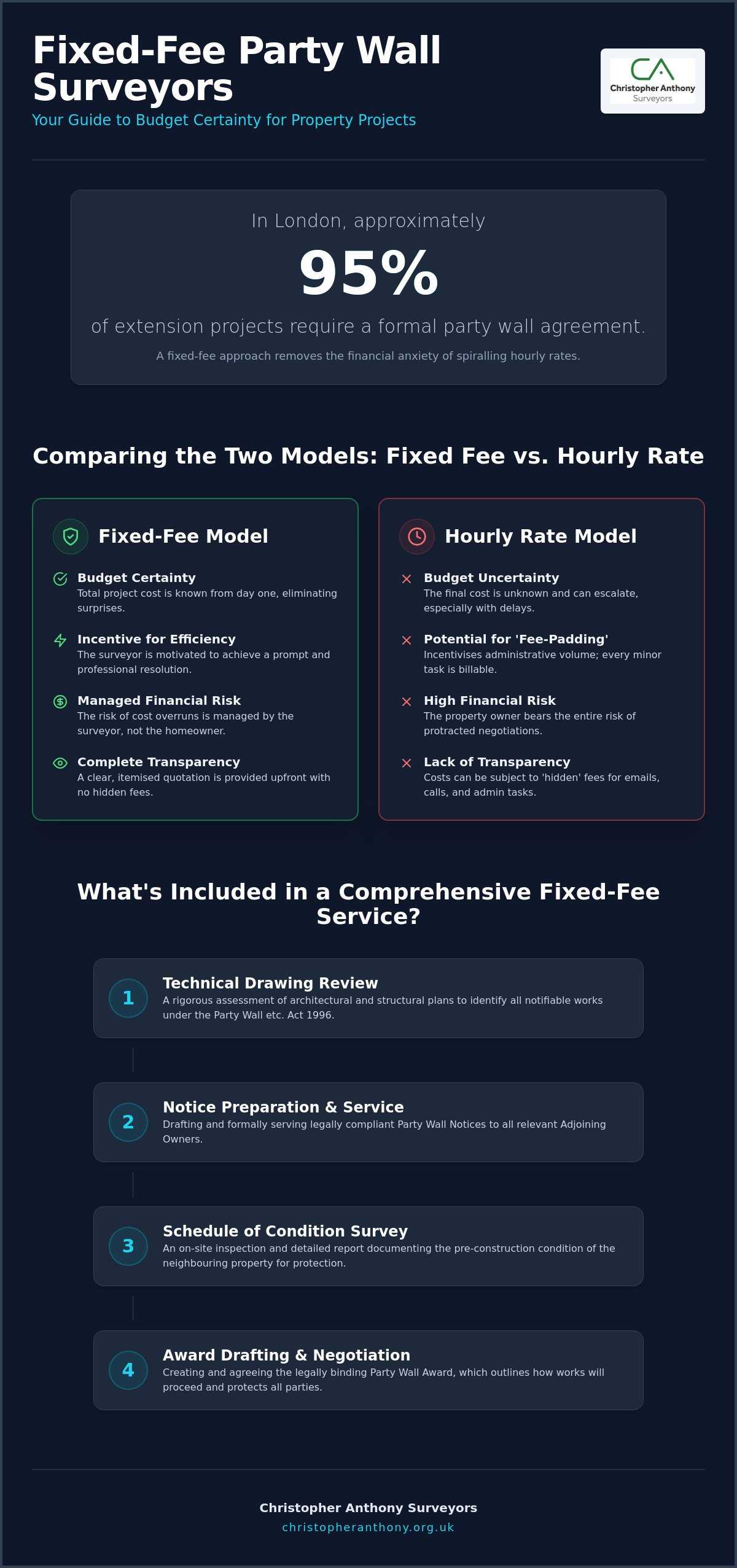
Choosing a fixed fee party wall surveyor is a strategic move for any property owner. Under the Party Wall etc. Act 1996, the statutory duties of a surveyor are clearly defined. A fixed fee applies a pre-agreed total cost to these duties, replacing the traditional "billable hour." This model doesn't just offer transparency; it aligns the surveyor's efficiency with your construction timeline. When the fee is capped, the focus remains on resolving matters with precision rather than generating administrative volume. It's a modern approach that respects both your budget and your project's momentum.
| Service Feature | Fixed Fee Model | Hourly Rate Model |
|---|---|---|
| Budget Certainty | Total cost is known from day one. | Final cost is unknown and variable. |
| Incentive Structure | Efficiency and prompt resolution. | Potential for administrative bloat. |
| Financial Risk | Managed by the surveyor. | Held entirely by the property owner. |
| Transparency | Clear, upfront quotation. | Subject to "hidden" time-based fees. |
Financial predictability is the foundation of a successful build. By removing the anxiety of open-ended invoices, you can manage your development with confidence. There are three primary reasons why this structure benefits residential projects:
- You gain total cost clarity before the first notice is even drafted.
- The risk of "fee-padding" for minor administrative tasks is eliminated.
- Surveyors are incentivised to reach a fair, professional resolution without delay.
Why Hourly Rates Can Jeopardise Your Build Budget
Residential renovations in London and the Home Counties often operate on tight margins. Hourly rates introduce a variable that can spiral if negotiations with neighbours become protracted. If a surveyor bills for every minor email or phone call, your contingency fund can vanish before work begins. A fixed-fee approach ensures that your surveyor is a proactive problem-solver, not a distant administrator. It keeps the focus on the technical specifics of your build rather than the clock.
Fixed Fees for the Adjoining Owner
In most cases, the Building Owner is responsible for the Adjoining Owner's reasonable surveyor fees. This is often a source of significant stress for developers. Agreeing on a fixed fee caps this liability from the outset. It ensures your neighbour receives a professional Schedule of Condition Survey and full legal protection without you facing an open-ended bill. It turns a potentially contentious requirement into a transparent, manageable professional service.
What is Included in a Comprehensive Fixed Fee Service?
A comprehensive service package removes the guesswork from property development by providing a structured roadmap through the statutory requirements. While the previous section highlighted the financial advantages, understanding the specific deliverables is key to ensuring your project remains compliant. A fixed fee party wall surveyor manages the entire lifecycle of the process, ensuring every legal obligation is met without the need for additional, unscheduled site visits or administrative top-ups.
The core components of this service follow a logical sequence designed to protect your build timeline:
- Technical Drawing Review: A rigorous assessment of your architectural plans and structural engineering details to identify which sections of the official government legislation apply to your specific boundary.
- Notice Preparation and Service: Drafting and formally serving Party Wall Notices under Sections 1, 3, and 6 of the Act to all relevant Adjoining Owners.
- On-Site Inspection: A physical visit to the neighbouring property to document its current state before any heavy machinery or structural work begins.
- Award Drafting and Negotiation: Creating the legally binding document that sets out how the works will be handled, including protective clauses for both owners.
The Role of the Schedule of Condition
This document is the most vital protection for both parties. It serves as a meticulous photographic and written record of the neighbouring property's state before work begins. A Schedule of Condition Survey ensures every existing crack, damp patch, or defect is recorded in detail. If a neighbour later claims your extension caused damage, this report provides the definitive evidence needed to resolve the matter fairly. In our fixed-fee model, this thoroughness is guaranteed as part of the standard package.
Serving Notices and Managing Responses
Construction schedules rely on precision. The Act dictates strict response windows: an initial 14-day period followed by a 10-day follow-up if a neighbour remains silent. A fixed-fee service manages these "deemed disputes" seamlessly. It bridges the gap between the initial Notice and the final negotiated Award. This proactive approach prevents administrative delays that could stall your contractor. If you are planning a project and need clarity on the next steps, you can request a fixed-fee quotation to see how we manage these statutory timelines.
How to Evaluate Fixed Fee Quotations for Your Project
When you receive a quote, your first instinct might be to look at the total figure. However, a fixed fee party wall surveyor must offer more than just a low price. You need to verify their professional credentials. Look for membership in the Royal Institution of Chartered Surveyors (RICS) or the Faculty of Party Wall Surveyors. These bodies ensure the surveyor adheres to strict RICS professional guidance and ethical standards. Local expertise is equally vital. A surveyor familiar with the specific property archetypes in London, Hertfordshire, and Essex will anticipate structural nuances that others might miss. They understand the difference between a Victorian terrace in London and a detached 1930s home in the Home Counties.
Communication is the final piece of the puzzle. You need a surveyor who is approachable and ready to explain complex points in plain English. If a quote arrives without a clear breakdown of the scope of work, ask questions. A transparent professional will always be happy to clarify what is included. Your peace of mind depends on knowing your surveyor is a proactive problem-solver, not just a distant administrator.
Red Flags in Low-Cost Surveying Quotes
Cheap quotes often hide significant risks. Be wary of "notice-only" services. These often leave you stranded if a neighbour dissents, forcing you to pay higher hourly rates later. Some low-cost providers exclude travel expenses or site visits from their initial fee. A professional quote should be all-encompassing. It must include a thorough review of your structural plans and a commitment to on-site inspections. Relying on generic templates without reviewing your specific build is a recipe for legal challenges. Don't let a "bargain" fee lead to a costly construction delay.
The Importance of an Agreed Surveyor
The most cost-effective path is often the appointment of an Agreed Party Wall Surveyor. In this scenario, a single impartial expert acts for both the Building Owner and the Adjoining Owner. This significantly reduces the total fixed costs whilst ensuring both parties' rights are protected under the Act. It's a pragmatic solution that maintains neighbourly relations. If you want to understand how this applies to your specific project, you can request a transparent fixed-fee quotation today to secure your build budget.
Practical Advice from Christopher Anthony Surveyors
Every construction project brings its own set of technical hurdles. In our experience across London and the Home Counties, specific works trigger the most common neighbourly concerns. For loft conversions, the focus is almost always on steelwork insertion. It's vital to document the condition of top-floor ceilings in the neighbouring property before work starts. These areas are particularly sensitive to vibration. By recording them early, you prevent speculative claims later on. It's a simple step that provides massive protection.
Rear extensions and garden rooms involve different risks. Managing excavation within 3 or 6 metres of a neighbour’s foundations is the primary concern here. Your fixed fee party wall surveyor will review the depth of your new foundations relative to the adjoining property. This ensures the structural integrity of both buildings remains uncompromised. For chimney breast removals, the Award must detail the support method, whether you're using gallows brackets or structural beams. Precision in these details prevents disputes over shared chimney stacks.
The most effective way to save time and money is through early communication. Talk to your neighbour before the formal notice is served. A friendly conversation often paves the way for an "Agreed Surveyor" appointment. This keeps costs down and maintain positive relations throughout the build.
Navigating London and Hertfordshire Projects
Victorian terraces in North London and semi-detached homes in Watford present unique challenges. These properties often have shared stacks and thin party walls that require careful handling. Access is another frequent issue. If your project involves a side-return extension, you may need access to the neighbour's land for scaffolding. We help manage these requirements fairly. Basement excavations are a different beast entirely. Due to the significant structural risks and complexity, these often require a more bespoke fee structure. We'll always be transparent about this from the outset to ensure you have the right level of expertise.
Avoiding Common Pitfalls
Don't fall into the trap of using generic online templates. A faulty notice can invalidate your entire legal process, forcing you to start again from scratch. It's a costly and frustrating delay. You should also ensure your structural engineer has finalised the designs before the surveyor begins the Award process. Changes to steelwork or foundation depths mid-way through can lead to expensive addendums. If you're ready to secure your project's legal standing, request a fixed-fee quotation from our expert team. We'll help you get the details right the first time.
Secure Your Construction Timeline with Budget Certainty
Your construction project deserves a foundation built on legal clarity and financial predictability. We've explored how moving away from unpredictable hourly rates removes the risk of spiralling costs. A comprehensive award ensures your build remains compliant whilst protecting your property and your neighbour's rights. Appointing a fixed fee party wall surveyor means you can focus on the progress of your build instead of worrying about hidden administrative surprises.
At Christopher Anthony Surveyors, we bring over 20 years of expertise to residential and commercial projects across London and the Home Counties. Our specialist knowledge of loft conversions, extensions, and complex structural alterations ensures every statutory detail is handled with precision. We provide transparent, fixed-fee pricing to give you the confidence you need to stay on schedule. Ready to secure your project's legal standing? Request a Fixed-Fee Quotation for Your Project today and let our expert team guide you through the process with ease.
Frequently Asked Questions
Is a fixed fee party wall surveyor always cheaper than an hourly rate?
A fixed fee is typically more cost-effective for residential projects as it provides a guaranteed ceiling on your professional outgoings. Hourly rates can quickly escalate if a neighbour’s surveyor becomes pedantic or if minor disputes arise during the award drafting. By appointing a fixed fee party wall surveyor, you remove the risk of budget creep. This ensures your contingency fund is reserved for the actual building work rather than administrative invoices.
What happens if my neighbour refuses to agree to a fixed fee?
Your neighbour doesn't have the legal right to dictate your surveyor's fee structure. However, they do have the right to dissent to your notice and appoint their own independent surveyor. In this scenario, that surveyor may choose to charge an hourly rate. We always aim to encourage the "Agreed Surveyor" model to keep costs predictable for everyone, but we'll protect your interests regardless of the neighbour's choice.
Does a fixed fee include the cost of a second surveyor for my neighbour?
No, a fixed fee quote covers the specific statutory duties performed by your appointed surveyor only. Under the Act, you're usually responsible for the "reasonable" fees of the adjoining owner’s surveyor too. If they refuse an "Agreed Surveyor" and pick their own, their costs are separate from your fixed fee. We can, however, review their invoice to ensure it remains reasonable and proportionate to the project complexity.
Are there any hidden costs I should watch out for in a fixed fee quote?
You should check for exclusions such as Land Registry search fees, courier costs, or additional site visits if the project scope changes significantly. A truly transparent fixed fee party wall surveyor will list these potential disbursements clearly in their initial quotation. Be wary of "notice-only" prices that don't include the Schedule of Condition or the final Award. These elements are essential for your full legal protection.
How long does the fixed fee process take from notice to award?
The process typically takes between two and four months from the service of the initial notice to the final publication of the Award. While a fixed fee provides cost certainty, it doesn't bypass the statutory timelines required by the 1996 Act. We work efficiently to meet these deadlines, managing the 14-day and 10-day response windows proactively to prevent your contractor from being delayed by administrative silence.
Can I get a fixed fee for a complex basement excavation project?
Basement projects are significantly more complex and often require a bespoke or "capped" fee structure rather than a standard flat rate. These excavations involve higher structural risks and usually necessitate multiple site visits and detailed monitoring. While we always strive for transparency, the level of expertise required for a London basement means fees are tailored to the specific technical demands of the site and the structural engineer's designs.