What Is a Party Wall? A Specialist Guide for Homeowners in 2026

Imagine your builder is ready to start your loft conversion, but a single shared boundary brings the entire project to a grinding halt. It's a common scenario for homeowners who haven't yet asked: what is a party wall? Understanding this legal definition is the difference between a seamless build and an expensive, stressful dispute. Accuracy matters. Speed is essential.

We know the anxiety that comes with construction. You worry about damaging your neighbour's property. You fear unexpected legal delays. It's a lot to manage. This specialist guide ensures you understand your obligations under the Party Wall etc. Act 1996 and how to safeguard your property's value. We'll explore the essential procedures, from serving valid notices to the importance of a Schedule of Condition, giving you a clear roadmap for a successful project. No jargon. Just practical advice.

Key Takeaways

  • Learn exactly what is a party wall, including shared building structures and garden boundary walls, to identify if your project requires legal notice.
  • Understand how the Party Wall etc. Act 1996 protects your property whilst facilitating your development, rather than acting as a barrier to construction.
  • Discover why formal Party Wall Notices are essential for loft conversions and extensions, providing legal certainty that informal agreements cannot offer.
  • Recognise the role of a Party Wall Award as a vital "legal rulebook" that manages potential disputes and protects your property's structural integrity.
  • Gain practical insights on how to navigate the process efficiently to avoid expensive delays and maintain positive relationships with your neighbours.

What is a Party Wall? Defining the Shared Boundary

At its most basic level, a party wall is a wall shared by two or more properties. It usually separates terraced or semi-detached houses. However, the legal reality is more nuanced. Correctly identifying What is a Party Wall? is the vital first step for any homeowner planning a renovation. Without this clarity, you risk starting unauthorised building works. This can lead to costly injunctions and damaged relationships. It's about more than just a surface; it's about legal boundaries.

Identifying what is a party wall involves looking at how the structure was built and how it's used today. If you're planning a loft conversion or a rear extension, you'll likely encounter one of these shared structures. Failing to recognise them early is a primary cause of project delays in London and the Home Counties.

Type A vs Type B Party Walls

The Act distinguishes between two main types of walls. A Type A party wall stands on the land of different owners to a greater or lesser extent. It straddles the boundary line. Think of the main dividing wall in a Victorian terrace or a shared chimney stack. These are the most common examples we see.

A Type B wall is slightly different. It stands wholly on one owner’s land but is used by two owners to separate their buildings. For instance, if your neighbour built their garage right up to your existing house wall and "leant" their structure against it, that wall becomes a party wall. Even though it sits on your land, the shared use brings it under the Act. It's a subtle distinction that often requires a Building Owner Party Wall Surveyor to verify.

Party Fence Walls and Party Structures

Don't let the name confuse you. A "party fence wall" isn't a timber fence. In the eyes of the law, it must be a masonry structure, like a brick garden wall that sits on the boundary line. If you plan to raise or rebuild a shared garden wall, you must follow the correct procedures. Timber fences are excluded from the Act entirely.

Then there are "party structures". This term is crucial for owners of flats or converted houses. It covers horizontal divisions, such as the floors and ceilings between properties. If you're removing a chimney breast in a ground-floor flat, you're working on a party structure that supports the neighbour above. The "etc" in the Party Wall etc. Act 1996 is equally important. It extends the law's reach to excavations within 3 or 6 metres of a neighbouring building. This ensures your foundations don't compromise the stability of the property next door.

Legislation shouldn't be viewed as a hurdle. It's a facilitator. The Party Wall etc. Act 1996 provides a clear, statutory framework for homeowners in England and Wales to carry out building works whilst protecting the interests of their neighbours. It isn't a tool for an adjoining owner to stop your project. Rather, it's a process designed to ensure that works are performed safely and that any damage is correctly rectified. Understanding what is a party wall in a legal context allows you to move forward with confidence.

The Act covers three primary categories of work. These include alterations to an existing party wall, building a new wall at the boundary line, and excavating near a neighbour's structure. For many homeowners in London and Hertfordshire, budget certainty is a top priority. Appointing a fixed fee party wall surveyor ensures that professional costs remain transparent and predictable from the outset. This "no-nonsense" approach prevents the financial surprises that often plague complex construction projects.

Rights of the Building Owner

If you are the one initiating the work, the Act grants you specific rights that might otherwise be restricted by common law. You have the legal right to cut into a party wall to insert steel beams for a loft conversion. You can demolish and rebuild a ruinous or defective shared wall. Crucially, you have the right to excavate for foundations within 3 or 6 metres of a neighbour’s building, provided you follow the correct notice procedures. These rights are essential for modern urban development where space is at a premium.

Protections for the Adjoining Owner

The law is balanced. Neighbours have significant protections to ensure their property value and structural integrity aren't compromised. Every adjoining owner has the right to be served a formal notice in writing before any work begins. They also have the right to appoint their own surveyor to oversee the process, with the building owner typically covering all reasonable costs. A vital part of this protection is the schedule of condition survey. This creates a detailed photographic and written record of the neighbour's property before works start. It acts as a baseline, preventing false damage claims whilst ensuring genuine issues are repaired promptly. If you're planning a project soon, reviewing our transparent pricing can help you factor these essential protections into your budget.

What Is a Party Wall? A Specialist Guide for Homeowners in 2026

Practical Advice from Christopher Anthony Surveyors

Every project we handle across London and the Home Counties, from Hackney to Watford, carries its own set of structural challenges. Generic online templates often miss the specific nuances of your building's history. Relying on them is a gamble. We've seen many homeowners assume that a friendly "over the fence" chat with a neighbour is enough. It's a great starting point for maintaining goodwill, but it doesn't replace a formal Party Wall Notice. Without that legal paperwork, you're effectively performing unauthorised works.

Unauthorised works can haunt you years later. When you decide to sell your property, a buyer's solicitor will ask for the Party Wall Award. If you can't provide it, the sale could collapse or require expensive indemnity insurance. To keep your project on track and your budget intact, we recommend checking party wall surveyor prices as early as possible. Knowing your costs upfront prevents stressful surprises when the skips arrive.

Common Scenarios: Lofts and Extensions

Loft conversions almost always involve inserting steel beams into shared walls. This is a clear trigger for the Act. Even if you're only cutting in a few inches, you must notify your neighbour. For rear extensions or garden rooms, the "3-metre rule" is the primary factor. If your new foundations are deeper than the neighbour's and within three metres, the Act applies. Chimney breast removals are another frequent flashpoint. In older London terraces, these breasts often provide vital structural support. Removing them without a professional assessment is a recipe for a dispute.

Request a fixed-fee quotation for your project

Avoiding Construction Delays

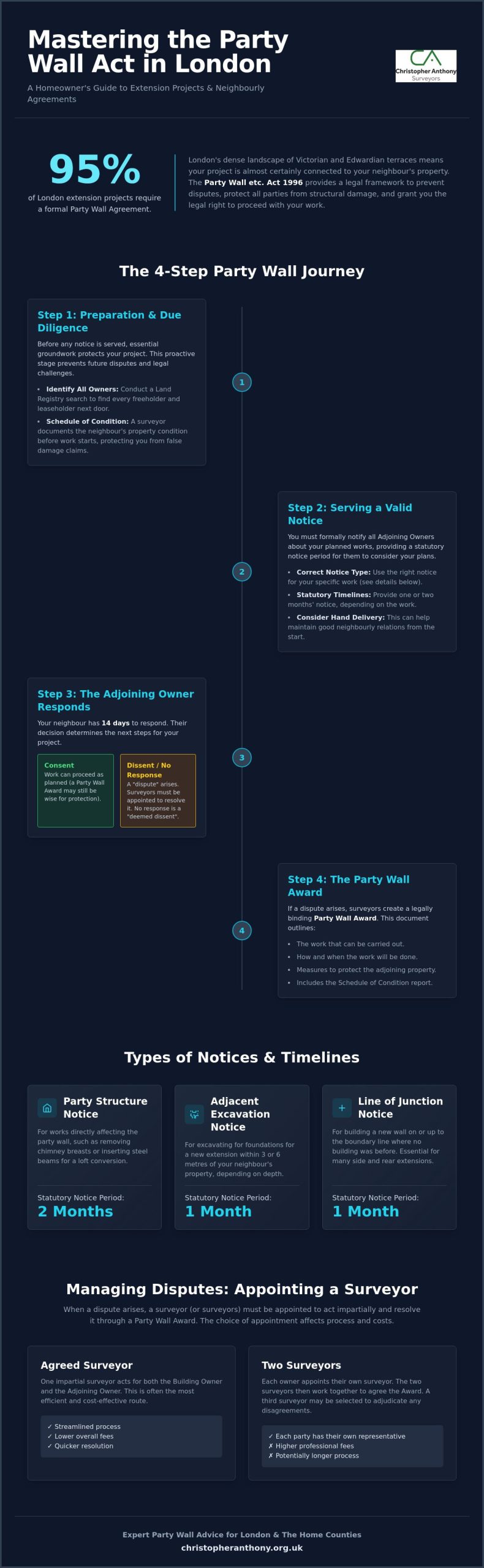
Timing is everything in construction. If you serve your notices too late, your contractor might be standing on-site with nothing to do whilst you wait for legal periods to expire. You must serve notices at least two months before starting work on a shared wall and one month for new boundary walls or excavations. Accuracy is equally vital. Ensure your architectural drawings clearly show the relationship between your work and the boundary line.

Efficiency is often found in collaboration. Appointing an agreed party wall surveyor can save significant time and money for both parties. One impartial professional manages the process for both you and your neighbour, ensuring the Award is served quickly and fairly. Understanding what is a party wall and its associated timelines is the best way to prevent your renovation from becoming a legal headache. Early engagement protects your timeline and your peace of mind.

The journey towards a successful renovation begins the moment you serve a formal notice. This isn't a mere formality. It's a statutory requirement. If your neighbour dissents or simply ignores the notice for 14 days, the law deems a dispute to have arisen. This doesn't mean you're in a personal argument. It's a procedural status that triggers the need for professional surveyors to step in. Understanding what is a party wall and the obligations it carries is your best defence against project stoppages.

A Party Wall Award serves as the resolution to this dispute. Think of it as the "legal rulebook" for your construction. This document outlines how and when the works will be carried out, providing a clear path forward for both parties. It allows the build to proceed whilst ensuring the neighbouring property is protected. Professional guidance is essential here. A building owner party wall surveyor ensures your project complies with the Act from day one. If you're the neighbour, an adjoining owner party wall surveyor acts as your safeguard, ensuring your rights are upheld and your property is respected.

The Party Wall etc. Act 1996 is mandatory. It's not an optional extra or a "nice to have" for your project. Compliance is your legal duty. Skipping this step can lead to expensive legal injunctions that could halt your builders mid-flow. Proactive management is the only way to ensure a smooth, delay-free construction process.

Need Advice About Your Project?

Don't leave your project to chance. We encourage a proactive approach to prevent legal headaches before they even begin. You can request a fixed-fee quotation directly through our website to get your budget in order. For quick guidance on your specific situation, use the "Christopher Anthony Party Wall Assistant" tool. It's designed to give you clarity when you're unsure of the next steps. We're here to help you move from confusion to a clear, actionable plan.

About Christopher Anthony Surveyors

Christopher Anthony Surveyors is an independent specialist practice led by Tony (Christopher Anthony). We provide expert party wall services across London, Hertfordshire, Essex, and Kent. Our team brings over 20 years of experience to every project, specialising in the unique structural challenges of London loft conversions and extensions. We value transparency, speed, and protecting our clients' peace of mind above all else. By choosing us, you're choosing a no-nonsense partner dedicated to keeping your project moving forward without hidden complications.

Secure Your Project's Success

Navigating shared boundaries doesn't have to be a source of anxiety. Understanding what is a party wall and your legal obligations under the 1996 Act is the foundation of a successful renovation. By identifying shared structures early and prioritising clear, formal communication, you protect your property's structural integrity whilst maintaining positive relationships with your neighbours. Proactive steps today prevent expensive legal headaches tomorrow.

Request a Fixed-Fee Party Wall Quotation Today

With over 20 years of experience serving London and Hertfordshire, our team provides the expert advice you need to keep your build on track. We offer fixed-fee transparency so you're never caught out by hidden costs mid-project. Every home is unique, and we pride ourselves on providing a personal touch that larger firms often lack. You don't have to manage these complex procedures alone. Let's ensure your project moves forward with speed, precision, and total peace of mind.

Frequently Asked Questions

Do I need a party wall agreement for a garden fence?

You don't need a party wall agreement for a standard timber garden fence. The Act only applies to "party fence walls," which are shared masonry structures like brick or stone walls sitting on the boundary. If you're replacing a wooden fence with another wooden one, the legislation doesn't apply. However, if you're building a new brick wall on the boundary line, you'll need to serve a formal notice.

Can my neighbour stop me from carrying out building works?

Your neighbour cannot stop you from exercising your legal rights to build, provided your project is lawful. Whilst they can "dissent" to your notice, this simply triggers a dispute resolution process rather than a project veto. The resulting Party Wall Award ensures your work proceeds whilst protecting their property from damage. It's a mechanism to enable development, not to block it.

Who pays the surveyor fees for a party wall agreement?

The Building Owner initiating the work typically pays all reasonable fees. This includes the costs for their own surveyor and the surveyor appointed by the neighbour. This ensures the adjoining owner isn't financially disadvantaged by your development. In rare cases where work is required due to shared defects, costs might be split, but this depends on the surveyor's professional assessment.

What happens if I start work without serving a party wall notice?

Starting work without serving notice is a serious risk that can lead to a court injunction. If you proceed without following the Act, your neighbour can legally stop your project, leaving you liable for their legal costs. It also creates a "headache" during future property sales. Solicitors will look for evidence of compliance, and a lack of paperwork can cause a sale to collapse.

How long does a party wall award last once it is served?

A Party Wall Award is generally valid for 12 months from the date it's served. If you haven't started the works within this year, you may need to seek professional advice on re-serving notices. This time limit ensures that the Schedule of Condition remains an accurate reflection of the property's state before the construction activity begins.

Is a party wall agreement the same as planning permission?

No, they are entirely separate legal requirements. Planning permission deals with the use and appearance of land, whilst the Act manages the structural relationship between shared boundaries. You must still identify what is a party wall and follow the correct procedures even if you already have full planning approval and building regulations consent. Having one doesn't exempt you from the other.

Article by

Tony Neilson MRPSA MFPWS

Party Wall Notice Deadline: Statutory Timelines and Response Windows Explained

A single missed party wall notice deadline can freeze your construction project and lead to a costly legal injunction before the first skip even arrives. Whether you are planning a London loft conversion or a rear extension, the timing of your paperwork is just as critical as the quality of your build. You likely feel that the Party Wall etc. Act 1996 is a complex maze of red tape designed to slow you down; it is a sentiment we hear often from homeowners and developers across the Home Counties.

We're here to show you that mastering these statutory timelines is actually your best defence against project delays and fractured neighbourly relations. This guide provides total clarity on the 1-month and 2-month notice rules, the vital 14-day response window, and the "deemed dissent" process that occurs if your neighbour stays silent. You will gain a clear, actionable roadmap to ensure your project remains legally compliant whilst keeping your construction schedule moving forward with confidence and precision.

Key Takeaways

  • Distinguish between one-month and two-month statutory periods to align your construction programme with legal requirements from the outset.
  • Understand the critical 14-day response window and how to navigate a "deemed dissent" should your neighbour fail to reply to your party wall notice deadline.
  • Ensure your project remains compliant by learning the 12-month validity rule and what specific actions constitute a formal "commencement" of works.
  • Avoid costly resets by identifying common administrative errors that can invalidate your notice and force you to restart the statutory waiting period.
  • Gain professional insight into the strategic benefits of serving notices early to minimise overall project lead times and protect your build schedule.

Understanding the One-Month and Two-Month Statutory Notice Periods

Many homeowners assume they can hand a letter to their neighbour on Friday and have the builders arrive on Monday. This is a common misconception that leads to project-stopping legal trouble. The Party Wall etc. Act 1996 mandates specific lead times to protect adjoining owners and their property. If you ignore your party wall notice deadline, you risk an injunction that could halt your site for months. You cannot simply bypass these windows because your contractor has a gap in their diary.

When Does the Two-Month Deadline Apply?

This longer window typically applies to works that directly interfere with the shared fabric of a building. In surveying terms, these are Section 2 works. If you're planning a loft conversion, you'll likely need to cut into the party wall to insert steel beams. Other common triggers include removing chimney breasts that form part of the shared structure or raising the height of the wall for a new extension. Because these works carry a higher risk of structural impact, the law gives your neighbour two full months to prepare and seek advice. It's a protection that ensures no one's home is compromised without fair warning.

The One-Month Deadline for Excavations

For works that don't touch the wall itself but involve digging nearby, the party wall notice deadline is usually one month. This falls under Section 6 of the Act. If you're excavating for a rear extension or a garden room within 3 metres of your neighbour's property, you must serve notice. For deeper basement excavations in London, the 6-metre rule often applies. This requires a notice if your new foundations will be deeper than theirs within that radius. Piling work is a frequent trigger here. Even if your wall is entirely separate, the vibration and soil movement from piling require statutory notice to ensure the neighbouring building stays safe. Building a new wall directly on the line of junction also falls into this one-month category.

Accuracy is vital when determining which deadline applies to your project. A flawed notice that cites the wrong section or timeframe will reset your deadline clock to zero. We've seen projects delayed by weeks because a building owner served a one-month notice for work that legally required two. Getting it right the first time is the only way to keep your project on schedule. Understanding how to serve a party wall notice correctly from the outset is therefore essential to avoiding these costly administrative errors.

The 14-Day Response Window: What Happens When the Clock Starts Ticking

Once your notice is served, the 14-day statutory clock begins. It's vital to understand that "Day 0" is the date the neighbour actually receives the document, not the day you signed it. If you're sending notices by post, you must factor in delivery times to ensure you don't jump the gun on your party wall notice deadline. This fortnight is the first major milestone in your project's legal timeline.

If that period passes without a written response, the law assumes a dispute has arisen. This is a "deemed dissent". You cannot simply start building if your neighbour ignores you. Instead, you must issue a formal 10-day follow-up letter under Section 10(4) of the Act. This is a final warning. If they still don't respond after those ten days, you gain the legal authority to appoint a surveyor on their behalf. This prevents a silent neighbour from blocking your project indefinitely. Following RICS professional guidance ensures this sensitive process is handled with the necessary impartiality.

Option 1: Consent with or without a Schedule of Condition

Written consent is the fastest route to your start date. If your neighbour signs the consent form, you can often bypass the remainder of the one or two-month notice periods. We strongly advise pairing this with a Schedule of Condition survey. This provides a photographic and descriptive record of their property before you begin. It's a protective shield for both sides. It ensures you aren't blamed for pre-existing cracks whilst giving your neighbour confidence that any genuine damage will be identified and rectified.

Option 2: Dissent and the Appointment of Surveyors

A dissent doesn't mean your project is over. It simply means the process becomes more formal. Your neighbour has the right to appoint an Adjoining Owner Party Wall Surveyor to review your plans and protect their interests. To keep your timeline on track, you might propose an Agreed Party Wall Surveyor. This is a single, neutral expert who acts for both parties. It's a streamlined approach that often leads to a quicker resolution and a faster Party Wall Award. If you're currently facing a non-responsive neighbour, you can consult our specialist team to manage these delicate timelines for you.

Party Wall Notice Deadline: Statutory Timelines and Response Windows Explained

Notice Validity and Expiration: The 12-Month Rule

The law doesn't allow a notice to hang over a neighbour's head indefinitely. Once you've served your paperwork, you enter a "use it or lose it" phase. Every notice issued under the Act has a strict lifespan of 12 months. If you haven't commenced the specific works described in your notice by the time this party wall notice deadline expires, the notice becomes void. You cannot simply pick up where you left off; you'll need to restart the entire statutory process from scratch.

Commencing work means more than just putting up a fence or clearing some garden waste. To keep the notice valid, you must begin the actual structural work authorised by the Act, such as digging the foundations or inserting steel beams. If you stop work for a significant period and the 12-month anniversary passes, you may find yourself in a legal grey area. Re-serving notices isn't just an administrative headache; it can involve fresh surveyor fees and further delays to your build schedule.

Request a fixed-fee quotation for your party wall notices

Managing Your Project Timeline in London and Hertfordshire

Coordinating your party wall notice deadline with planning permission is a delicate balancing act. In London, basement excavations often face complex engineering hurdles or planning revisions that can easily consume six to nine months of your notice's validity. We often suggest serving notices once you're confident that planning is imminent but before the final decision notice arrives. This allows the statutory periods to run concurrently with the final stages of design, ensuring you're ready to break ground the moment permission is granted.

Can You Shorten the Statutory Notice Period?

The only legal way to bypass the one or two-month waiting period is through written consent from your neighbour. If they agree in writing to let you start earlier, the statutory lead time is effectively waived. However, you must never start work before the notice period ends without this explicit agreement. Doing so leaves you vulnerable to a court injunction. A "stop-work" order can be devastating, resulting in significant legal costs and a total halt to your construction project until the matter is resolved by surveyors.

Practical Advice from Christopher Anthony Surveyors

Experience has taught us that the most successful projects begin with a proactive approach to the party wall notice deadline. Don't wait for your contractor to arrive on-site with a digger before you think about the Act. We recommend serving notices as soon as your plans are finalised, ideally alongside your planning application. This strategy allows the statutory waiting periods to run whilst you wait for council approval, effectively neutralising potential delays to your construction programme.

Professionalism is your best tool for securing a quick response. A notice served on our firm's letterhead carries a level of authority that generic letters lack. It signals to your neighbour that you're taking your legal obligations seriously and that their property is being protected by experts. Whilst it's a formal process, a friendly chat before the envelope arrives can work wonders. Explaining the project over a cup of tea often prevents the anxiety that leads to an immediate dissent.

Avoiding Common Deadline Pitfalls

Accuracy is everything in this process. A single administrative error can invalidate your paperwork and reset your party wall notice deadline clock to zero. Many homeowners rely on party wall notice templates found online, but these often lack the technical precision required for complex Section 6 excavation works. If you want to understand the full procedural requirements before drafting your documents, our detailed walkthrough on how to serve a party wall notice correctly in 2026 covers every step in depth. Common mistakes that cause project-stopping delays include:

Need Advice About Your Project?

Every property is unique. A basement excavation in a London terrace requires a different strategic approach than a simple garden room extension in Hertfordshire. Generic timelines don't always account for the nuances of complex urban builds or the specific concerns of your neighbours. Relying on assumptions can lead to expensive legal disputes that far outweigh the cost of professional guidance.

We provide clear, no-nonsense expertise to keep your project moving. You can request a fixed-fee quotation to secure your project's legal compliance from the very start. For an instant steer on your specific obligations and the timelines involved, we encourage you to use the Christopher Anthony Party Wall Assistant tool on our website. It's designed to demystify the process and give you the confidence to proceed with your build schedule.

Secure Your Build Schedule with Expert Timing

Mastering these statutory windows ensures your project stays on track. We have explored how the one and two-month notice periods dictate your start date. We also covered why the 14-day response window requires active management to avoid a "deemed dissent" situation. Accurate paperwork is your best defence against delays. Don't let your party wall notice deadline expire after 12 months; ensure your structural works begin within the legal validity period to avoid costly resets.

Request a Fixed-Fee Party Wall Quotation Today

Our team brings over 20 years of experience to London and Hertfordshire projects, offering fixed-fee transparency for both building owners and adjoining owners. We handle the procedural heavy lifting so you can focus on the build itself. Take the first step toward a compliant and stress-free construction project today.

Frequently Asked Questions

How long is a party wall notice valid for once served?

A party wall notice remains valid for exactly 12 months from the date it is served. If the structural works described in your notice have not commenced within this one-year window, the notice expires. In such cases, you must restart the statutory process by serving fresh notices and waiting for the relevant notice periods to elapse before you can legally begin your build.

Can I start building work before the two-month notice period ends?

You can only start work before the two-month period expires if you obtain explicit written consent from your neighbour. If they agree to the works and sign a consent form, the statutory waiting period is effectively waived. However, without this written agreement, you must wait for the full notice period to pass to avoid the risk of a project-stopping legal injunction.

What happens if my neighbour ignores the 14-day notice deadline?

If your neighbour fails to respond by the 14-day party wall notice deadline, the law assumes a "deemed dissent" has occurred. This means a dispute is officially considered to have arisen. You must then issue a formal 10-day follow-up letter. If they still remain silent after this second window, you gain the legal right to appoint a surveyor on their behalf to resolve the dispute.

Do I need to serve a new notice if I change my building plans?

Significant changes to your design, such as deepening foundations or moving a new wall's position, typically require a new notice. Minor tweaks might be managed through a surveyor's addendum, but substantial deviations from the original notice can make it invalid. Serving a fresh notice ensures your party wall notice deadline is legally sound and protects you from claims that the work is unauthorised.

Is there a deadline for my neighbour to appoint their own surveyor?

Yes, once the initial 14-day response window passes and a dissent is recorded, your neighbour has a further 10 days to appoint their own surveyor. If they do not make an appointment within this secondary timeframe, the Building Owner has the statutory power to appoint a surveyor on their behalf. This prevents a non-responsive neighbour from stalling your construction schedule indefinitely.

Does the 12-month expiration rule apply if I have already started the work?

The 12-month rule specifically applies to the commencement of the works. As long as you have physically started the structural work authorised by the notice within the first year, the notice remains valid until those specific tasks are finished. You don't need to complete the entire construction project within twelve months; you simply need to have broken ground or begun the party wall works.

Article by

Tony Neilson MRPSA MFPWS

Fixed Fee Party Wall Surveyor: A Guide to Transparent Costs and Expertise in 2026

In London, approximately 95% of extension projects require a formal party wall agreement. It's a staggering figure that often leaves homeowners feeling cornered by legal complexity. You're likely worried about open-ended hourly rates and "hidden" fees that could spiral your renovation budget out of control before the first brick is even laid. It's a common anxiety. The fear of a neighbour dispute stalling your build or a misunderstanding of the 1996 Act causing a legal headache is enough to keep any property owner awake at night.

We understand the pressure of a strict construction timeline. This guide explains how appointing a fixed fee party wall surveyor provides the absolute budget certainty you need to move forward. You'll learn how to secure a legally binding Party Wall Award whilst ensuring your project remains compliant and your neighbourly relations stay intact. We will break down the 2026 landscape of transparent costs, the efficiency of the "Agreed Surveyor" model, and the practical steps Christopher Anthony Surveyors takes to keep your project moving. No jargon. No surprises. Just expert protection for your home and your investment.

Key Takeaways

  • Learn why appointing a fixed fee party wall surveyor is the most effective way to eliminate financial uncertainty and protect your construction budget from spiralling hourly rates.
  • Understand the essential components of a comprehensive service, from the formal service of statutory notices to the vital role of a detailed Schedule of Condition.
  • Discover how to evaluate professional quotations by verifying RICS or Faculty of Party Wall Surveyors credentials to ensure your project remains legally compliant.
  • Gain practical, project-specific advice for managing loft conversions and extensions whilst maintaining positive, long-term relations with your neighbours.
  • Explore how a transparent, pre-agreed fee structure aligns your surveyor’s expertise with your construction timeline to prevent costly and unnecessary delays.

The Advantages of Appointing a Fixed Fee Party Wall Surveyor

Choosing a fixed fee party wall surveyor is a strategic move for any property owner. Under the Party Wall etc. Act 1996, the statutory duties of a surveyor are clearly defined. A fixed fee applies a pre-agreed total cost to these duties, replacing the traditional "billable hour." This model doesn't just offer transparency; it aligns the surveyor's efficiency with your construction timeline. When the fee is capped, the focus remains on resolving matters with precision rather than generating administrative volume. It's a modern approach that respects both your budget and your project's momentum.

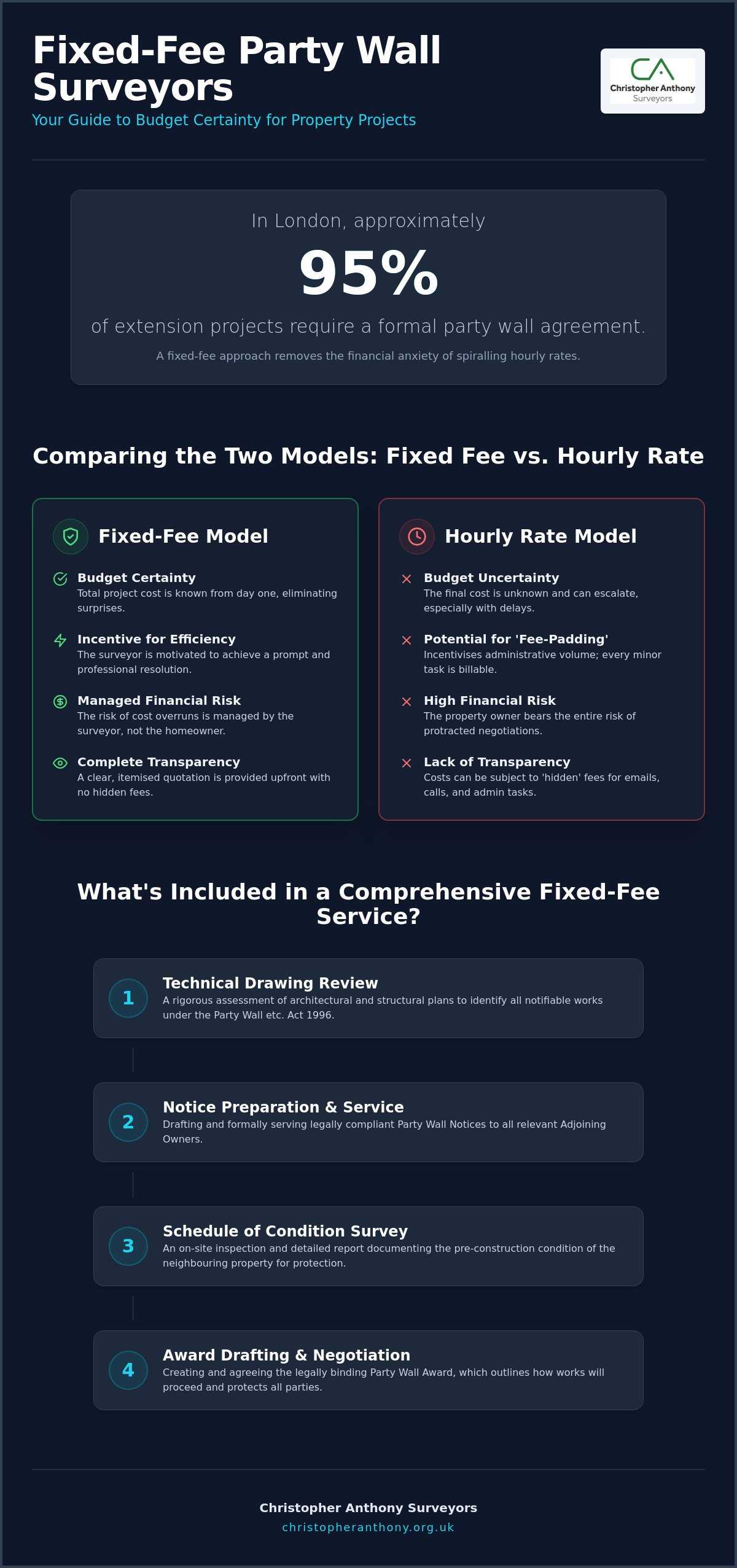
Service Feature Fixed Fee Model Hourly Rate Model
Budget Certainty Total cost is known from day one. Final cost is unknown and variable.
Incentive Structure Efficiency and prompt resolution. Potential for administrative bloat.
Financial Risk Managed by the surveyor. Held entirely by the property owner.
Transparency Clear, upfront quotation. Subject to "hidden" time-based fees.

Financial predictability is the foundation of a successful build. By removing the anxiety of open-ended invoices, you can manage your development with confidence. There are three primary reasons why this structure benefits residential projects:

  1. You gain total cost clarity before the first notice is even drafted.
  2. The risk of "fee-padding" for minor administrative tasks is eliminated.
  3. Surveyors are incentivised to reach a fair, professional resolution without delay.

Why Hourly Rates Can Jeopardise Your Build Budget

Residential renovations in London and the Home Counties often operate on tight margins. Hourly rates introduce a variable that can spiral if negotiations with neighbours become protracted. If a surveyor bills for every minor email or phone call, your contingency fund can vanish before work begins. A fixed-fee approach ensures that your surveyor is a proactive problem-solver, not a distant administrator. It keeps the focus on the technical specifics of your build rather than the clock.

Fixed Fees for the Adjoining Owner

In most cases, the Building Owner is responsible for the Adjoining Owner's reasonable surveyor fees. This is often a source of significant stress for developers. Agreeing on a fixed fee caps this liability from the outset. It ensures your neighbour receives a professional Schedule of Condition Survey and full legal protection without you facing an open-ended bill. It turns a potentially contentious requirement into a transparent, manageable professional service.

What is Included in a Comprehensive Fixed Fee Service?

A comprehensive service package removes the guesswork from property development by providing a structured roadmap through the statutory requirements. While the previous section highlighted the financial advantages, understanding the specific deliverables is key to ensuring your project remains compliant. A fixed fee party wall surveyor manages the entire lifecycle of the process, ensuring every legal obligation is met without the need for additional, unscheduled site visits or administrative top-ups.

The core components of this service follow a logical sequence designed to protect your build timeline:

  1. Technical Drawing Review: A rigorous assessment of your architectural plans and structural engineering details to identify which sections of the official government legislation apply to your specific boundary.
  2. Notice Preparation and Service: Drafting and formally serving Party Wall Notices under Sections 1, 3, and 6 of the Act to all relevant Adjoining Owners.
  3. On-Site Inspection: A physical visit to the neighbouring property to document its current state before any heavy machinery or structural work begins.
  4. Award Drafting and Negotiation: Creating the legally binding document that sets out how the works will be handled, including protective clauses for both owners.

The Role of the Schedule of Condition

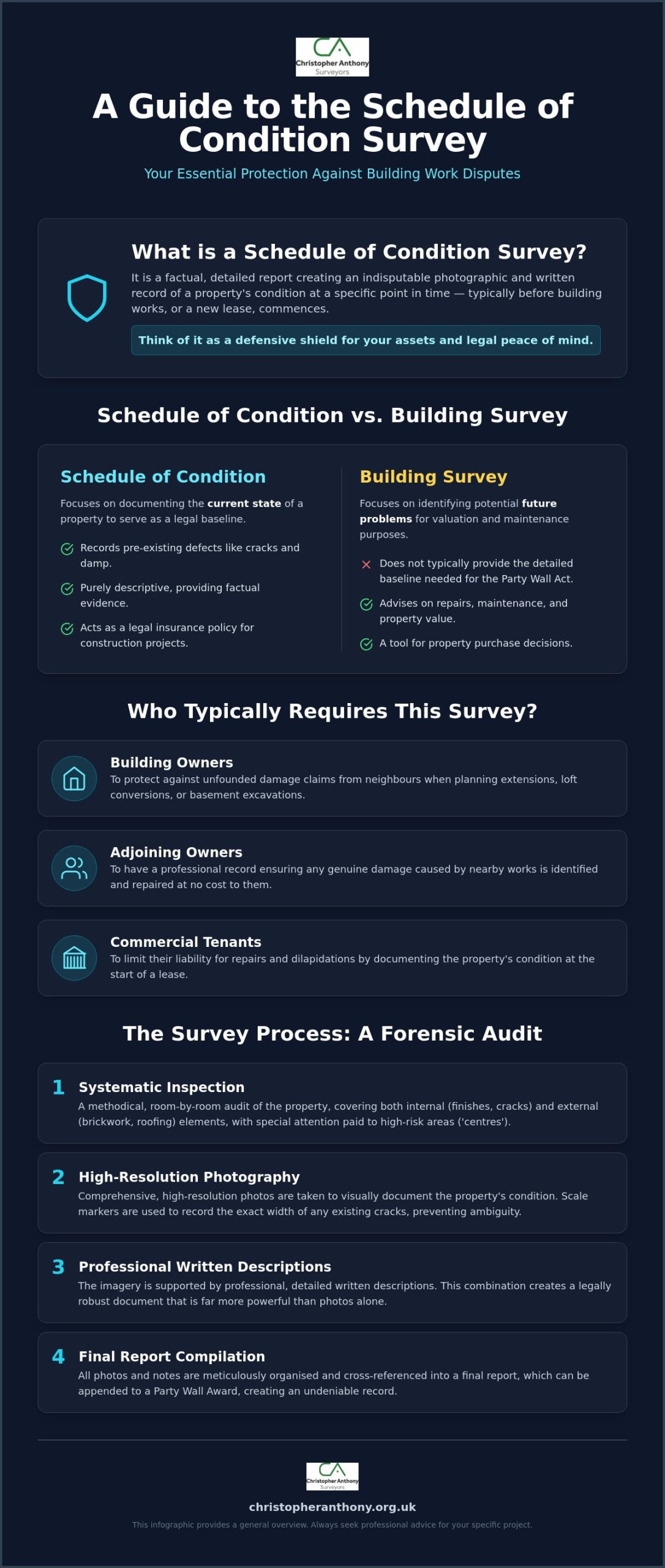
This document is the most vital protection for both parties. It serves as a meticulous photographic and written record of the neighbouring property's state before work begins. A Schedule of Condition Survey ensures every existing crack, damp patch, or defect is recorded in detail. If a neighbour later claims your extension caused damage, this report provides the definitive evidence needed to resolve the matter fairly. In our fixed-fee model, this thoroughness is guaranteed as part of the standard package.

Serving Notices and Managing Responses

Construction schedules rely on precision. The Act dictates strict response windows: an initial 14-day period followed by a 10-day follow-up if a neighbour remains silent. A fixed-fee service manages these "deemed disputes" seamlessly. It bridges the gap between the initial Notice and the final negotiated Award. This proactive approach prevents administrative delays that could stall your contractor. If you are planning a project and need clarity on the next steps, you can request a fixed-fee quotation to see how we manage these statutory timelines.

Fixed Fee Party Wall Surveyor: A Guide to Transparent Costs and Expertise in 2026

How to Evaluate Fixed Fee Quotations for Your Project

When you receive a quote, your first instinct might be to look at the total figure. However, a fixed fee party wall surveyor must offer more than just a low price. You need to verify their professional credentials. Look for membership in the Royal Institution of Chartered Surveyors (RICS) or the Faculty of Party Wall Surveyors. These bodies ensure the surveyor adheres to strict RICS professional guidance and ethical standards. Local expertise is equally vital. A surveyor familiar with the specific property archetypes in London, Hertfordshire, and Essex will anticipate structural nuances that others might miss. They understand the difference between a Victorian terrace in London and a detached 1930s home in the Home Counties.

Communication is the final piece of the puzzle. You need a surveyor who is approachable and ready to explain complex points in plain English. If a quote arrives without a clear breakdown of the scope of work, ask questions. A transparent professional will always be happy to clarify what is included. Your peace of mind depends on knowing your surveyor is a proactive problem-solver, not just a distant administrator.

Red Flags in Low-Cost Surveying Quotes

Cheap quotes often hide significant risks. Be wary of "notice-only" services. These often leave you stranded if a neighbour dissents, forcing you to pay higher hourly rates later. Some low-cost providers exclude travel expenses or site visits from their initial fee. A professional quote should be all-encompassing. It must include a thorough review of your structural plans and a commitment to on-site inspections. Relying on generic templates without reviewing your specific build is a recipe for legal challenges. Don't let a "bargain" fee lead to a costly construction delay.

The Importance of an Agreed Surveyor

The most cost-effective path is often the appointment of an Agreed Party Wall Surveyor. In this scenario, a single impartial expert acts for both the Building Owner and the Adjoining Owner. This significantly reduces the total fixed costs whilst ensuring both parties' rights are protected under the Act. It's a pragmatic solution that maintains neighbourly relations. If you want to understand how this applies to your specific project, you can request a transparent fixed-fee quotation today to secure your build budget.

Practical Advice from Christopher Anthony Surveyors

Every construction project brings its own set of technical hurdles. In our experience across London and the Home Counties, specific works trigger the most common neighbourly concerns. For loft conversions, the focus is almost always on steelwork insertion. It's vital to document the condition of top-floor ceilings in the neighbouring property before work starts. These areas are particularly sensitive to vibration. By recording them early, you prevent speculative claims later on. It's a simple step that provides massive protection.

Rear extensions and garden rooms involve different risks. Managing excavation within 3 or 6 metres of a neighbour’s foundations is the primary concern here. Your fixed fee party wall surveyor will review the depth of your new foundations relative to the adjoining property. This ensures the structural integrity of both buildings remains uncompromised. For chimney breast removals, the Award must detail the support method, whether you're using gallows brackets or structural beams. Precision in these details prevents disputes over shared chimney stacks.

The most effective way to save time and money is through early communication. Talk to your neighbour before the formal notice is served. A friendly conversation often paves the way for an "Agreed Surveyor" appointment. This keeps costs down and maintain positive relations throughout the build.

Navigating London and Hertfordshire Projects

Victorian terraces in North London and semi-detached homes in Watford present unique challenges. These properties often have shared stacks and thin party walls that require careful handling. Access is another frequent issue. If your project involves a side-return extension, you may need access to the neighbour's land for scaffolding. We help manage these requirements fairly. Basement excavations are a different beast entirely. Due to the significant structural risks and complexity, these often require a more bespoke fee structure. We'll always be transparent about this from the outset to ensure you have the right level of expertise.

Avoiding Common Pitfalls

Don't fall into the trap of using generic online templates. A faulty notice can invalidate your entire legal process, forcing you to start again from scratch. It's a costly and frustrating delay. You should also ensure your structural engineer has finalised the designs before the surveyor begins the Award process. Changes to steelwork or foundation depths mid-way through can lead to expensive addendums. If you're ready to secure your project's legal standing, request a fixed-fee quotation from our expert team. We'll help you get the details right the first time.

Secure Your Construction Timeline with Budget Certainty

Your construction project deserves a foundation built on legal clarity and financial predictability. We've explored how moving away from unpredictable hourly rates removes the risk of spiralling costs. A comprehensive award ensures your build remains compliant whilst protecting your property and your neighbour's rights. Appointing a fixed fee party wall surveyor means you can focus on the progress of your build instead of worrying about hidden administrative surprises.

At Christopher Anthony Surveyors, we bring over 20 years of expertise to residential and commercial projects across London and the Home Counties. Our specialist knowledge of loft conversions, extensions, and complex structural alterations ensures every statutory detail is handled with precision. We provide transparent, fixed-fee pricing to give you the confidence you need to stay on schedule. Ready to secure your project's legal standing? Request a Fixed-Fee Quotation for Your Project today and let our expert team guide you through the process with ease.

Frequently Asked Questions

Is a fixed fee party wall surveyor always cheaper than an hourly rate?

A fixed fee is typically more cost-effective for residential projects as it provides a guaranteed ceiling on your professional outgoings. Hourly rates can quickly escalate if a neighbour’s surveyor becomes pedantic or if minor disputes arise during the award drafting. By appointing a fixed fee party wall surveyor, you remove the risk of budget creep. This ensures your contingency fund is reserved for the actual building work rather than administrative invoices.

What happens if my neighbour refuses to agree to a fixed fee?

Your neighbour doesn't have the legal right to dictate your surveyor's fee structure. However, they do have the right to dissent to your notice and appoint their own independent surveyor. In this scenario, that surveyor may choose to charge an hourly rate. We always aim to encourage the "Agreed Surveyor" model to keep costs predictable for everyone, but we'll protect your interests regardless of the neighbour's choice.

Does a fixed fee include the cost of a second surveyor for my neighbour?

No, a fixed fee quote covers the specific statutory duties performed by your appointed surveyor only. Under the Act, you're usually responsible for the "reasonable" fees of the adjoining owner’s surveyor too. If they refuse an "Agreed Surveyor" and pick their own, their costs are separate from your fixed fee. We can, however, review their invoice to ensure it remains reasonable and proportionate to the project complexity.

Are there any hidden costs I should watch out for in a fixed fee quote?

You should check for exclusions such as Land Registry search fees, courier costs, or additional site visits if the project scope changes significantly. A truly transparent fixed fee party wall surveyor will list these potential disbursements clearly in their initial quotation. Be wary of "notice-only" prices that don't include the Schedule of Condition or the final Award. These elements are essential for your full legal protection.

How long does the fixed fee process take from notice to award?

The process typically takes between two and four months from the service of the initial notice to the final publication of the Award. While a fixed fee provides cost certainty, it doesn't bypass the statutory timelines required by the 1996 Act. We work efficiently to meet these deadlines, managing the 14-day and 10-day response windows proactively to prevent your contractor from being delayed by administrative silence.

Can I get a fixed fee for a complex basement excavation project?

Basement projects are significantly more complex and often require a bespoke or "capped" fee structure rather than a standard flat rate. These excavations involve higher structural risks and usually necessitate multiple site visits and detailed monitoring. While we always strive for transparency, the level of expertise required for a London basement means fees are tailored to the specific technical demands of the site and the structural engineer's designs.

Article by

Tony Neilson MRPSA MFPWS

Neighbour Refuses to Sign Party Wall Notice: What Happens Next?

What if a neighbour’s "no" was actually the best way to protect your home renovation? It’s a common fear that when a neighbour refuses to sign party wall notice documents, your project is effectively dead in the water. We understand the frustration of silence or the anxiety of a strained relationship with those next door. You’re likely worried about indefinite delays and the potential for rising surveyor fees. It feels like a roadblock; in reality, it's just a change of lane.

A refusal to sign isn't a veto; it's a statutory trigger for the professional protections of the Party Wall etc. Act 1996. This guide will demystify the "dissent" process and explain why formalising the agreement is often the safest route for everyone involved. You'll learn exactly how the dispute resolution mechanism works, the role of an appointed surveyor, and the realistic timeline for when your contractors can finally get to work. Let’s replace that uncertainty with a clear, professional roadmap to your build, with expert guidance from Christopher Anthony Surveyors.

Key Takeaways

Understanding "Dissent": Why a Refusal is Not a Project Stop Sign

It's a common misconception that a building project stops the moment a neighbour refuses to sign party wall notice documents. In reality, the law is on your side. The Party Wall etc. Act 1996 is "enabling" legislation. This means its primary purpose is to facilitate your right to build whilst ensuring your neighbour's property remains protected. When a neighbour says "no", they aren't exercising a veto; they're simply choosing a formal route over an informal one.

Legally, this refusal is recorded as a "dissent". It doesn't mean your loft conversion or extension is cancelled. It just shifts the process from a simple exchange of letters to a professional, legal framework. This framework eventually leads to a Party Wall Award. This is a legally binding document that outlines exactly how and when the work will take place, providing a clear set of rules for both parties to follow.

The Difference Between Consenting and Dissenting

Consenting is the simplest path. If your neighbour agrees in writing, you can usually start work once the notice period expires without further surveyor involvement. Dissenting, however, triggers the dispute resolution procedure under Section 10 of the Act. Don't let the word "dispute" alarm you. In this context, it's a legal term meaning the parties haven't reached an informal agreement. You should also be aware of "Deemed Dissent". If your neighbour fails to respond to your notice within 14 days, the law automatically assumes they've dissented to the works. This ensures the process keeps moving forward even if a neighbour is unresponsive.

Common Reasons Neighbours Refuse to Sign

Most refusals aren't born out of malice. Often, it's a genuine fear of structural damage during complex works like chimney breast removals or rear extensions. Some homeowners wrongly believe that if a neighbour refuses to sign party wall notice paperwork, the project must stop entirely. Others simply want the peace of mind that comes with a professional schedule of condition survey. This survey records the state of their property before you start, providing a clear benchmark if any damage is claimed later. Understanding these motivations helps you manage the relationship without unnecessary anxiety.

The Statutory Process: 3 Steps to Take When a Neighbour Refuses

Once the 14-day response period expires, or if your neighbour explicitly declines your proposal, the process shifts from informal to statutory. It’s a transition, not a dead end. You aren't stuck; you just need to follow the sequence laid out in the official government guidance. Three steps. One goal. Legal certainty.

If your neighbor refuses to sign party wall notice documents, your first move is a formal acknowledgement of the dispute. You must then request that they appoint a surveyor. This is the point where transparency pays off. Clearly explain that the Act is there to protect their property just as much as your right to build. Keeping a meticulous paper trail of all correspondence is vital for legal compliance if matters escalate later.

The 10-Day Rule and Section 10(4)

The Act has teeth to prevent projects from being stalled by silence. If your neighbour fails to appoint a surveyor within 10 days of your formal request, you can invoke Section 10(4). This allows you to appoint a surveyor on their behalf. Don't worry; this isn't a conflict of interest. The surveyor you appoint for them must act impartially and cannot be the same person acting for you. It ensures the process moves forward whilst maintaining fair, independent oversight for both homes. If you're struggling with the wording of this notice, professional guidance can ensure your follow-up is legally watertight.

Choosing Between an Agreed Surveyor or Separate Surveyors

Efficiency often comes down to the choice of surveyor. You should always offer the option of an Agreed Party Wall Surveyor. This is a single, neutral professional who acts for both parties. It's faster, simpler, and significantly more cost-effective since the building owner usually pays all surveyor fees. However, for high-risk projects like deep basement excavations or complex structural work in London terraces, separate surveyors might be more appropriate. This provides each owner with their own dedicated expert to scrutinise the structural designs and method statements.

Neighbour Refuses to Sign Party Wall Notice: What Happens Next?

Practical Advice from Christopher Anthony Surveyors: Navigating Neighbour Objections

In our experience across London’s Victorian terraces and Hertfordshire’s semi-detached extensions, initial resistance is rarely about the bricks and mortar. It’s about the unknown. If a neighbor refuses to sign party wall notice documents, it usually signals a lack of trust rather than a desire to block your build. Transparency is your most effective tool here. Share your structural details and method statements early. Showing exactly how you’ll protect the shared wall often defuses anxiety before it turns into a formal dispute.

We often suggest offering a Schedule of Condition even if it isn't strictly required. It’s a powerful gesture of good faith. It tells your neighbour you respect their property and are prepared to be held accountable. Avoid using generic DIY templates. These often contain errors that make homeowners look unprofessional or suspicious. A correctly served notice, backed by professional expertise, sets a tone of competence that naturally encourages cooperation.

Handling the "Difficult" Neighbour

Personal history can sometimes cloud a professional process. If relations are strained, stop the "over the fence" negotiations. They rarely end well. Instead, opt for a surveyor-led informal chat. We act as neutral experts, explaining the "Building Owner" rights under the Act without the emotional baggage. We often point owners toward the Official Government Guidance on the Party Wall Act to provide a neutral, third-party perspective on their rights and obligations.

Minimising Delays in London and Hertfordshire

Efficiency requires foresight. If you suspect a dissent, build it into your project timeline immediately. Allow at least 4 to 6 weeks for the Award process to reach completion. Getting your notices right the first time is non-negotiable; a single mistake can force you to restart the statutory clock, costing you weeks of construction time. To manage your budget effectively during a dissent, consider our fixed-fee services. This provides total clarity on costs, regardless of how many letters need to be exchanged. If you are unsure about your neighbour's likely reaction, request a professional assessment from our team today.

The "no" from your neighbour isn't a dead end. It’s a redirection toward the most robust legal protection available: the Party Wall Award. When a neighbor refuses to sign party wall notice papers, the resulting Award becomes the definitive rulebook for your project. It’s a formal document, drafted by professional surveyors, that provides the legal indemnity you need to start construction with total confidence.

Think of the Award as a shield. It doesn't just permit the work; it sets clear boundaries that prevent future conflict. If a neighbour later claims your loft conversion caused a crack in their ceiling, you have a professional schedule of condition survey as evidence. This prevents spurious claims from draining your budget or stalling your progress. To keep your finances predictable during this formal phase, we offer fixed-fee Party Wall services. This ensures that a dissent doesn't lead to spiralling costs.

What Does a Party Wall Award Actually Cover?

The Award is incredibly specific. It leaves nothing to chance. It details exactly how your contractor will dig foundations or remove chimney breasts. It also secures your access rights; if your builders need to put up scaffolding on the neighbour’s land to finish an extension, the Award can grant that legal right. Key inclusions typically involve:

The Final Steps and Starting Work

Once the surveyors agree on the terms, the Award is served to both parties. This marks the start of a 14-day statutory appeal period. It’s a final window for either side to raise legitimate legal concerns, though successful appeals are rare when the process is handled by experts. You've followed the law, and the law now provides the green light.

The most important takeaway is this: once the Award is served and the appeal period passes, you have the absolute legal right to proceed. You don't need your neighbour’s signature or their permission. The law has spoken, the protections are in place, and your project can move forward. If you're facing a dissent, get a professional quote for an Award to ensure your project remains on firm legal ground.

Move Your Project Forward with Confidence

A neighbour's refusal is a procedural shift, not a project stop sign. It moves your build from an informal agreement into the robust, professional framework of the Party Wall etc. Act 1996. If your neighbor refuses to sign party wall notice documents, the law provides a clear path forward through the dissent process. This ensures your loft conversion or extension can proceed whilst both properties remain fully protected by a legally binding Party Wall Award.

With over 20 years of experience serving London and Hertfordshire, we specialise in resolving these complex situations with speed and precision. We focus on transparency and specialist expertise to de-escalate tensions and secure your project’s legal indemnity. Don't let procedural uncertainty stall your construction timeline or lead to unpredictable costs. Our transparent, fixed-fee pricing provides the clarity and value you need to build with total peace of mind.

Take the next step toward your build today. Request a Fixed-Fee Party Wall Quotation from Christopher Anthony Surveyors and let our experts handle the statutory details for you. Your project is our priority.

Frequently Asked Questions

Can a neighbour stop me from building an extension?

No, a neighbour cannot permanently stop you from building a legitimate extension. The Party Wall etc. Act 1996 is enabling legislation designed to facilitate construction whilst protecting adjoining properties. If a neighbor refuses to sign party wall notice documents, they are simply triggering a formal legal framework rather than exercising a veto. You will eventually need a Party Wall Award to proceed, but the work itself cannot be blocked if it complies with the law.

How long does a party wall award take if a neighbour dissents?

You should allow a minimum of 2 to 4 months for the resolution process once a neighbour dissents. This timeline accounts for the formal appointment of surveyors, the completion of a Schedule of Condition, and the drafting of the final Award. Whilst some simple cases are resolved faster, planning for this duration prevents construction delays and ensures all legal requirements are met before your contractors arrive on site.

Who pays the surveyor fees if the neighbour refuses to sign?

The Building Owner carrying out the work is almost always responsible for paying all reasonable surveyor fees. This includes the costs for your own surveyor and the fees for any surveyor appointed by your neighbour. This rule applies even if the neighbor refuses to sign party wall notice paperwork initially. Costs only shift in rare circumstances, such as when a neighbour acts vexatiously or the dispute relates to the repair of a shared structure.

What happens if my neighbour ignores the party wall notice entirely?

If a neighbour ignores your notice for 14 days, the law treats this as a "deemed dissent". You cannot take silence as permission to start work. Instead, you must follow a statutory procedure by issuing a follow-up letter giving them a further 10 days to appoint a surveyor. If they continue to ignore the process, you have the legal right to appoint a surveyor on their behalf to ensure the project moves forward without their active cooperation.

Do I need a party wall agreement for a loft conversion?

Yes, most loft conversions require a party wall agreement because they involve structural interventions in the shared wall. This usually includes cutting into the masonry to insert steel beams or the removal of chimney breasts. You must serve a formal notice at least two months before these specific works begin. Getting this right early prevents legal challenges that could stall your project mid-build.

Can I appeal a party wall award if I am unhappy with the terms?

Yes, you can appeal a Party Wall Award through the County Court within 14 days of the document being served. However, appeals are expensive and should only be pursued if the surveyors have acted outside their legal jurisdiction or made a significant error. It’s a complex process that requires specialist legal advice. Most disagreements are better resolved during the drafting stage through clear communication between the appointed surveyors.

Article by

Tony Neilson MRPSA MFPWS

Expert Party Wall Surveyor in Hackney | Protect Your Home

You have spent months planning your Hackney kitchen extension, but a single "dissenting" notice from a neighbour could halt your progress before the first brick is laid. In the tightly packed streets of Stoke Newington and Dalston, where Victorian terraces share more than just a postcode, structural concerns are a valid reality. Engaging a specialist party wall surveyor Hackney residents trust is the most effective way to protect your property and your peace of mind.

We understand that the legalities of the Party Wall etc. Act 1996 can feel like a minefield of deadlines and jargon. It's completely normal to worry about accidental damage to a period building or the strain a dispute might put on your relationship with your neighbours. This article will provide a clear roadmap through the process, offering professional, fixed-fee guidance tailored to the unique challenges of London developments. You will learn how to serve notices correctly, the benefits of a Schedule of Condition, and how to resolve disputes with efficiency and transparency.

Key Takeaways

  • Learn why the Party Wall etc. Act 1996 is essential for protecting Hackney’s period properties during structural renovations.
  • Understand the specific requirements for loft conversions and rear extensions, including the critical three-metre excavation rule.
  • See how an expert party wall surveyor Hackney homeowners trust ensures legal notices are served correctly to avoid costly project restarts.
  • Gain practical strategies for managing neighbour relations, including why informal conversations should always precede formal legal paperwork.

The Party Wall etc. Act 1996 is a mandatory legal framework. It governs how you carry out building works that affect shared structures or boundaries. In Hackney, where Victorian and Edwardian terraces dominate the landscape, this legislation is vital. These properties are often over a century old. They share delicate structural footprints. A specialist party wall surveyor Hackney residents can rely on understands that a simple loft conversion in a Dalston terrace isn't the same as a modern build. It requires a nuanced approach to ensure the structural integrity of both homes remains intact.

Our role isn't to take sides. A surveyor acts as an impartial expert, ensuring the Act is followed to the letter. We protect the rights of both the person building and the neighbour living next door. Transparency is at the heart of our service. We offer fixed-fee guidance to ensure Hackney homeowners aren't met with unexpected costs mid-project. Efficiency matters when construction timelines are tight. We focus on moving the process forward without unnecessary delays.

When Does the Act Apply to Your Hackney Property?

The Act is triggered by specific types of construction. You'll likely need a Building Owner Party Wall Surveyor if your project involves:

The Risks of Proceeding Without an Agreement

Starting work without a formal agreement is a gamble. If a neighbour objects, they can seek a legal injunction. This halts construction immediately. The costs of a stopped site can escalate into thousands of pounds per week. Beyond the build, a lack of compliance creates a "paperwork gap" when you come to sell. Future buyers’ solicitors will look for the Party Wall Award. Without it, your sale could fall through. You also face unprotected liability. Without a Schedule of Condition Survey, it's your word against theirs if a crack appears in their hallway. Professional oversight prevents these disputes before they start.

Common Building Projects in Hackney Covered by the Act

Hackney's architectural heritage, primarily its dense Victorian terraces, means almost any significant home improvement project will trigger the need for a party wall surveyor Hackney property owners can trust. Whether you're in Stoke Newington or London Fields, your renovation likely shares more than just a postcode with your neighbours. You can find the specific legal requirements in the official text of the Party Wall Act, but applying these rules to a 140-year-old wall requires practical experience rather than just a theoretical understanding.

Every project is unique. A chimney breast removal in a Hackney Central flat presents different risks compared to a basement excavation in De Beauvoir. We focus on identifying these risks early to prevent disputes. If you're planning any of the following, the Act is almost certainly relevant to your build.

Loft Conversions and Shared Structures

Loft conversions are the most frequent project we handle in the borough. They almost always involve inserting heavy steel beams into the shared party wall to support new floor joists. You might also need to raise the height of the party wall to accommodate a dormer extension. These tasks are not just simple building works; they are structural alterations that require a Building Owner Party Wall Surveyor to ensure the period brickwork isn't compromised or overloaded.

Extensions and Excavation Challenges

Rear and side-return extensions are popular for creating open-plan living spaces. However, the '3-Metre Rule' is a common stumbling block for homeowners. If your new foundations are deeper than your neighbour’s and within three metres of their property, the Act applies. In Hackney's narrow plots, this is almost a certainty. Chimney breast removals also fall under the Act's remit as they often provide structural stability to the shared wall. For more complex projects, like basement excavations, the '6-Metre Rule' comes into play, requiring even more rigorous oversight and deeper foundation analysis.

Before the first spade hits the ground, it's vital to protect yourself. A Schedule of Condition Survey provides a detailed photographic record of the neighbouring property's state. This prevents unfair claims for pre-existing cracks. If you're unsure if your project qualifies, checking our fixed-fee options can provide the clarity you need to proceed with confidence.

Expert Party Wall Surveyor in Hackney | Protect Your Home

The Party Wall Process: From Initial Notice to Final Award

The process begins with a formal notice. If you're the one building, you must inform your neighbours of your intentions well in advance. Engaging an expert party wall surveyor Hackney clients trust ensures these notices are valid from the outset. An invalid notice is a common cause of project delays. The procedure follows RICS professional standards for party wall surveyors, which dictate how we manage everything from initial contact to the final legal document.

Once the notice is served, your neighbour has three options. They can consent, which allows work to proceed immediately. They can dissent, which triggers the need for a surveyor to resolve the dispute. Finally, if they don't respond within 14 days, the law deems this a "dissent." In cases of dissent, a Schedule of Condition Survey becomes essential. This photographic and written record captures the property's state before work starts. It acts as a protective shield for both parties, ensuring no one is blamed for damage they didn't cause.

Responding to a Party Wall Notice

If you've received a notice from your neighbour, don't panic. You have the right to appoint an Adjoining Owner Party Wall Surveyor to protect your interests. In almost all cases, the Building Owner is responsible for paying all professional fees. This means you get expert protection at no cost to yourself. To keep things moving quickly, both parties can appoint an Agreed Party Wall Surveyor. This single, impartial expert acts for both sides, significantly reducing costs and administrative friction.

Timelines and Deadlines to Remember

Timing is everything in London construction. Navigating these timelines is critical, as obtaining a full agreement typically takes a minimum of 2 to 4 months. Starting early is the only way to avoid construction delays.

The final outcome is the Party Wall Award. This legal document authorises the works whilst setting out exactly how and when they will be carried out. If you need help drafting or responding to a notice, view our fixed-fee options to get your project moving with professional support.

Practical Advice from Christopher Anthony Surveyors for Hackney Residents

Success in any renovation project depends on more than just good builders. While companies like Horns Construction provide high-quality building services across London, a successful project also requires a proactive approach to legal obligations. As an experienced party wall surveyor Hackney residents trust, we've seen how early preparation transforms a potentially stressful process into a smooth one. Period properties in E5, E8, and N16 have unique structural quirks. Navigating these requires a combination of technical expertise and clear communication.

Managing Neighbourly Relations

A professional, friendly approach prevents disputes from escalating into expensive legal battles. Transparency about your build schedule helps maintain neighbourly harmony during the noisy phases of construction. We recommend a Schedule of Condition for every project. It provides peace of mind for both parties by documenting the existing state of the adjoining property. This transparency removes the fear of the unknown, which is often the root cause of neighbourly anxiety.

Once the dust has settled and you are ready to celebrate your new space with those same neighbours, you can learn more about Chris Dodd Magic to find the perfect entertainment for your housewarming event.

Why Choose Christopher Anthony Surveyors?

We bring over 20 years of experience to every instruction across London and the Home Counties. Our team is intimately familiar with Hackney's specific terraced housing stock and the structural challenges they present. We don't believe in hidden costs or spiralling hourly rates. Our fixed-fee approach ensures you know exactly what you're paying for from the start. We offer a modern, efficient service designed to keep your project moving forward without unnecessary delay. Your peace of mind is our priority.

Secure Your Hackney Renovation Today

Building in the heart of East London requires a precise understanding of shared structures and strict legal timelines. We've seen how a valid notice protects your project from costly injunctions and how a detailed Schedule of Condition guards against unfair damage claims. Whether you're planning a Stoke Newington loft conversion or a side-return extension in Dalston, professional oversight is the key to maintaining neighbourly goodwill. Finding a specialist party wall surveyor Hackney residents can depend on ensures your home remains protected throughout the construction phase.

Christopher Anthony Surveyors brings over 20 years of professional experience to your doorstep. We combine deep knowledge of Hackney's Victorian housing stock with a commitment to fixed-fee transparency. You won't face hidden costs or unexpected delays with our modern, efficient approach. It's time to move your project from the planning stage to reality with absolute confidence in your legal standing.

Ready to take the next step? Request a Fixed-Fee Quotation for Your Hackney Project today. Let's get your build started on the right track.

Frequently Asked Questions

Who pays for the party wall surveyor in Hackney?

The person carrying out the works, known as the Building Owner, usually pays the fees for all surveyors involved. This includes the fees for an Adjoining Owner Party Wall Surveyor if your neighbour decides to appoint their own professional. There are rare exceptions where a neighbour might contribute if the work is for their benefit too, but the vast majority of Hackney projects follow this standard cost structure.

Can I start my building work without a party wall agreement in place?

You shouldn't start any notifiable work until the notice period has expired or a formal agreement is reached. Proceeding without an Award is a breach of statutory duty. Your neighbour could seek a court injunction to halt your project immediately. This often leads to significant site delays and increased costs. It's much safer to ensure your party wall surveyor Hackney has finalised the paperwork before the contractors arrive.

What happens if my Hackney neighbour refuses to sign the party wall notice?

If a neighbour refuses to sign or simply ignores the notice for 14 days, a dispute is "deemed" to have arisen. This doesn't mean your project is cancelled. Instead, it triggers the requirement for surveyors to be appointed to resolve the matter through a Party Wall Award. You can still move forward, but you'll need professional intervention to document the protections required for the shared structure.

How much does a party wall surveyor cost for a Hackney loft conversion?

Costs depend entirely on the complexity of your project and whether your neighbour consents or dissents. For a standard loft conversion in a Victorian terrace, fees usually cover the serving of notices, the Schedule of Condition, and the final Award. We recommend looking for fixed-fee options to keep your budget predictable. Every project is unique, so it's best to request a tailored quote based on your specific architectural drawings.

Is a party wall award the same as planning permission?

No, these are two completely separate legal requirements. Planning permission is granted by Hackney Council and deals with the usage and appearance of a building. A Party Wall Award is a statutory requirement under the Party Wall etc. Act 1996 and deals with the structural relationship between shared properties. You might have planning permission but still be legally blocked from building if you haven't followed the Party Wall process correctly.

Can one surveyor act for both me and my neighbour in Hackney?

Yes, you can appoint an Agreed Party Wall Surveyor to act impartially for both parties. This is a very common choice for straightforward residential projects like extensions or loft conversions. It's often the most efficient route as it halves the professional fees and streamlines communication. The surveyor remains neutral and ensures the interests of both the Building Owner and the Adjoining Owner are protected.

Article by

Tony Neilson MRPSA MFPWS

Party Wall Surveys in London, Hertfordshire & Essex

Did you know that approximately 95% of home extension projects in London require a formal party wall agreement? It is a staggering figure that highlights just how likely you are to encounter the Party Wall etc. Act 1996 during your build. We understand the anxiety this causes. You have likely spent months planning your loft conversion or rear extension, and the fear of a legal dispute or a project delay can be overwhelming.

At Christopher Anthony Surveyors, we believe a party wall survey shouldn't be a hurdle; it should be a tool for peace of mind. Our expert team provides the clarity you need to navigate notices and awards without the stress of hidden costs or confusing jargon. We are here to protect your property and ensure your relationship with the person next door remains intact. In this article, we'll explain your legal obligations, the importance of a Schedule of Condition, and how to keep your construction moving forward with confidence.

Key Takeaways

  • Understand when your project triggers the Party Wall etc. Act 1996 and why a professional party wall survey is a legal necessity for most London extensions.
  • Learn the critical deadlines for serving notices and the three specific ways your neighbour can respond to your proposed works.
  • Discover how a Schedule of Condition acts as your ultimate safeguard against spurious damage claims from adjoining owners.
  • Find out why an informal conversation with your neighbour before serving notice is the most effective way to prevent project delays.
  • Gain expert insight into technical requirements for specialist projects, such as managing steel insertions during loft conversions.

What is a Party Wall Survey and When is it Legally Required?

A party wall survey is a formal legal procedure designed to manage construction work that affects shared boundaries or nearby structures. It's governed by the Party Wall etc. Act 1996. This legislation provides a clear framework to prevent and resolve disputes between neighbours. If you're planning work that touches a shared wall, you can't rely on a "handshake deal" over the garden fence. Whilst a friendly chat is a great starting point, verbal agreements offer zero legal protection if cracks appear or structural issues arise later. Without a formal agreement, you leave yourself vulnerable to injunctions or expensive compensation claims.

The Act applies to three specific types of structures. A party wall sits on the land of two or more owners and forms part of a building. A party structure is a broader term that includes horizontal partitions, such as the floors or ceilings between flats. Finally, a party fence wall is a masonry wall that sits astride the boundary line but isn't part of a building, like a shared garden wall. Understanding these distinctions is vital for determining your responsibilities before the first brick is laid.

Common Projects that Require a Party Wall Survey

Most residential renovations in London and the Home Counties trigger the need for professional oversight. Loft conversions are a prime example. These almost always involve cutting into the shared wall to insert heavy steel beams. Rear or side extensions are equally common. If you're digging foundations within three or six metres of a neighbour's property, you'll likely need a party wall survey to ensure those foundations don't compromise their soil stability. To ensure your project starts on a solid footing, you may wish to explore Groundworks experts who specialise in site preparation. Internal changes matter, too. Removing a chimney breast that's attached to a party wall is a notifiable task that requires a specialist to assess the impact on the shared structure.

The Three Pillars of the Party Wall etc. Act 1996

The legislation is divided into three core sections that dictate when you must serve notice to your neighbour:

The Party Wall Process: A Step-by-Step Guide to Compliance

Compliance begins with clarity. Once you've identified that your project falls under the Act, the first formal step is serving a Party Wall Notice. This isn't a request for permission; it's a legal obligation to inform your neighbours of your intentions. Getting this right is vital. If a notice is technically flawed, it can be declared invalid, potentially halting your project just as the builders arrive. To help you plan your timeline, the following table outlines the statutory notice periods required for different types of work.

Type of Work Relevant Section of the Act Notice Period Required
Work on an existing shared wall or structure Section 2 Two Months
Building a new wall on the boundary line Section 1 One Month
Excavating within 3m or 6m of a neighbour Section 6 One Month

Serving Notice: Getting the Paperwork Right

Timing is everything. Your neighbour has exactly 14 days to respond to your notice. They can consent, which allows work to proceed without further formality, or they can dissent. If they ignore the notice entirely, the law treats this as a "deemed dispute" after the 14-day window closes. In these instances, a formal party wall survey becomes a mandatory requirement to move the project forward. If you're unsure about the correct forms, we can help you prepare and serve valid notices to keep your project on track.

Appointing a Surveyor: Your Options

When a dispute arises, surveyors must be appointed to resolve it through a Party Wall Award. You can appoint your own Building Owner’s Surveyor, whilst your neighbour selects an Adjoining Owner’s Surveyor. Alternatively, both parties can appoint an Agreed Party Wall Surveyor. This single professional acts for both sides, which is often the most efficient route for residential projects in London and Essex.

It's vital to remember that surveyors follow RICS professional guidance, which mandates absolute impartiality. Even though the building owner typically pays the fees, the surveyor's duty is to the Act itself, not to the person signing the cheque. Their role is to ensure the work is carried out safely and that the interests of both properties are balanced fairly. This statutory duty provides a level of security that protects everyone involved from unreasonable demands or negligence.

Party Wall Surveys in London, Hertfordshire & Essex

Protecting Your Property: The Role of the Schedule of Condition

A Schedule of Condition Survey is arguably the most vital part of the entire party wall survey process. It serves as a factual, unbiased "snapshot" of the neighbouring property before any construction begins. By creating a detailed photographic and written record, both parties gain a clear, objective baseline. This prevents "spurious" damage claims where a neighbour might mistakenly attribute a pre-existing crack to your new loft conversion or extension. If you want to ensure your project starts on a footing of trust, you can request a professional Schedule of Condition to protect your interests.

The process is straightforward but meticulous. A surveyor visits the Adjoining Owner's property to document the current state of walls, ceilings, and floors. At the end of the project, we use this document to verify if any genuine damage has occurred. If the property is unchanged, the building owner is shielded from unfair liability. If cracks have appeared, the record provides the evidence needed to put things right quickly. It's a simple step that saves thousands in potential legal fees.

Why Adjoining Owners Should Insist on a Schedule

If you're the neighbour, this survey is your primary safeguard. It ensures that any pre-existing defects are documented so you aren't unfairly blamed for them later. Having an expert eye assess your property provides immense peace of mind. You'll know that the structural integrity of your home is being monitored by a professional. Should the works next door cause genuine issues, this document streamlines the resolution, making it much easier to agree on repairs without a drawn-out dispute.

The Party Wall Award: Your Legal Shield

The final step in the process is the Party Wall Award. This is a legally binding document that acts as the rulebook for your project. It includes essential details like permitted working hours, rights of access for builders, and specific insurance requirements to cover any mishaps. Once the Award is served, it grants the legal right to proceed with the project. We believe in total transparency, which is why we offer clear, fixed-fee options for these awards to help you budget with confidence.

Practical Advice from Christopher Anthony Surveyors

Success in any residential project starts with communication. Before you drop a formal legal document through your neighbour's letterbox, have an informal chat. It's the most effective way to avoid a dissent. People are far less likely to panic when they understand the scope of the work over a cup of tea. Timing is also critical. You should start the party wall survey process at least three months before your builder is scheduled to arrive. This allows sufficient time for surveyors to be appointed, the Schedule of Condition to be recorded, and the Award to be served without delaying your start date.

Technical details matter, especially in densely populated areas like London and Essex. For loft conversions, ensure your surveyor checks for existing chimney flues within the party wall. If steel beams are inserted too deeply or into an active flue, it can cause significant safety issues or noise transfer. When modifying shared roof structures, coordinating with professionals like Roofing in Hackney can prevent technical oversights that lead to disputes. In Victorian terraces, foundations are often surprisingly shallow. We recommend digging trial pits early to confirm exactly how your new footings will interact with the neighbour's property. Real-world experience beats a generic template every time; we've seen projects halted because these simple site-specific checks were missed during the planning stage.

Expert Tips for Building Owners

Don't wait for planning permission to be granted before considering your neighbours. You can serve notice as soon as your architectural drawings are finalised. This gives you a head start on the statutory notice periods and helps you identify potential objections early. Remember to budget for professional fees as part of your overall build cost. In the vast majority of cases, the building owner is responsible for paying the fees of both surveyors. If you need help managing these requirements, our Building Owner Party Wall Surveyor service provides the end-to-end support needed to keep your project moving.

Expert Tips for Adjoining Owners

Understand your rights under the Act. You are usually entitled to appoint your own independent surveyor, and the neighbour doing the work will cover the reasonable costs. This ensures your property is professionally protected by someone looking out for your specific interests. Most importantly, don't make the mistake of ignoring a notice. Doing so won't stop the builders; it simply triggers a "deemed dispute" where a surveyor is appointed on your behalf, removing your ability to choose your own representative. If you've received a notice, speak to an Adjoining Owner Party Wall Surveyor to ensure your home is fully protected against potential damage.

Secure Your Project with Professional Expertise

Your property is likely your most valuable asset. Protecting it requires more than just a good builder; it requires legal certainty and professional oversight. By following the correct procedures under the Act, you ensure that your loft conversion or extension proceeds without the shadow of a legal dispute. A thorough party wall survey isn't just about ticking boxes. It's about building a foundation of trust with your neighbours and creating a clear record that safeguards your home.

With over 20 years of experience across London and Hertfordshire, we specialise in navigating these complexities so you don't have to. We provide fixed-fee transparency and the technical expertise needed for even the most challenging residential projects. Don't leave your project to chance or rely on generic templates that might fail you. We're here to ensure your build is compliant and your property is protected.

Request a fixed-fee party wall quotation from Christopher Anthony Surveyors today

Your peace of mind is our priority, and we're ready to guide you through every stage of the process. Let's get your project moving forward with confidence.

Frequently Asked Questions

Do I need a party wall survey for a simple garden room or fence?

Garden rooms often require a party wall survey if the foundations are within three metres of a neighbour’s building and dug deeper than their footings. Whilst a simple timber fence doesn't usually trigger the Act, a "party fence wall" built of masonry does. If you’re planning a garden structure, it’s vital to check the proximity and depth of your excavations to avoid accidental non-compliance.

Can I be my own party wall surveyor to save on costs?

No, you cannot act as your own surveyor. The Party Wall etc. Act 1996 is clear that a person who is a party to the matter cannot also be the surveyor. This ensures the process remains impartial and fair. You must appoint an independent professional to manage the proceedings, even if you have the technical skills yourself. This protects the integrity of the legal process.

What happens if my neighbour refuses to sign the party wall notice?

If your neighbour refuses to sign or simply ignores the notice, the law treats this as a "dissent." A dispute is then deemed to have arisen. This doesn't mean your project is cancelled; it just means you must appoint a surveyor to resolve the matter formally. You can either use an Agreed Surveyor or each side can appoint their own professional to draft the Award.

How much does a party wall surveyor typically cost in London?

Costs in London and the Home Counties depend on the complexity of your project and whether your neighbour consents or dissents. Typically, the Building Owner pays all reasonable fees for both their own surveyor and the neighbour's surveyor. Using an Agreed Surveyor is usually the most cost-effective route, as it simplifies the process and reduces the number of professional fees you need to cover.

How long does the entire party wall process take from start to finish?

You should allow between one and three months for the process to conclude. The statutory notice period is either one or two months depending on the work type. If your neighbour dissents, the time taken to conduct a party wall survey and finalise the Award depends on how quickly the Schedule of Condition can be arranged and documents signed by all parties.

Can I start my building work before the Party Wall Award is finalised?

No, you must wait until the Award is formally served before starting any notifiable work. Beginning construction early is a serious risk that can lead to your neighbour seeking a court injunction to stop your project. This results in significant costs and legal delays. Always wait for the legal paperwork to be finalised to ensure your project stays on the right side of the law.

Article by

Tony Neilson MRPSA MFPWS

What is a Schedule of Condition Survey? A Guide for Property Owners

Imagine the dust has finally settled on your new extension, only for your neighbour to knock on the door, pointing at a fresh crack in their hallway. Without a clear record of how that wall looked before the builders arrived, it's your word against theirs. It's a nightmare scenario. Expensive. Stressful. If you're currently planning building works or navigating a lease change, you're likely asking: what is a schedule of condition survey and is it worth the investment?

We understand the anxiety that comes with structural changes. You want to improve your home, not end up in a legal battle over pre-existing damp or hairline fractures. Legal peace of mind. A clear record. No hidden complications. This guide will show you exactly how a Schedule of Condition acts as your ultimate insurance policy; it protects your property and your pocket. We'll break down the legal requirements of the Party Wall Act, explain the surveying process, and reveal why this report is the most effective tool for avoiding costly disputes when your project concludes.

Key Takeaways

  • Understand what is a schedule of condition survey and how it creates an objective, photographic record of a property’s state before any building works commence.
  • Learn how this professional document satisfies your legal duty of care under the Party Wall etc. Act 1996 to prevent expensive and stressful end-of-project disputes.
  • Discover why systematic, room-by-room inspections by a specialist are far more legally robust than basic smartphone photos or informal agreements with neighbours.
  • Gain practical insights into the surveying process, including how surveyors document the condition of walls, ceilings, and joinery to ensure no detail is overlooked.
  • Find out how to select a surveyor who offers fixed-fee transparency and deep expertise in the local property landscapes of London, Hertfordshire, and Essex.

What is a Schedule of Condition Survey? Defining the Essentials

At its core, a Schedule of Condition Survey is a factual, detailed record of a property’s condition at a specific point in time. It isn't just a quick walk-around. It's a rigorous assessment that combines high-resolution photography with professional written descriptions of every room. By capturing the exact state of a building before any hammers hit a wall or a new lease begins, it creates an indisputable snapshot of the property's fabric. If you're asking what is a schedule of condition survey, think of it as a defensive shield for your assets.

This report is crucial for identifying pre-existing defects like cracks, damp, or structural movement. Without it, you're vulnerable to disputes that can drag on for months. We've seen projects in London and Hertfordshire stall because of arguments over a single crack that "wasn't there before." A professional schedule removes the guesswork. It provides clear, objective evidence that protects everyone involved. Understanding what is a schedule of condition survey helps you realise it's more than just a document; it's a vital part of the modern construction process.

The Difference Between a Building Survey and a Schedule of Condition

It's easy to confuse different types of reports. Building surveys look for future problems; Schedules of Condition record current ones. While a structural survey focuses on value and long-term maintenance advice, a condition survey is purely descriptive. It doesn't tell you how much a house is worth or how to fix a roof. Instead, it documents every hairline fracture and scuff on the joinery as they exist right now. A Schedule of Condition acts as a legal insurance policy for your property's physical fabric.

While a survey protects your bricks and mortar, comprehensive financial planning protects your future; firms like Timothy Roberts & Associates, LLC provide wealth management and tax solutions that complement your property investment strategy.

Who Typically Requires a Schedule of Condition?

Several parties benefit from this level of detail. Under the Party Wall Act 1996, it's often the most sensible way to manage risk. The following people usually require one:

The Survey Process: What Happens During the Inspection?

When the surveyor arrives at the property, the process is methodical and highly organised. It isn't a casual walkthrough. Instead, it's a forensic audit. If you're still wondering what is a schedule of condition survey in a practical sense, it's the systematic documentation of every room, from the floorboards to the ceiling coving. The surveyor records the current state of the building fabric to ensure that any future changes can be accurately measured against this baseline. Understanding what is a schedule of condition survey involves recognising that it is a proactive step to safeguard your interests before any work begins.

Internal vs. External Inspections

The inspection is split into two distinct phases. Internally, the surveyor documents every hairline crack, blemish, and the general condition of decorative finishes. Externally, the focus shifts to structural stability, brickwork, roofing, and garden walls. We pay particular attention to 'centres'. These are the specific areas of the property closest to the proposed construction or excavation. By prioritising these high-risk zones, we provide the most robust protection possible. This What is a Schedule of Condition guide highlights why such detail is necessary to prevent future disputes.

The Role of High-Resolution Photography

Photos are a vital part of the report, but they aren't enough on their own. A robust legal defence requires professional descriptions to accompany the imagery. We use scale markers to document the exact width of existing cracks. This prevents any ambiguity later on. These photos are then meticulously organised. They're cross-referenced with the written report so they can be easily navigated within a final Party Wall Award. Precision is the priority here. If you're concerned about the specifics of your own property, you can view our dedicated service page for more details on how we tailor these inspections.

Once the site visit is complete, a final report is compiled. This document is then shared and agreed upon by both parties. It serves as an impartial record that is held as evidence until the project is finished. It's a simple, effective way to ensure transparency and maintain good relations with your neighbours throughout the build.

Why a Schedule of Condition is Vital for the Party Wall Act 1996

The Party Wall etc. Act 1996 provides the essential legal framework for building near boundaries. Whilst the Act doesn't explicitly state that a survey must be carried out, it's the most effective way to satisfy the "duty of care" required by law. If you're asking what is a schedule of condition survey in a legal context, it's the evidentiary backbone of your entire project. It protects the Building Owner from false claims of damage by a neighbour. At the same time, it protects the Adjoining Owner by ensuring any genuine damage is repaired at no cost to them. This process follows professional guidance from RICS to ensure every report meets the highest industry standards.

Without this document, you're operating in the dark. Disputes often arise from simple misunderstandings. A neighbour might notice a crack they've never seen before and assume your extension caused it. Understanding what is a schedule of condition survey helps you realise that having a pre-work record stops these "he-said, she-said" arguments before they even start. It provides a clear, objective baseline that both parties can trust.

Preventing Disputes in London and Hertfordshire

In high-density areas like London, properties are often physically linked. Terraced houses and converted flats share structural elements that are sensitive to vibration and movement. Our surveyors in London, Hertfordshire, and Essex understand the specific challenges of the region, such as the heavy clay soil common in the Home Counties which can lead to seasonal movement. A clear record prevents complex legal battles over whether a crack was caused by your basement excavation or by natural ground heave. We provide the clarity needed to keep your project moving forward without friction.

Incorporating the Schedule into a Party Wall Award

The Schedule of Condition usually forms the core part of the final legal Award. This document is the formal agreement that sets out how the works will be handled. Both surveyors, or the Agreed Surveyor, must sign off on the schedule before the Award is served. Having this document ready prevents unnecessary delays to your construction start date. It's a proactive step that ensures all parties are satisfied with the recorded state of the property before a single brick is moved. This transparency builds trust and keeps the relationship with your neighbour professional and respectful.

What is a Schedule of Condition Survey? A Guide for Property Owners

Common Myths and Misconceptions About Condition Surveys

Many property owners assume that formal documentation is an unnecessary expense. They believe that a few quick photos or a friendly chat with the neighbour is enough to prevent trouble. This is rarely the case. If you're currently asking what is a schedule of condition survey, you might also be wondering if your own smartphone snaps are a valid substitute. In reality, a professional report is an objective, third-party document that carries significantly more weight in court or mediation than amateur evidence. It removes the emotion from the situation and replaces it with cold, hard facts.

Another common myth is that a survey is too expensive for a small extension or loft conversion. We often hear owners say their neighbour is a friend, so they don't need to bother with paperwork. Unfortunately, even the best friendships can sour when structural damage is suspected. A professional survey isn't about lack of trust; it's about clarity for both sides. It provides a neutral starting point that protects the building owner from exaggerated claims and ensures the adjoining owner is treated fairly.

Why DIY Photos Often Fail in Legal Disputes

Amateur photography often lacks the technical detail required for a robust legal defence. Problems with poor lighting, a lack of timestamping, and missing context are frequent. A photo of a crack on a phone doesn't explain how wide it is or exactly where it sits on the wall. Professional surveys include detailed written descriptions to accompany the visual evidence. They use scale markers to provide precise measurements. Whilst DIY efforts are better than nothing, they rarely stand up to professional scrutiny when a surveyor or judge is looking for definitive proof.

The Cost of Not Having a Survey

The real risk isn't the cost of the survey; it's the cost of the dispute. Without a clear record, you could face thousands of pounds in legal fees and repair costs if a neighbour makes a claim. The emotional stress of a falling out over property damage can be overwhelming. A fixed-fee survey provides a known, manageable cost versus an unknown and potentially massive future liability. To help you plan your budget, you can request a fixed-fee quotation to ensure your project starts on the right foot. Understanding what is a schedule of condition survey allows you to see it as a small investment that prevents a very large, expensive problem.

Choosing the Right Surveyor: Fixed Fees and Professional Expertise

Selecting a surveyor shouldn't be a gamble. You need a partner who understands the specific building stock in London, Hertfordshire, and Essex. Whether it's a Victorian terrace in Islington or a modern semi in St Albans, local knowledge matters. London’s heavy clay soil and the diverse foundation types found across the Home Counties require a surveyor with local boots on the ground. A professional who understands what is a schedule of condition survey in these specific contexts will identify risks like seasonal subsidence or vibration-sensitive masonry that a generic report would overlook.

We pride ourselves on a boutique approach. This means you get personal attention and a rapid turnaround that larger, more detached firms simply can't match. Expertise in the Party Wall etc. Act 1996 is non-negotiable. Because these surveys are the first line of defence in a legal dispute, the surveyor must understand how the document fits into the wider statutory framework. We act as a proactive guide, handling the complexities so you can focus on your build. Understanding what is a schedule of condition survey allows you to see it as a shield for your property's value.

The Benefits of Fixed-Fee Surveying Services

Transparency is vital. Many firms leave you guessing about the final bill, but we believe in total clarity. Christopher Anthony Surveyors prioritises a fixed-fee structure to prevent budget creep. This approach ensures you know exactly what you'll pay before the inspection even begins. It also drives efficiency. Fixed-fee models encourage a streamlined, fast-paced process because the focus is on delivering a high-quality report without unnecessary delays. It's about straightforward, professional advice that respects your project's timeline and your wallet.

Next Steps: Securing Your Property Protection

Ready to move forward? The process is simple. To request a quote, you'll just need to provide some basic details like the project type, the property location, and the number of affected neighbours. Once booked, we move quickly. The timeline from the initial site visit to receiving your final, comprehensive Schedule of Condition report is designed to keep your build on track. Don't leave your property's safety to chance. Protect your project with a fixed-fee Schedule of Condition survey from Christopher Anthony Surveyors today.

Secure Your Property and Your Peace of Mind

Building projects are stressful enough without the added worry of legal disputes or damaged relations with your neighbours. By documenting the exact state of a property before works begin, you eliminate ambiguity and replace it with objective, photographic evidence. Now that you understand what is a schedule of condition survey, you can see why it's the most effective way to satisfy your duty of care under the Party Wall etc. Act 1996.

At Christopher Anthony Surveyors, we bring over 20 years of experience in London and Hertfordshire to every project. We offer a fixed-fee guarantee for total price transparency, ensuring you never face hidden costs or budget creep. Our deep expertise in the Party Wall etc. Act 1996 means your interests are protected by seasoned professionals who know exactly how to safeguard your property fabric and your legal position.

Don't leave your most valuable asset to chance. Get a fixed-fee quote for your Schedule of Condition survey today and move forward with your project in total confidence. We're here to provide the clarity and security you need for a successful, dispute-free build.

Frequently Asked Questions

Is a Schedule of Condition survey a legal requirement?

It isn't a strict legal requirement under the Party Wall etc. Act 1996, but it is highly recommended as standard practice. Most professional surveyors won't agree to a Party Wall Award without one. It's the only way to satisfy your legal duty of care by providing objective evidence of a property's state before works begin. Without this record, you're vulnerable to claims that are impossible to disprove.

Who pays for the Schedule of Condition survey in a Party Wall matter?

The Building Owner, the person undertaking the construction work, is typically responsible for the costs. This includes the surveyor's fees for inspecting both their own property and any affected neighbouring buildings. In residential projects like loft conversions or extensions, the law ensures the neighbour isn't financially disadvantaged by your project. This covers all reasonable costs associated with documenting the property's condition.

How long does a Schedule of Condition survey take to complete?

A typical site inspection for a standard residential home takes between one and three hours. The exact time depends on the size of the property and the complexity of the areas being recorded. When asking what is a schedule of condition survey in terms of timeline, you should also account for the report's preparation. We usually compile and issue the final document within a few working days of the site visit.

Can I use a Schedule of Condition for a residential lease?

Yes, these surveys are a vital tool for both residential and commercial tenants. By attaching a professional report to your lease agreement, you create a clear baseline of the property's state when you moved in. This limits your future liability for repairs and protects you against unfair dilapidation claims when the tenancy ends. It's a simple way to protect your deposit and ensure you only pay for damage you actually caused.

What happens if damage is found after the building work is finished?

You should contact your surveyor immediately to arrange a re-inspection. We compare the new damage against the original records to determine if it was caused by the construction project. If the what is a schedule of condition survey record shows the defect is new, the Building Owner is usually required to either repair the damage or pay a compensatory sum. This process is designed to be fair and transparent for both parties.

Does a Schedule of Condition cover structural issues or just cosmetic ones?

The report covers both visible cosmetic finishes and structural elements. The surveyor documents everything from hairline plaster cracks and scuffed joinery to significant cracks in external brickwork or garden walls. However, it's a non-invasive visual record. It doesn't involve structural engineering calculations or opening up floors and walls to inspect hidden components. It records what can be seen by a professional eye at that specific time.

What is the difference between a Schedule of Condition and a Schedule of Dilapidations?

The main difference is timing and purpose. A Schedule of Condition is a protective baseline recorded at the *start* of a project or lease to show the property's state. A Schedule of Dilapidations is a claim served at the *end* of a lease, listing the repairs a tenant must complete. One is a shield used for protection, while the other is a list of required works to return a property to its original state.

How long is a Schedule of Condition valid for?

In Party Wall matters, the survey is typically valid for twelve months, matching the lifespan of a Party Wall Notice. If your project is delayed beyond this point, a fresh inspection might be necessary to ensure the record is still accurate. For leasehold agreements, the document remains valid and legally binding for the entire duration of the tenancy, providing long-term protection against repair claims.

Article by

Tony Neilson MRPSA MFPWS