Party Wall Notice London: A Professional Guide to Compliance and Procedures in 2026
Did you know that approximately 95% of extension projects in London require a formal party wall agreement? You've likely spent months perfecting your architectural drawings and securing planning permission, only to feel a sudden sense of dread about uncooperative neighbours stalling your progress. It's a common worry for homeowners in the capital. London's dense Victorian and Edwardian terraces mean your project is almost certainly tied to your neighbour's property and their peace of mind. Serving a party wall notice London doesn't have to be a source of conflict or a drain on your budget.
We understand that you want valid legal protection and a smooth start to your build without the fear of hidden surveying fees. This professional guide will show you how to master the complexities of the Party Wall etc. Act 1996 with total confidence. We'll explore the essential procedures for 2026, including critical timelines and dispute resolution strategies that keep your timeline intact. You'll learn how to secure cost certainty through fixed-fee models and exactly when you need a specialist surveyor for your extension. Let's move your project from the drawing board to the construction phase with efficiency and precision.
Key Takeaways
- Understand why London's dense terrace and semi-detached properties require specialist vigilance to ensure full legal compliance under the 1996 Act.
- Identify the specific statutory deadlines for your project, ensuring you allow the required one or two months' notice before any work commences.
- Learn the precise steps required to serve a valid party wall notice London to avoid costly project delays or potential legal challenges from neighbours.
- Discover how appointing an Agreed Surveyor can streamline the dispute resolution process whilst providing essential cost certainty for your build.
- Gain professional insight into managing neighbour responses, from securing formal consent to navigating the "deemed dissent" process with confidence.
Understanding the Party Wall Act in Londons Unique Landscape
The Party Wall etc. Act 1996 is the legal framework designed to prevent building works from spiralling into expensive neighbourly disputes. In London, it's far more than a simple tick-box exercise. It's a vital shield for your project. The Act provides a clear, statutory process for carrying out work on or near a shared boundary. It ensures neighbours are protected from structural damage whilst granting you the legal right to improve your property.
London's architectural history creates a specific set of challenges. In boroughs like Hackney or Islington, Victorian and Edwardian terraces are the standard. These properties share more than just a wall; they share structural DNA. A chimney breast removal or a rear extension in these dense areas can have immediate knock-on effects for the property next door. This high-density environment is exactly why a party wall notice London is a non-negotiable step before the first contractor arrives on site.
Appointing a building owner party wall surveyor early in the planning phase helps mitigate these risks. They act as a protective guide. They ensure every technical detail is accounted for before the build begins. This proactive approach saves time and prevents the stress of a mid-project legal halt.
The Challenges of High-Density London Construction
Construction in central London is tight. You're often dealing with narrow access and shared boundaries that leave zero room for error. Scaffolding licences are frequently required to swing over a neighbour's land, and the Act provides a specific right of access for certain works. We've found that hand-delivering a party wall notice London can help maintain neighbourly relations. It breaks the ice. It shows you're a considerate developer. For basement excavations, transparency is essential to manage noise and vibration expectations amongst those living nearby.
Identifying Owners: Freeholders vs Leaseholders
One common trap for London homeowners is failing to identify every "Adjoining Owner". You can't simply notify the person living next door. If the neighbouring property is divided into flats, you might need to serve notice on the freeholder and every leaseholder with an interest longer than a year. This is often referred to as the "Ten-Year Rule" regarding lease lengths. We always recommend a thorough Land Registry search. It's the only way to ensure you haven't missed a party who could legally halt your project later. For projects involving international owners where document authentication is required, you can learn more about the specialist support available from Staple Inn Notaries. This step provides the legal certainty you need to proceed without fear of injunctions.
Types of Party Wall Notices and Statutory Deadlines
Not all construction projects are treated equally under the Act. The specific nature of your build determines which notice you must serve and how much time you must give your neighbours. Getting this right is the difference between a project that starts on time and one that ends up in the County Court. The official government guidance clarifies these timelines, but applying them to a complex London site requires a seasoned eye. For a thorough understanding of how the legislation works in practice, our comprehensive guide to the party wall act 1996 covers every aspect of the statutory framework in detail.
Serving a party wall notice London early is the most effective way to avoid a costly injunction. If you start work without a valid notice, your neighbour can legally stop your project. This leads to idle contractors and soaring costs. Before the clock starts, we strongly recommend a schedule of condition survey. This protects you from false claims of damage later. It provides a clear, photographic record of the neighbouring property's state before any vibrations or excavations begin.
Common mistakes often involve incorrect dates or missing information. A simple typo can invalidate the entire process, forcing you to start the statutory clock from scratch. If you're feeling overwhelmed by the paperwork, reviewing our fixed-fee pricing for notice service can offer immediate peace of mind and professional certainty.
Section 3: The Party Structure Notice for Loft Conversions
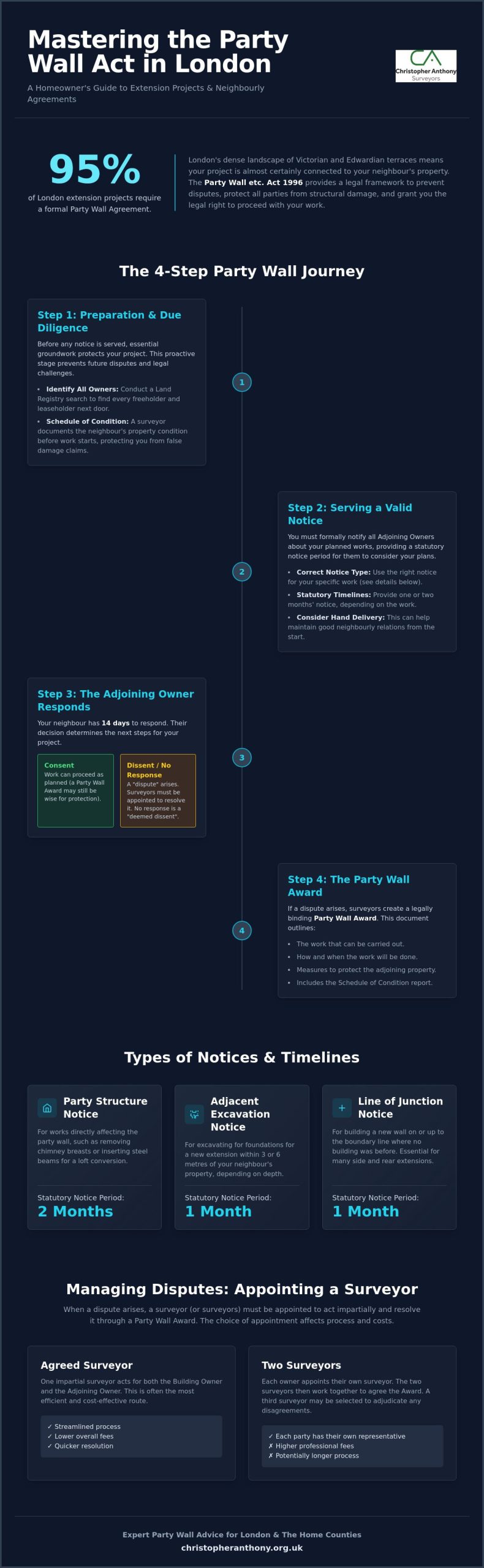
Loft conversions are the most frequent reason for a Section 3 Party Structure Notice in London. If your architect has specified steel beams that cut into the shared wall, you must provide a two-month notice period. This ensures your neighbour has ample time to seek advice. We specialise in loft conversion party wall agreements, ensuring these technical details don't delay your move-in date. Accuracy in these notices prevents "deemed dissent" from becoming a project-ending hurdle.
Section 6: Adjacent Excavations and the Three-Metre Rule
Digging for a rear extension or a garden room usually triggers Section 6. The "Three-Metre Rule" applies if you're excavating within three metres of a neighbour's structure and going deeper than their foundations. In certain circumstances, a six-metre notice is required if the excavation falls within a 45-degree plane from the neighbour's foundations. These works require a one-month notice period. We ensure your excavation plans are compliant so your groundworks can proceed without legal friction.
Serving and Responding to a Notice: Practical Advice from Christopher Anthony Surveyors
Serving a party wall notice London is the moment your project becomes a reality for your neighbours. It's often the first formal communication they receive about your plans. Precision is vital. To start, you must identify all affected owners and serve the correct notice type based on your specific works. We recommend following a professional step-by-step guide to ensure every procedural detail is covered. Once served, your neighbour has three options under the Party Wall etc. Act 1996. They can consent to the works, dissent and appoint their own surveyor, or dissent and agree to use an Agreed Surveyor.
Always ensure you get a response in writing. Verbal agreements are not legally binding. They offer no protection if a dispute arises later. A practical tip we often share is to include your architectural drawings with the notice. Visual plans often reduce neighbour anxiety. They see exactly what is happening. This transparency frequently leads to a faster consent and a better relationship throughout the build.
View our party wall surveyor costs
Why Generic Online Templates Often Fail
Free templates are tempting but dangerous. They often lack the specific technical data or the precise statutory wording required for London properties. An invalid notice is a legal void. It can lead to a project-stopping court injunction just as your builders are ready to start. We ensure every notice we serve is legally robust. It must be tailored to the unique geometry of your site to remain valid under scrutiny.
What to Do if a Neighbour Ignores Your Notice
London is full of absentee landlords and busy professionals. If a neighbour ignores your party wall notice London, the 14-day rule applies. After 14 days of silence, a "Deemed Dissent" occurs. This doesn't mean your project stops. Instead, a dispute is legally considered to have arisen. You must then serve a follow-up 10-day notice. If they still don't respond, Section 10(4) of the Act allows you to appoint a surveyor on their behalf. This keeps your project moving whilst complying with all statutory party wall notice deadlines.
Managing Disputes and Appointing a London Party Wall Surveyor
If your neighbour dissents or fails to respond to your party wall notice London, a dispute is legally considered to have arisen. This doesn't mean your project is over. It simply means you need professional intervention to move forward. As the Building Owner, you'll appoint your own surveyor to manage the process. Your neighbour then has the right to appoint an Adjoining Owner Surveyor. Whilst this is the standard legal route, it typically means you'll be responsible for two sets of professional fees.
We often recommend the Agreed Party Wall Surveyor role as a more efficient alternative. In this scenario, one impartial surveyor acts for both parties. It's a faster, more cost-effective way to reach a resolution. The surveyor's primary duty is to the Act itself, ensuring the build is fair and safe for everyone. This role provides a neutral ground that often prevents neighbourly relations from souring during the construction phase.
The process culminates in the Party Wall Award. This is a vital legal document that protects your London property. It sets out the exact "how, when, and where" of the construction works. It covers permitted working hours, specific methods of structural support, and vibration limits. The Award also incorporates the schedule of condition survey. This ensures that when the project is finished, a final sign-off review can confirm no damage has occurred. It's the ultimate peace of mind for any homeowner.
Fixed-Fee Certainty for London Homeowners
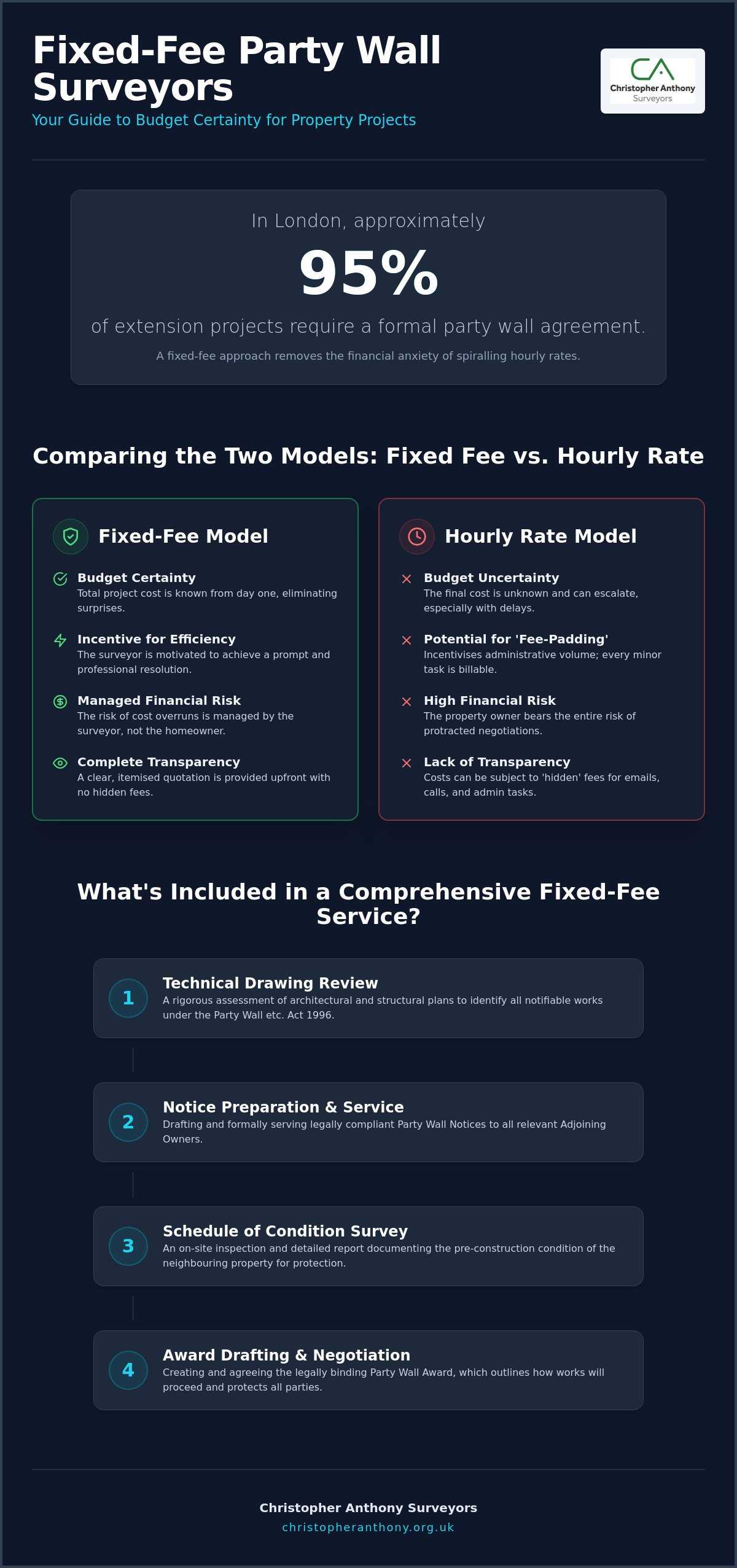
Many firms in the capital still use hourly rates. This can lead to an "open chequebook" situation where costs spiral out of control. We advocate for a different approach. Christopher Anthony Surveyors provides transparent, fixed-fee pricing. Our service includes everything from the initial party wall notice London to the final Award sign-off. You get expert guidance and total cost certainty from day one. There are no hidden extras or unexpected bills.
Summary of the Party Wall Process
- Serve your notices early to avoid project delays and legal injunctions.
- Always conduct a Schedule of Condition to protect against false damage claims.
- Consider an Agreed Surveyor to reduce professional fees and streamline disputes.
- Ensure all freeholders and leaseholders are correctly notified before work begins.
Frequently Asked Questions
How much does a party wall surveyor cost in London?
Fees vary depending on the complexity of the project and the number of neighbours. We offer fixed-fee quotations to provide total cost certainty for homeowners.
Can a neighbour stop my extension?
A neighbour cannot stop your work, but they can ensure it is done safely. The Act provides a framework for works to proceed even if a neighbour dissents.
When should I serve a party wall notice?
You should serve notice at least two months before starting work on a party structure, or one month for excavations.
Need Advice About Your Project?
Every London project is unique. If you're feeling confused about notice periods or surveyor appointments, our "Christopher Anthony Party Wall Assistant" tool offers instant guidance. We invite you to request a bespoke fixed-fee quotation for your project. Our team serves homeowners and developers across London, Hertfordshire, Essex, and Kent. We bring over 20 years of experience to every appointment, ensuring your project commences without delay.
About Christopher Anthony Surveyors
Christopher Anthony Surveyors is a specialist practice dedicated to party wall matters. We combine professional authority with a friendly, approachable style. We don't hide behind legal jargon. Instead, we provide practical solutions that keep projects moving. As a boutique consultancy, we offer high-level expertise with a personal touch. We're proactive problem-solvers who understand the pressures of London construction. We value your time and your peace of mind above all else.
Secure Your Construction Timeline with Confidence
Navigating the statutory requirements of the 1996 Act doesn't have to be a daunting hurdle for your London renovation. By identifying all affected owners early and ensuring your technical drawings are accurate, you set the stage for a collaborative and legally robust project. Serving a valid party wall notice London is the vital first step in protecting your investment and maintaining positive relationships with those living next door. Whether you're planning a complex basement excavation or a straightforward loft conversion, professional oversight ensures you avoid the costly delays of an injunction.
At Christopher Anthony Surveyors, we bring over 20 years of experience to every appointment. We specialise in both Building Owner and Adjoining Owner roles, providing a protective guide through every stage of the process. Our fixed-fee guarantee eliminates the anxiety of escalating costs, offering you total transparency from the outset. We handle the paperwork and the technical nuances so you can focus on the build itself.
Request Your Fixed-Fee Party Wall Quotation Today
Your property development journey should be a rewarding experience. With the right expert support, you can move forward with the certainty that your legal obligations are met and your property is fully protected. We're here to ensure your project starts on the right foot and stays on track.
Frequently Asked Questions
Do I really need a party wall notice for a simple London loft conversion?
Yes, you almost certainly do. Most London loft conversions involve cutting into the shared party wall to insert structural steel beams or removing chimney breasts. This work falls under Section 3 of the Act. Failing to serve a party wall notice London before starting can lead to legal injunctions and significant delays. It's better to be proactive and ensure your paperwork is in order before the contractors arrive on site.
What happens if my neighbour refuses to sign the party wall notice?
Your neighbour cannot stop the project simply by refusing to sign. If they dissent or ignore the notice for 14 days, the law considers a dispute to have arisen. This triggers the "deemed dissent" process. You'll then need to appoint a surveyor to resolve the matter through a formal Party Wall Award. This document sets out the rules for the work whilst protecting both properties from damage.
Who pays the surveyor fees in a London party wall dispute?
The Building Owner is typically responsible for all professional costs. This includes the fees for your own surveyor and the surveyor appointed by your neighbour. In some rare cases, costs might be shared if the work benefits both parties, such as repairing a dilapidated shared wall. We provide fixed-fee quotes to help you manage these expenses without any hidden surprises or hourly rate escalations.
How long does a party wall notice remain valid in the UK?
A notice is valid for exactly 12 months from the date of service. If you don't commence the specific works mentioned in the notice within this year, the notice expires. You'll then have to start the process again from scratch. It's essential to time your notice service carefully to align with your project's start date and any planning permission windows to avoid redundant paperwork.
Can I serve a party wall notice myself or should I use a professional?
You are legally permitted to serve your own notice, but we strongly advise against it. London properties often have complex ownership structures involving freeholders and leaseholders. A single technical error or an incorrect address can invalidate your party wall notice London, leading to project halts and wasted money. Professional service ensures your notice is legally robust and technically accurate from day one.
Does a party wall agreement give my neighbour the right to stop my building work?
No, a party wall agreement is not a veto. It's a regulatory framework that determines how the work will be carried out safely. Whilst a neighbour cannot stop you from building, they have the right to ensure their property is protected. The resulting Award will detail working hours and structural safeguards, but it won't prevent you from exercising your legal right to improve your home.