In 2026, viewing a schedule of condition survey cost as a mere expense is a mistake that could cost you thousands in litigious disputes later. Whether you are planning a loft conversion in Hertfordshire or a basement excavation in London, you are likely already juggling complex budgets and tight timelines. It is perfectly natural to worry about hidden surveyor fees or the prospect of an adjoining owner blaming your project for pre-existing cracks in their masonry whilst your work is underway.
We agree that you shouldn't have to deal with the stress of "estimate creep" or the fear of unsubstantiated damage claims. You deserve a process that is transparent, efficient, and protective. This guide explains exactly what influences the price of these surveys and how a fixed-fee approach provides the certainty you need. We will break down who is responsible for the bill under the Party Wall etc. Act 1996 and how professional evidence serves as your best legal defence. You will gain the confidence to choose a surveyor who values your time and provides the robust protection your property requires.
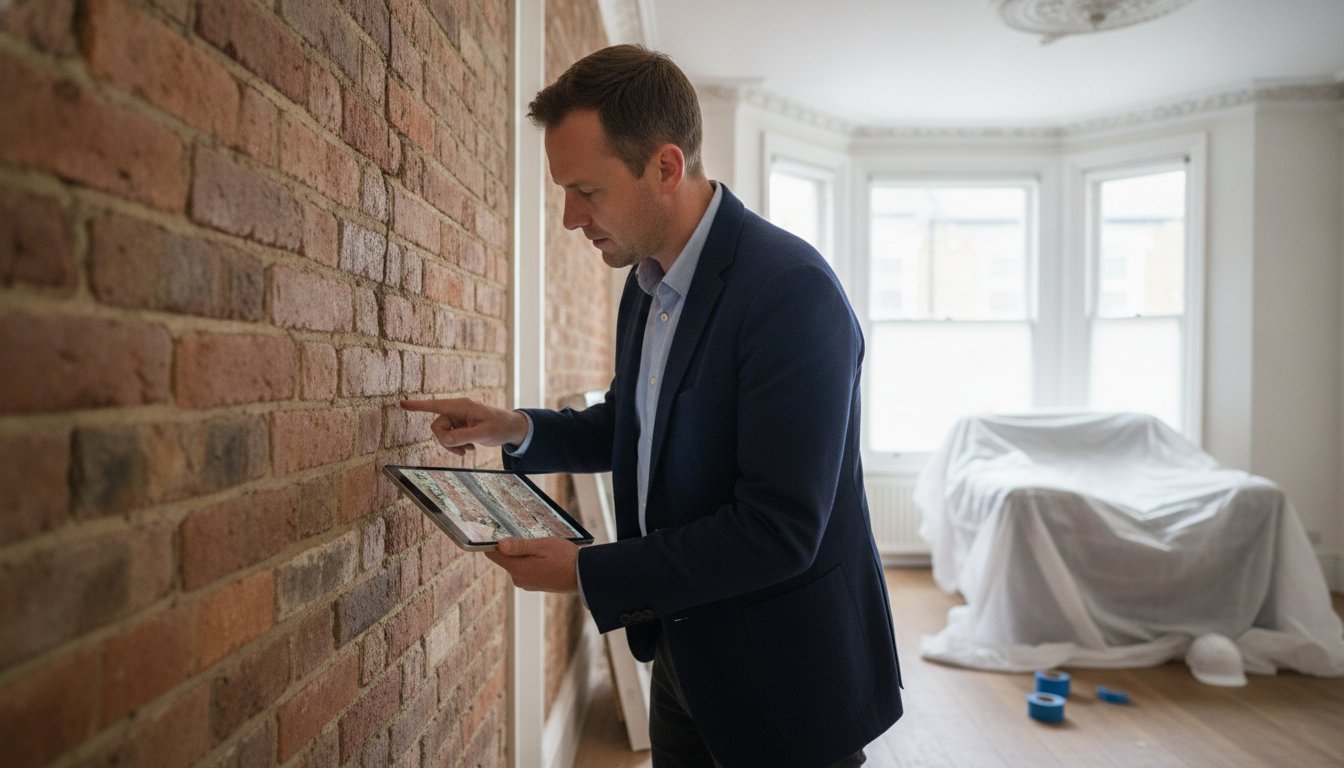
A Schedule of Condition (SoC) is a factual, photographic, and written record that captures the exact state of a property before any building work begins. It isn't a vague set of observations. It's a rigorous document that details every existing defect, from hairline cracks in plaster to the condition of external brickwork. Within the framework of the Party Wall etc. Act 1996, this survey provides the essential baseline for all parties involved in a project.
The schedule of condition survey cost is best viewed as a protective barrier for your budget. Without a professional record, you are vulnerable to "open-ended" damage claims that are impossible to disprove. It's much harder to argue that a crack was "already there" when you don't have the evidence to back it up. Investing in this survey provides genuine peace of mind for both building owners and adjoining owners alike. It keeps the process fair.
In many cases, an adjoining owner party wall surveyor will insist on a Schedule of Condition to protect their client's property rights. It ensures that if damage occurs, there's no room for debate about the cause. Building owners should also demand a professional SoC. It prevents neighbours from making fraudulent claims or mistakenly attributing old wear and tear to your new extension or loft conversion. It's about factual clarity.
Amateur snapshots rarely suffice in a formal dispute. They often lack the systematic detail and date-verified evidence that a court or surveyor requires. In the commercial world, these documents are vital for avoiding breaches of lease covenants, but they are just as critical for residential projects in London and the Home Counties. A surveyor's record is legally robust. It captures the "hidden" areas that homeowners often miss. This level of evidential depth is what makes the document a powerful tool for dispute resolution in 2026. For those undertaking works in densely populated urban areas, a party wall surveyor north London homeowners rely on can ensure this evidence is gathered to the highest professional standard.
Your schedule of condition survey cost isn't a random figure pulled from thin air. It's a direct reflection of the time and expertise required to document a specific property accurately. Several variables dictate how much time a surveyor spends on-site and how long the subsequent report takes to compile. We don't believe in one-size-fits-all pricing because every property in London and the Home Counties has its own story.
Property size is the most obvious driver. A large five-bedroom detached house in Hertfordshire takes significantly longer to record than a one-bedroom flat in Essex. Every room, hallway, and cupboard needs to be scrutinised. Complexity also plays a major role. Recording the intricate details of a Grade II listed building or a weathered Victorian terrace in London requires far more precision than a modern apartment. We follow the professional standards for a Schedule of Condition set by RICS to ensure every report is legally sound.
The scope of your building work also shifts the fee. A simple chimney breast removal might only require a survey of the immediate adjoining rooms. Conversely, a deep basement excavation is a high-risk project. It necessitates a comprehensive survey of the entire neighbouring property to mitigate the risk of structural claims. If you're unsure about the scope needed for your project, you can view our transparent pricing guide for more clarity.
Commercial surveys are different. They often focus on "dilapidations" and future legal obligations for lease endings. These require a different level of legal scrutiny compared to standard Party Wall matters, and specialist firms like OMNIA Building Consultants Ltd can provide the necessary expertise for these complex professional requirements. The time spent on-site for a commercial unit is often higher due to the scale of the demise.
Don't overlook the exterior. Patios, garden walls, and outbuildings are frequently the subject of disputes. A comprehensive boundary-to-boundary record is the safest choice. While including external areas might slightly increase the total schedule of condition survey cost, it prevents "he said, she said" arguments about garden subsidence or cracked paving later on. It's about total protection.
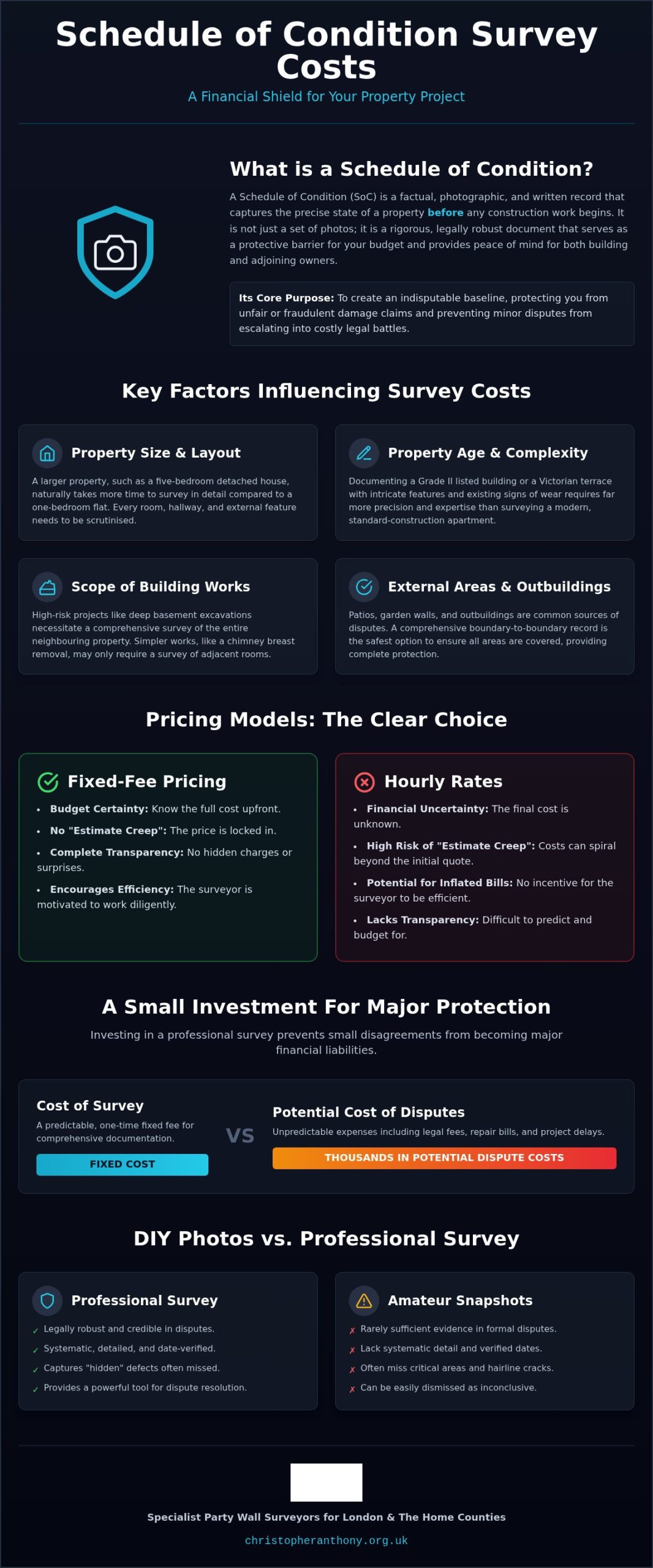
Hourly billing is a common trap in the surveying industry. It often leads to "estimate creep", where the final bill for your project quietly exceeds the initial quote. We don't believe in this approach. Choosing a fixed fee party wall surveyor ensures your project budget remains intact from the start. You shouldn't have to guess your total schedule of condition survey cost while managing a complex build in London or Hertfordshire.
A transparent quote should cover everything: travel, site time, and the detailed drafting of the report. When you compare quotes, look beyond the bottom line. Consider the quality of the evidence provided. A cheap report that fails to stand up in a dispute is a poor investment. You are paying for the certainty that your property is protected by high-quality, professional documentation.
View our fixed-fee pricing for schedule of condition surveys
Under the Party Wall Act, the Building Owner is usually responsible for the cost of the schedule of condition survey for both properties. This is standard practice across the Home Counties. The person undertaking the work carries the legal burden to return the property to the state it was in before the project began. There are rare exceptions, such as when an adjoining owner requests an unnecessarily extensive survey, but these are handled on a case-by-case basis depending on the specific project requirements.
Beyond the financial protection, there is significant psychological value. Building works are inherently stressful for neighbours. Providing an objective, third-party record reduces friction and prevents the project from becoming a personal battleground. It sets a professional tone from day one. When the dust settles, having a professional SoC also speeds up the final "signing off" process. It allows both parties to agree that the property is in the same condition as when you started; this closes the file without lingering disputes.
At Christopher Anthony Surveyors, our approach is built on speed, precision, and the total removal of hidden complications. We don't believe in dragging out the process or using detached legal jargon. We provide the facts clearly and quickly so you can focus on your build.
Every project is unique. Whether you are planning a side extension in Essex or a basement excavation in London, you need advice tailored to your specific circumstances. We invite you to request a fixed-fee quotation that provides the budget certainty you need. You can also use the "Christopher Anthony Party Wall Assistant" tool for rapid guidance on your obligations. Don't leave your property protection to chance.
Christopher Anthony Surveyors is an independent specialist practice led by Tony, an expert with over 20 years of experience in the property industry. We serve clients across London, Hertfordshire, Essex, and Kent, providing a modern alternative to traditional, slow-moving firms. Our mission is to demystify the Party Wall etc. Act 1996 for homeowners and developers alike. We pride ourselves on professional authority, rapid results, and a personal touch that ensures your project stays on track without unnecessary stress.
Navigating a building project shouldn't feel like a gamble. We've explored how a professional record protects your budget and your relationship with neighbours. Choosing a fixed-fee model eliminates the risk of "estimate creep" and ensures you know your total schedule of condition survey cost from the very first day. It's about replacing uncertainty with objective evidence. This factual baseline is the only way to ensure that both parties are treated fairly if issues arise.
With over 20 years of specialist experience across London and the Home Counties, we understand that precision is non-negotiable. A high-quality survey is your most effective shield against unfair claims. It keeps your timeline moving and your peace of mind intact whilst you focus on the build itself. If you are undertaking a loft conversion in St Albans or a basement excavation in Watford, working with a party wall surveyor Hertfordshire specialists trust ensures your Schedule of Condition is handled with the local expertise your project demands. We guarantee transparency and local expertise to help you move forward with confidence. Professional documentation isn't just a requirement; it's your project's best defence.
Request your fixed-fee schedule of condition quote today
We're here to ensure your project starts on the right foot. Don't leave your property's safety to chance or amateur photos. Reach out to our team today for straightforward advice and the professional protection your investment deserves. We look forward to helping you secure your property's future.
The price for a survey in London and the Home Counties varies depending on the property's size, age, and structural complexity. A large Victorian terrace with intricate period features requires more detailed recording than a modern apartment block. Rather than relying on generic estimates, we suggest requesting a fixed-fee quotation to ensure you have a precise figure tailored to your specific project and property type.
Whilst the Party Wall etc. Act 1996 doesn't explicitly state that a survey is mandatory, it's considered essential professional practice. Most surveyors will strongly advise it as part of the Party Wall Award process. Without this factual baseline, it's virtually impossible to settle damage disputes fairly, leaving both the building owner and the adjoining owner vulnerable to drawn-out legal arguments.
The building owner undertaking the construction work is typically responsible for the schedule of condition survey cost for both their own property and the neighbour's. This follows the general principle of the Act that the person benefiting from the works should cover the associated professional fees. This ensures the adjoining owner isn't financially penalised by your project's procedural requirements.
A standard residential site visit usually takes between one and three hours, depending on the scale of the property and the areas being inspected. Following the visit, the surveyor requires time to compile the photographic evidence and written descriptions into a formal report. We prioritise efficiency and typically aim to deliver the completed document within 24 to 48 hours of the site inspection.
Using amateur photos is a significant risk that often fails to provide robust evidence in a formal dispute. Professional surveyors use a systematic, "room-by-room" methodology that ensures every defect is captured with high-resolution clarity and professional context. Amateur snapshots frequently lack the date-verification and comprehensive coverage needed to be legally persuasive if a neighbour makes a claim for damages later.