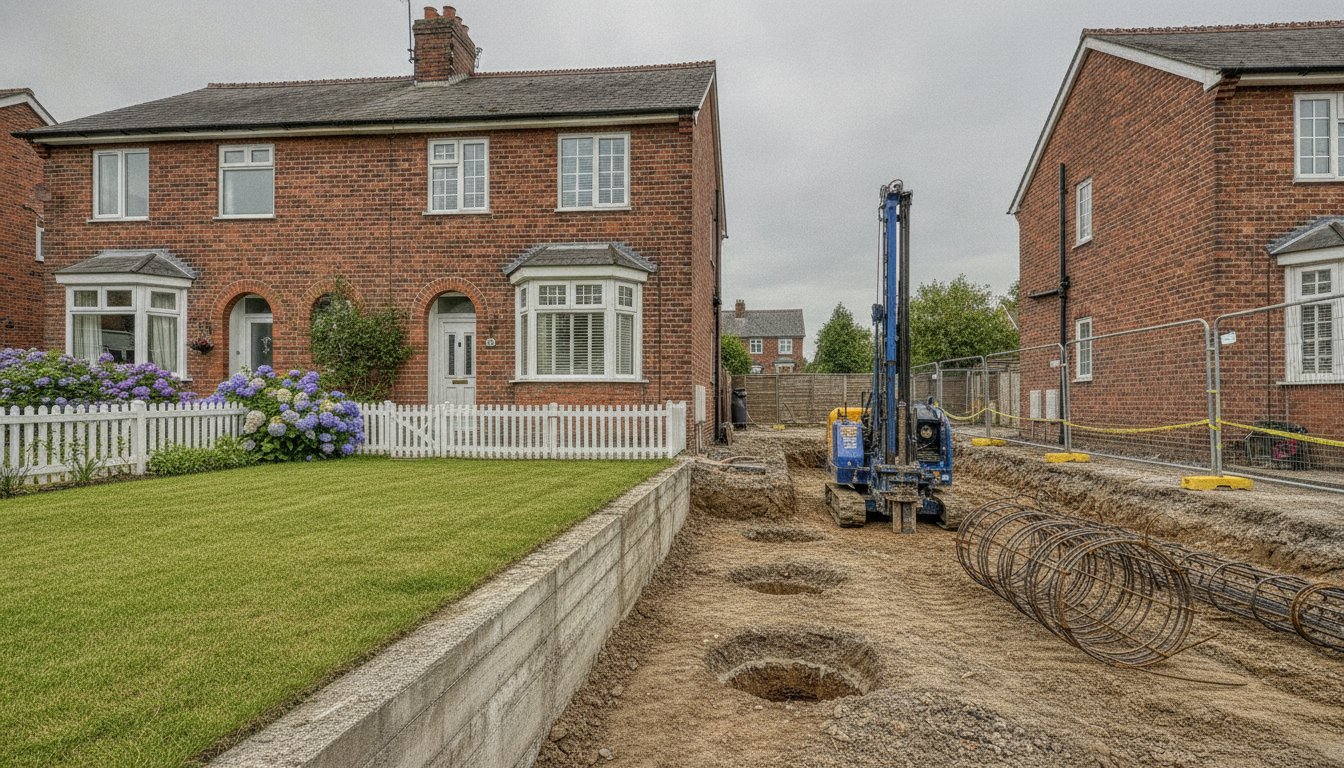
Is a pile driver vibrating your floorboards a sign of progress or a pending structural disaster? When a neighbour chooses piled foundations over standard trenches, the stakes for your property's safety rise significantly. It's natural to feel anxious about structural cracks or ground movement when heavy machinery starts thumping next door. You're right to be concerned; piling is a high-impact structural event that triggers specific protections under the piled foundations party wall act framework.
This guide explains exactly where you stand and what your neighbour must do before they start work. We'll clarify the confusing 6-metre rule and explain why special foundations often require your express written consent. You'll learn how to ensure your home is legally protected through a Schedule of Condition and when it's time to appoint a professional surveyor. By the end of this article, you'll have the clarity needed to handle the situation with confidence, ensuring your property remains secure whilst your neighbour's project moves forward correctly.
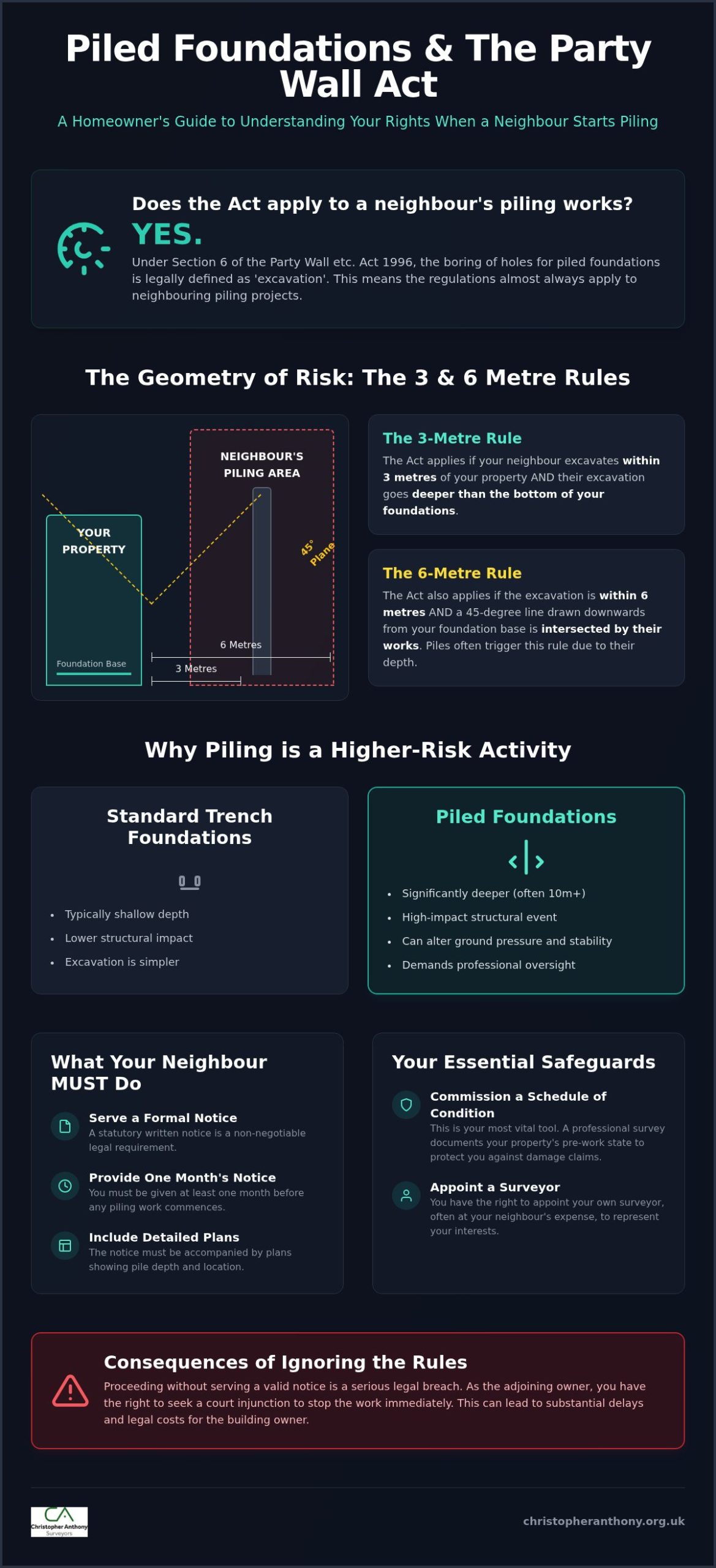
Under Section 6 of the Party Wall etc. Act 1996, any excavation within 3 or 6 metres of a neighbouring structure, including the boring of holes for piled foundations, requires formal notice and compliance with statutory procedures.
Many homeowners mistakenly believe the Act only applies to digging traditional trenches. However, the legal definition of excavation includes the boring or drilling required for piling. The primary purpose of the legislation is to manage the risk of subsidence or heave caused by works near your property boundary. If a project triggers the 3-metre or 6-metre rules, the piled foundations party wall act requirements become mandatory. These rules ensure that structural risks are identified before the first rig arrives on site.
Standard strip foundations are typically shallow. Piling is a different beast entirely. These structures often go significantly deeper to reach stable soil strata. The bore and fill process involves removing a column of earth and replacing it with reinforced concrete. This interaction with the subsoil can alter ground pressure and affect your own home's stability. It's a high-impact structural event that demands professional oversight to prevent movement in the surrounding ground. For complex developments where this type of engineering is part of a larger planning application, you can visit ML Traffic Engineers UK for specialized transport planning support.
The neighbour planning the work has a clear legal obligation. They must serve a formal notice at least one month before any piling begins. This statutory window gives you time to assess the risks and protect your interests. For those in the capital, following the correct Party Wall Notice London procedure is essential for staying compliant and avoiding costly delays. Don't let work start without the proper paperwork in place; the law is there to protect your home.
Understanding the geometry of excavation is the only way to determine if the Act applies. The 3-metre rule is the most common trigger. If your neighbour excavates within three metres of your property and goes deeper than your foundations, they must serve notice. It's a simple test of proximity and depth. However, piling projects often involve a more complex calculation known as the 6-metre rule.
Section 6(2) of the Act introduces the 45-degree plane. Imagine a line sloping downwards at a 45-degree angle from the bottom of your foundations. If the neighbour's excavation intersects this line within six metres of your wall, the Act applies. Because piles often reach depths of 10 metres or more, they almost always trigger the piled foundations party wall act requirements. A project that seems far away can still legally impact your home's stability. If you're unsure about the geometry, checking party wall surveyor costs now can save thousands in legal fees later.
Don't guess the measurements. A valid notice must include detailed plans and sections. These drawings must show the site, the depth of the proposed piles, and their position relative to your property. Following RICS professional standards, these sections provide the technical proof needed to assess structural risk. Without these drawings, a notice is likely invalid.
Distance is measured from the external face of the neighbour's wall. To check if you are in the "danger zone", follow these steps:
Proceeding without a notice is a significant legal gamble. You have the right to seek an injunction to stop the work. This halts the project instantly and can lead to substantial legal costs for the person digging. If you are the one planning the work, appointing a specialist Building Owner Party Wall Surveyor ensures all notices are served correctly, keeping your project on track and legally compliant.
Piling rigs are powerful machines. In dense urban areas like London or Hertfordshire, the energy they transmit through the ground can be significant. For terrace or semi-detached properties, these vibrations pose a genuine risk to decorative finishes and structural integrity. The piled foundations party wall act framework provides mechanisms to mitigate these risks before they manifest as costly repairs.
A central pillar of this protection is the neighbour’s legal obligation to "make good". Under the Act, if the piling work causes damage to your property, the building owner is responsible for repairing it to its original state. Proving that damage was caused by their works rather than historic settlement is where many disputes begin.
Book a Schedule of Condition Survey today
This document is an Adjoining Owner’s best friend. It provides a detailed photographic and descriptive record of your property’s condition before any machinery arrives. If a crack appears in your hallway once piling starts, this survey acts as the definitive "before" snapshot. Without it, you may struggle to secure repairs. For projects in the capital, a Schedule of Condition Survey ensures that every pre-existing defect is documented by a professional, removing the guesswork from future claims.
Your surveyor can include specific safeguards within the Party Wall Award. We often insist on vibration monitoring, where sensors are placed on your walls to alert contractors if energy levels exceed safe thresholds. We can also restrict working hours to ensure you aren't disturbed during sensitive times. Choosing the right piling method matters too; continuous flight auger (CFA) piling is often quieter and produces less vibration than traditional percussion methods. In some cases, we may even require "trial piles" to test the ground’s response before the main works proceed.
Piling is precision work. It leaves no room for error or ambiguity. Our first piece of advice is simple: never consent to a notice until you have seen the structural engineer’s piling method statement. This document reveals the mechanics behind the build, detailing the machinery, the sequence of bores, and the specific safeguards in place. For those managing their own site logistics, resources like rocketrentals.co.uk offer useful guidance on selecting the correct plant for the job. Relying on a verbal "gentleman’s agreement" is a significant risk when deep excavation is involved. Handshakes don't pay for structural repairs; a legally binding Award does.
To protect your property without causing unnecessary friction, ensure an Adjoining Owner Party Wall Surveyor is appointed as soon as you receive a notice. Early involvement allows us to review technical drawings before the project programme is finalised. If the works are relatively straightforward, you might consider an Agreed Party Wall Surveyor to act for both parties, though this depends entirely on the complexity and risks associated with the piled foundations party wall act triggers.
The resulting Party Wall Award is your structural insurance policy. It will dictate exactly how the piling must be carried out, including the precise depth and location of every pile relative to your foundations. We scrutinise these details to ensure the neighbour isn't over-sailing your boundary or risking the stability of your subsoil. The Award also sets out the procedure for monitoring and the timeline for the works, ensuring the piled foundations party wall act requirements are met in full.
Homeowners are often relieved to learn that the Building Owner usually covers the professional fees for the Adjoining Owner’s surveyor. This ensures you receive expert representation at no personal cost. We believe in total transparency regarding Party Wall Surveyor costs, providing fixed-fee certainty so all parties can proceed with confidence. Professional oversight isn't an obstacle; it's the foundation of a successful, dispute-free project.
Piling is a significant structural undertaking that requires careful legal management to protect your home. Most piling projects trigger the piled foundations party wall act requirements due to the extreme depth of the bores and proximity to your boundary. Ensuring a formal notice is served and a detailed Schedule of Condition is recorded are the most effective ways to safeguard your property against vibration damage. These steps provide the technical and legal evidence needed should any issues arise during construction.
Expert oversight from a specialist surveyor removes the stress of navigating complex 45-degree planes. It ensures your neighbour’s project moves forward without compromising your peace of mind. Our team brings over 20 years of experience, offering fixed-fee transparency across London and Hertfordshire. Don't leave your property's safety to a verbal agreement when statutory protections are available.
Taking proactive steps today ensures a smoother build for everyone involved. We're here to act as your protective guide through every stage of the process.
You generally can't stop a neighbour from using a specific foundation type if they've secured the necessary planning and building control approvals. However, the Act ensures the work is done safely. If the piles are "special foundations" reinforced with steel, Section 7(4) requires your express written consent. If you withhold this, they may have to redesign the foundations, but you can't block the project entirely without valid structural grounds.
Residential piles typically reach depths between 5 and 15 metres, depending on local soil conditions and the structure's load. In London areas with heavy clay, they often go deeper to reach stable ground. Because these depths far exceed standard foundations, the piled foundations party wall act 6-metre rule is almost always triggered. This necessitates a formal notice to be served to the adjoining owner before any work begins.
The Building Owner undertaking the work is usually responsible for all costs associated with the Party Wall process. This includes vibration monitoring if the surveyors deem it necessary for the property's safety. This monitoring is a vital protective measure that ensures energy levels stay within safe limits. It's typically written into the Award to provide peace of mind. You shouldn't have to pay for this essential structural safeguard yourself.
You should immediately notify your appointed surveyor, who'll compare the new damage against the pre-work Schedule of Condition. If the piling is found to be the cause, the Building Owner has a legal obligation to "make good" the damage or provide financial compensation. Having a professional record of your home's original state is vital here. It prevents the neighbour from claiming the cracks were pre-existing or caused by historic settlement.
The 6-metre rule applies to any "structure" belonging to an Adjoining Owner. This includes substantial garden walls, garages, and outbuildings, not just the main residence. If your neighbour's piling falls within 6 metres of your garden wall and meets the 45-degree depth criteria, they must serve a formal notice. Protecting these boundary structures is important, as ground movement from piling can easily cause them to lean or crack over time.