
Has a neighbour’s building project left you wondering whether a formal notice affects your property or plans? A section 3 party wall notice can raise immediate questions: does it cover the work proposed, what should you do next, and is it the same as an excavation or boundary notice? It’s sensible to check what the notice means before responding.
Christopher Anthony Surveyors helps building owners and adjoining owners understand what a notice says and what needs checking in their circumstances. This guide explains the purpose of a Section 3 notice under the Party Wall etc. Act 1996, including the two-month notice period, and how it differs from notices under Sections 1 and 6. You’ll find practical points to check, the response routes that may be available and when project-specific surveying advice can help. The right next step depends on the notice, the work and the properties involved, so don’t rely on a project label or generic template alone.
A Section 3 notice is formal notice that a building owner intends to carry out work under Section 2 of the Party Wall etc. Act 1996 to a party structure. It tells the adjoining owner what work is proposed and when it is intended to start. It is not, by itself, permission to proceed or confirmation that every detail has been agreed.
In practice, this notice is used where proposed work involves rights relating to a party wall or another party structure covered by the Act. The Act describes particular types of work, so a shared boundary or a project near a neighbour’s property does not automatically mean Section 3 applies. The structure, plans and work proposed all matter. For wider background, see this overview of the Party Wall etc. Act 1996.
A loft conversion might involve work to a party wall, while a rear extension could raise different Party Wall Act questions depending on its design. The project name alone won’t identify the correct notice. Read the notice alongside the actual scope of work, and check whether the drawings clearly show what is proposed to the party structure.
No. The notice communicates the building owner’s proposed work. A party wall award is a separate formal document prepared by surveyors where a dispute arises under the Act. It can set out how relevant work is to proceed and address matters such as access or protection. Depending on the circumstances, the owners may appoint separate surveyors or agree to use an Agreed Surveyor. The documents serve different purposes, and a notice doesn’t automatically mean an award will follow.
A Section 3 notice may be relevant when proposed work falls within the rights described in Section 2 of the Party Wall etc. Act 1996 and affects a party wall or another party structure. The work’s relationship to that structure matters more than the project name. A loft conversion, rear extension, chimney alteration or commercial refurbishment does not automatically require this notice. The details need to be assessed against the Act.
The notice route depends on the work involved. Section 3 concerns proposed work to a party structure under Section 2. Section 1 addresses certain new walls at or astride a boundary, while Section 6 concerns certain excavations near neighbouring structures. These routes have different scopes. You can check the official text of the Party Wall etc. Act 1996, but applying it to a particular property may require careful interpretation.
Start with the proposed work, not just the planning description. Check:
For example, removing a chimney breast may involve work to a party wall, but the construction and ownership details matter. Excavation for an extension may instead raise questions about another notice route. A Building Owner Party Wall Surveyor can help assess the notice position against the proposed work. The plans and site circumstances, rather than the project label, determine what needs to be considered.
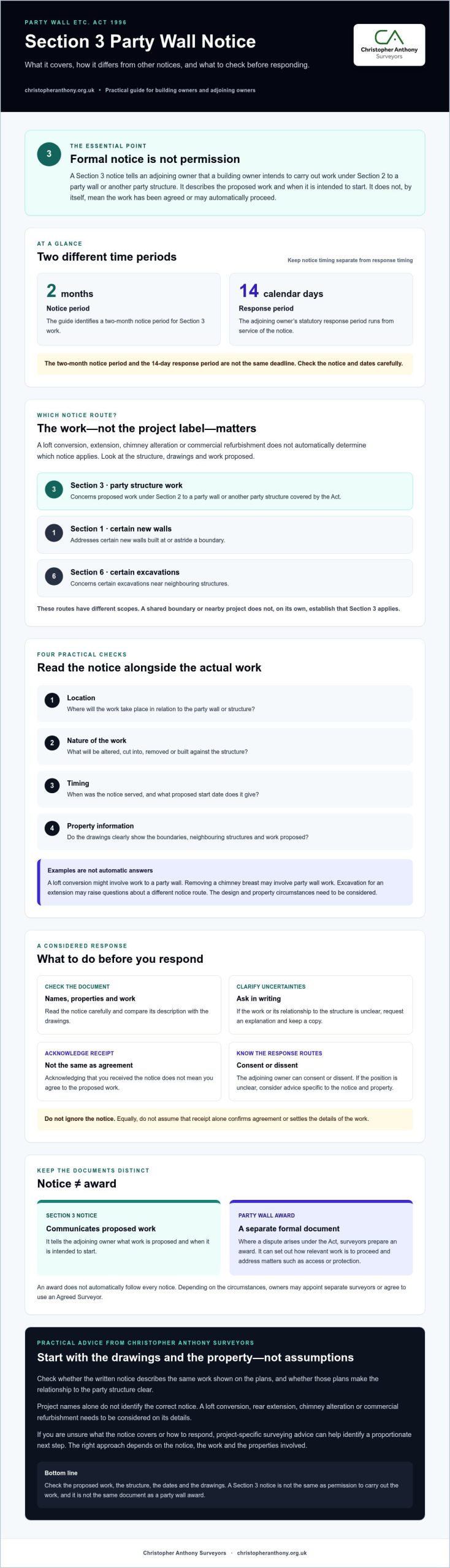
Don’t ignore the notice, but don’t assume that acknowledging receipt means you agree to the work. Acknowledging a notice confirms you’ve received it; it isn’t the same as agreeing to the proposed work.
Before deciding how to respond, work through these checks:
Under the Party Wall etc. Act 1996, the adjoining owner can consent or dissent. If dissenting, they can agree with the building owner to appoint one Agreed Surveyor, or each appoint a surveyor. If there’s no written response within 14 days, a dispute is deemed to have arisen under the Act. Don’t treat silence as consent. If the deadline has passed or you’re unsure how to proceed, seek advice promptly.
A surveyor can help clarify whether the notice reflects the proposed work, explain the available response routes and address questions about safeguards. This may be useful if the drawings are incomplete, the description is unclear or you’re concerned about effects on your property. A surveyor can explain the process, but the appropriate steps depend on the notice and circumstances.
adjoining owner party wall surveyor advice
For an adjoining owner, a focused review can help identify which details need clarification before you decide how to respond.
Consider a Section 3 notice in the context of the proposed work and the properties involved. If you’re the building owner, compare the notice with the current drawings and make sure the work is described clearly. If you’re an adjoining owner, list the points you need clarified and check the response deadline before deciding how to proceed. The right next step depends on the individual circumstances.
Christopher Anthony Surveyors advises building owners and adjoining owners in London, Hertfordshire, Essex and Kent. The Party Wall etc. Act applies consistently across these areas, but buildings, boundaries and project plans differ. If you’re serving a notice, a building owner party wall surveyor can help you consider the notice process in relation to your project.
If you’re unsure whether a notice reflects the proposed work or what to do next, Christopher Anthony Surveyors can help you consider the details. You can request a fixed-fee quotation or use the Christopher Anthony Party Wall Assistant to outline your situation.
Established for over 20 years, Christopher Anthony Surveyors provides party wall surveying advice and services to building owners and adjoining owners across London, Hertfordshire, Essex and Kent. Services include party wall notices, awards and schedules of condition, with guidance tailored to each project’s circumstances.
A section 3 party wall notice is part of a formal process, not blanket approval for building work. Check that the notice, project details and drawings align. Don’t assume that a loft conversion, extension or other project automatically calls for this notice. If anything is unclear, get advice based on the work and properties involved before deciding how to respond.
Christopher Anthony Surveyors provides party wall surveying services for building owners and adjoining owners across London, Hertfordshire, Essex and Kent. The firm can help you understand the notice and consider a proportionate next step, with advice shaped around the project rather than assumptions.
A Section 3 notice is formal notice connected with proposed work to a party wall or party structure under the Party Wall etc. Act 1996. Whether it applies depends on the work and property involved. It tells an adjoining owner what work is proposed, but it isn’t a party wall award. Check the notice details and seek project-specific advice if its scope is unclear.
A Section 3 notice may apply where proposed work falls within the Act’s provisions for work to a party wall or party structure. An extension, loft conversion or repair doesn’t automatically require one. The correct notice route depends on the work and property circumstances. Check the plans and the structure affected rather than relying on a project description or assuming another notice category applies.
Where a Section 3 Party Structure Notice applies, it must be served at least two months before the planned start of the work. Confirm that Section 3 is the correct route before using this period to plan a project, as other types of notice have different periods. Check the notice dates and current statutory requirements, and allow time to address questions that could affect the programme.
You can dissent from the proposed work under the Act, but disagreement doesn’t automatically stop the project. The adjoining owner can consent, dissent and appoint an Agreed Surveyor with the building owner, or dissent and appoint their own surveyor. A written response is generally due within 14 days. If there’s no response, a dispute is deemed to have arisen. Check the notice and seek advice promptly if you’re unsure.
The building owner proposing work covered by Section 3 is generally responsible for serving the appropriate notice on the adjoining owner. The correct recipients and notice details depend on the work and property ownership, so check these before serving it. Christopher Anthony Surveyors advises building and adjoining owners across London, Hertfordshire, Essex and Kent, with guidance tailored to the project rather than assumptions based on location.