
Imagine the dust has finally settled on your new extension, only for your neighbour to knock on the door, pointing at a fresh crack in their hallway. Without a clear record of how that wall looked before the builders arrived, it's your word against theirs. It's a nightmare scenario. Expensive. Stressful. If you're currently planning building works or navigating a lease change, you're likely asking: what is a schedule of condition survey and is it worth the investment?
We understand the anxiety that comes with structural changes. You want to improve your home, not end up in a legal battle over pre-existing damp or hairline fractures. Legal peace of mind. A clear record. No hidden complications. This guide will show you exactly how a Schedule of Condition acts as your ultimate insurance policy; it protects your property and your pocket. We'll break down the legal requirements of the Party Wall Act, explain the surveying process, and reveal why this report is the most effective tool for avoiding costly disputes when your project concludes.
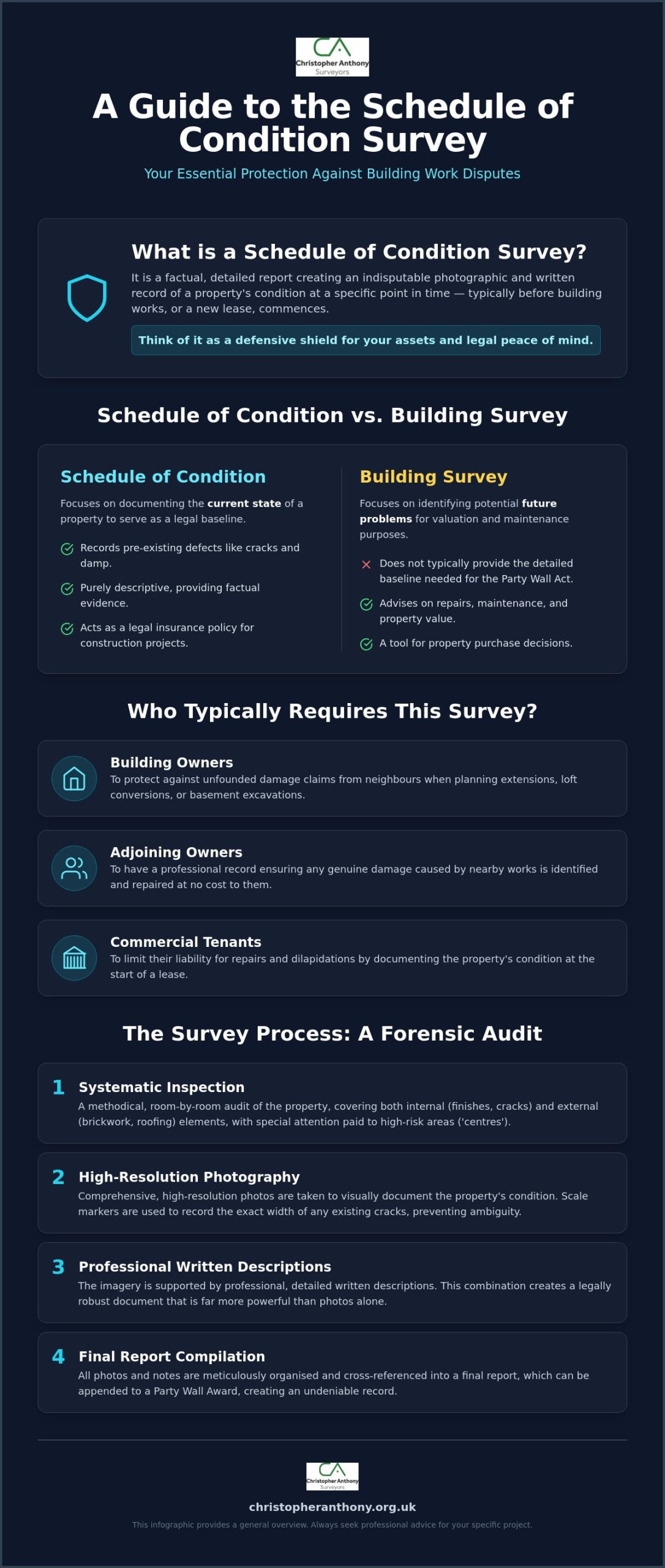
At its core, a Schedule of Condition Survey is a factual, detailed record of a property's condition at a specific point in time. It isn't just a quick walk-around. It's a rigorous assessment that combines high-resolution photography with professional written descriptions of every room. By capturing the exact state of a building before any hammers hit a wall or a new lease begins, it creates an indisputable snapshot of the property's fabric. If you're asking what is a schedule of condition survey, think of it as a defensive shield for your assets.
This report is crucial for identifying pre-existing defects like cracks, damp, or structural movement. Without it, you're vulnerable to disputes that can drag on for months. We've seen projects in London and Hertfordshire stall because of arguments over a single crack that "wasn't there before." A professional schedule removes the guesswork. It provides clear, objective evidence that protects everyone involved. Understanding what is a schedule of condition survey helps you realise it's more than just a document; it's a vital part of the modern construction process.
It's easy to confuse different types of reports. Building surveys look for future problems; Schedules of Condition record current ones. While a structural survey focuses on value and long-term maintenance advice, a condition survey is purely descriptive. It doesn't tell you how much a house is worth or how to fix a roof. Instead, it documents every hairline fracture and scuff on the joinery as they exist right now. A Schedule of Condition acts as a legal insurance policy for your property's physical fabric.
While a survey protects your bricks and mortar, comprehensive financial planning protects your future; firms like Timothy Roberts & Associates, LLC provide wealth management and tax solutions that complement your property investment strategy.
Several parties benefit from this level of detail. Under the Party Wall Act 1996, it's often the most sensible way to manage risk. The following people usually require one:
When the surveyor arrives at the property, the process is methodical and highly organised. It isn't a casual walkthrough. Instead, it's a forensic audit. If you're still wondering what is a schedule of condition survey in a practical sense, it's the systematic documentation of every room, from the floorboards to the ceiling coving. The surveyor records the current state of the building fabric to ensure that any future changes can be accurately measured against this baseline. Understanding what is a schedule of condition survey involves recognising that it is a proactive step to safeguard your interests before any work begins.
The inspection is split into two distinct phases. Internally, the surveyor documents every hairline crack, blemish, and the general condition of decorative finishes. Externally, the focus shifts to structural stability, brickwork, roofing, and garden walls. We pay particular attention to 'centres'. These are the specific areas of the property closest to the proposed construction or excavation. By prioritising these high-risk zones, we provide the most robust protection possible. This What is a Schedule of Condition guide highlights why such detail is necessary to prevent future disputes.
Photos are a vital part of the report, but they aren't enough on their own. A robust legal defence requires professional descriptions to accompany the imagery. We use scale markers to document the exact width of existing cracks. This prevents any ambiguity later on. These photos are then meticulously organised. They're cross-referenced with the written report so they can be easily navigated within a final Party Wall Award. Precision is the priority here. If you're concerned about the specifics of your own property, you can view our dedicated service page for more details on how we tailor these inspections.
Once the site visit is complete, a final report is compiled. This document is then shared and agreed upon by both parties. It serves as an impartial record that is held as evidence until the project is finished. It's a simple, effective way to ensure transparency and maintain good relations with your neighbours throughout the build.
The Party Wall etc. Act 1996 provides the essential legal framework for building near boundaries. Whilst the Act doesn't explicitly state that a survey must be carried out, it's the most effective way to satisfy the "duty of care" required by law. If you're asking what is a schedule of condition survey in a legal context, it's the evidentiary backbone of your entire project. It protects the Building Owner from false claims of damage by a neighbour. At the same time, it protects the Adjoining Owner by ensuring any genuine damage is repaired at no cost to them. This process follows professional guidance from RICS to ensure every report meets the highest industry standards.
Without this document, you're operating in the dark. Disputes often arise from simple misunderstandings. A neighbour might notice a crack they've never seen before and assume your extension caused it. Understanding what is a schedule of condition survey helps you realise that having a pre-work record stops these "he-said, she-said" arguments before they even start. It provides a clear, objective baseline that both parties can trust. If damage does occur after works are complete, understanding the full process for making a party wall damage claim will help you resolve the matter efficiently and fairly.
In high-density areas like London, properties are often physically linked. Terraced houses and converted flats share structural elements that are sensitive to vibration and movement. Our surveyors in London, Hertfordshire, and Essex understand the specific challenges of the region, such as the heavy clay soil common in the Home Counties which can lead to seasonal movement. A clear record prevents complex legal battles over whether a crack was caused by your basement excavation or by natural ground heave. We provide the clarity needed to keep your project moving forward without friction.
The Schedule of Condition usually forms the core part of the final legal Award. This document is the formal agreement that sets out how the works will be handled. Both surveyors, or the Agreed Surveyor, must sign off on the schedule before the Award is served. Having this document ready prevents unnecessary delays to your construction start date. It's a proactive step that ensures all parties are satisfied with the recorded state of the property before a single brick is moved. This transparency builds trust and keeps the relationship with your neighbour professional and respectful.
Many property owners assume that formal documentation is an unnecessary expense. They believe that a few quick photos or a friendly chat with the neighbour is enough to prevent trouble. This is rarely the case. If you're currently asking what is a schedule of condition survey, you might also be wondering if your own smartphone snaps are a valid substitute. In reality, a professional report is an objective, third-party document that carries significantly more weight in court or mediation than amateur evidence. It removes the emotion from the situation and replaces it with cold, hard facts.
Another common myth is that a survey is too expensive for a small extension or loft conversion. We often hear owners say their neighbour is a friend, so they don't need to bother with paperwork. Unfortunately, even the best friendships can sour when structural damage is suspected. A professional survey isn't about lack of trust; it's about clarity for both sides. It provides a neutral starting point that protects the building owner from exaggerated claims and ensures the adjoining owner is treated fairly.
Amateur photography often lacks the technical detail required for a robust legal defence. Problems with poor lighting, a lack of timestamping, and missing context are frequent. A photo of a crack on a phone doesn't explain how wide it is or exactly where it sits on the wall. Professional surveys include detailed written descriptions to accompany the visual evidence. They use scale markers to provide precise measurements. Whilst DIY efforts are better than nothing, they rarely stand up to professional scrutiny when a surveyor or judge is looking for definitive proof.
The real risk isn't the cost of the survey; it's the cost of the dispute. Without a clear record, you could face thousands of pounds in legal fees and repair costs if a neighbour makes a claim. The emotional stress of a falling out over property damage can be overwhelming. A fixed-fee survey provides a known, manageable cost versus an unknown and potentially massive future liability. To help you plan your budget, you can request a fixed-fee quotation to ensure your project starts on the right foot. Understanding what is a schedule of condition survey allows you to see it as a small investment that prevents a very large, expensive problem.
Selecting a surveyor shouldn't be a gamble. You need a partner who understands the specific building stock in London, Hertfordshire, and Essex. Whether it's a Victorian terrace in Islington or a modern semi in St Albans, local knowledge matters. London's heavy clay soil and the diverse foundation types found across the Home Counties require a surveyor with local boots on the ground. A professional who understands what is a schedule of condition survey in these specific contexts will identify risks like seasonal subsidence or vibration-sensitive masonry that a generic report would overlook.
We pride ourselves on a boutique approach. This means you get personal attention and a rapid turnaround that larger, more detached firms simply can't match. Expertise in the Party Wall etc. Act 1996 is non-negotiable. Because these surveys are the first line of defence in a legal dispute, the surveyor must understand how the document fits into the wider statutory framework. We act as a proactive guide, handling the complexities so you can focus on your build. Understanding what is a schedule of condition survey allows you to see it as a shield for your property's value.
Transparency is vital. Many firms leave you guessing about the final bill, but we believe in total clarity. Christopher Anthony Surveyors prioritises a fixed-fee structure to prevent budget creep. This approach ensures you know exactly what you'll pay before the inspection even begins. It also drives efficiency. Fixed-fee models encourage a streamlined, fast-paced process because the focus is on delivering a high-quality report without unnecessary delays. It's about straightforward, professional advice that respects your project's timeline and your wallet.
Ready to move forward? The process is simple. To request a quote, you'll just need to provide some basic details like the project type, the property location, and the number of affected neighbours. Once booked, we move quickly. The timeline from the initial site visit to receiving your final, comprehensive Schedule of Condition report is designed to keep your build on track. Don't leave your property's safety to chance. Protect your project with a fixed-fee Schedule of Condition survey from Christopher Anthony Surveyors today.
Building projects are stressful enough without the added worry of legal disputes or damaged relations with your neighbours. By documenting the exact state of a property before works begin, you eliminate ambiguity and replace it with objective, photographic evidence. Now that you understand what is a schedule of condition survey, you can see why it's the most effective way to satisfy your duty of care under the Party Wall etc. Act 1996.
At Christopher Anthony Surveyors, we bring over 20 years of experience in London and Hertfordshire to every project. We offer a fixed-fee guarantee for total price transparency, ensuring you never face hidden costs or budget creep. Our deep expertise in the Party Wall etc. Act 1996 means your interests are protected by seasoned professionals who know exactly how to safeguard your property fabric and your legal position.
Don't leave your most valuable asset to chance. Get a fixed-fee quote for your Schedule of Condition survey today and move forward with your project in total confidence. We're here to provide the clarity and security you need for a successful, dispute-free build.
It isn't a strict legal requirement under the Party Wall etc. Act 1996, but it is highly recommended as standard practice. Most professional surveyors won't agree to a Party Wall Award without one. It's the only way to satisfy your legal duty of care by providing objective evidence of a property's state before works begin. Without this record, you're vulnerable to claims that are impossible to disprove.
The Building Owner, the person undertaking the construction work, is typically responsible for the costs. This includes the surveyor's fees for inspecting both their own property and any affected neighbouring buildings. In residential projects like loft conversions or extensions, the law ensures the neighbour isn't financially disadvantaged by your project. This covers all reasonable costs associated with documenting the property's condition.
A typical site inspection for a standard residential home takes between one and three hours. The exact time depends on the size of the property and the complexity of the areas being recorded. When asking what is a schedule of condition survey in terms of timeline, you should also account for the report's preparation. We usually compile and issue the final document within a few working days of the site visit.
Yes, these surveys are a vital tool for both residential and commercial tenants. By attaching a professional report to your lease agreement, you create a clear baseline of the property's state when you moved in. This limits your future liability for repairs and protects you against unfair dilapidation claims when the tenancy ends. It's a simple way to protect your deposit and ensure you only pay for damage you actually caused.
You should contact your surveyor immediately to arrange a re-inspection. We compare the new damage against the original records to determine if it was caused by the construction project. If the what is a schedule of condition survey record shows the defect is new, the Building Owner is usually required to either repair the damage or pay a compensatory sum. For a full breakdown of how to navigate this process, our guide on how to make a party wall damage claim explains each step in detail. This process is designed to be fair and transparent for both parties.
The report covers both visible cosmetic finishes and structural elements. The surveyor documents everything from hairline plaster cracks and scuffed joinery to significant cracks in external brickwork or garden walls. However, it's a non-invasive visual record. It doesn't involve structural engineering calculations or opening up floors and walls to inspect hidden components. It records what can be seen by a professional eye at that specific time.
The main difference is timing and purpose. A Schedule of Condition is a protective baseline recorded at the *start* of a project or lease to show the property's state. A Schedule of Dilapidations is a claim served at the *end* of a lease, listing the repairs a tenant must complete. One is a shield used for protection, while the other is a list of required works to return a property to its original state.
In Party Wall matters, the survey is typically valid for twelve months, matching the lifespan of a Party Wall Notice. If your project is delayed beyond this point, a fresh inspection might be necessary to ensure the record is still accurate. For leasehold agreements, the document remains valid and legally binding for the entire duration of the tenancy, providing long-term protection against repair claims.