
A friendly chat over the garden fence won't protect your home or your budget when the excavators arrive. It's natural to feel anxious about whether your planned extension or basement requires a formal section 6 party wall notice, especially with the risk of a stop-work injunction looming. You've likely spent months planning your build. The last thing you need is a legal dispute triggered by a simple foundation trench. We understand that the technical side of surveying often feels cold and complex. However, getting this right is the only way to safeguard your construction programme and maintain good relations with your neighbours.
This guide will give you total clarity on the statutory rules, helping you master the excavation distances and mandatory notice requirements under Section 6. We'll explain how to correctly calculate the 3-metre and 6-metre thresholds. We'll also show you why the 45-degree rule is vital for deeper digs and piling works. You'll learn exactly how to avoid the common errors that lead to invalid notices and costly project delays. Let's ensure your project moves forward with speed, precision, and complete peace of mind.
A section 6 party wall notice is a statutory document served by a building owner to an adjoining owner at least one month before starting excavation work within three or six metres of the neighbour's property. This specific part of the Party Wall etc. Act 1996 governs excavations that take place entirely on your own land. You don't need to be touching a shared boundary wall for these rules to apply. If you're digging a trench for a new extension, the law ensures you protect the stability of any nearby structures. It's about proximity, not just physical contact.
Digging near an existing building creates a risk of structural movement or subsidence. When you remove soil, you potentially compromise the lateral support of the neighbour's foundations. The Act imposes a statutory duty to safeguard the integrity of their property. While Section 2 deals with structural works to the wall itself, Section 6 focuses on the ground beneath. It's a protective measure. As a building owner party wall surveyor, we help you manage these risks through engineering data. This prevents the "stop-work" injunctions that occur when neighbours fear for their home's safety.
Many residential projects in London and Essex trigger these statutory rules. If you're planning a rear extension or side return with new trench foundations, you'll likely need to serve notice. Common triggers include:
Every project is unique. Whether it's a simple extension or a complex basement, serving a valid section 6 party wall notice prevents project delays and protects your legal position. Don't rely on generic templates; they often lack the technical drawings required by law.
Determining if your project triggers a section 6 party wall notice requires checking two specific distance thresholds. These rules focus on how your new excavation depth relates to the bottom of your neighbour's foundations. In London and Essex, many Victorian terraces sit on shallow footings; this makes them particularly vulnerable to ground movement. You should consult Section 6 of the Party Wall etc. Act to identify which criteria apply to your specific build.
| Rule Type | Horizontal Distance | Depth Trigger Condition |
|---|---|---|
| Section 6(1) | Within 3 metres | Excavation is deeper than the neighbour's foundation base. |
| Section 6(2) | 3 to 6 metres | Excavation intersects a 45-degree plane from the neighbour's foundations. |
The three-metre rule is the most common trigger for residential extensions. If you're digging a trench within three horizontal metres of a neighbouring building and going deeper than their footings, the Act applies. For typical two-metre deep foundations, this is almost a certainty. It's a binary check that ensures you don't undermine the soil supporting the adjacent structure.
For excavations between three and six metres away, the 45-degree rule takes effect. You must serve a section 6 party wall notice if any part of your dig falls within a plane projected downwards at a 45-degree angle from the base of the neighbour's foundations. This often involves deep-piled foundations or basement excavations. Identifying these depths often requires precision; we recommend professional trial holes to confirm foundation levels before serving paperwork. If you're unsure about your project's impact, our building owner party wall surveyors can assess your architectural plans to ensure full legal compliance. Don't guess, because the risk of a stop-work injunction is too high.
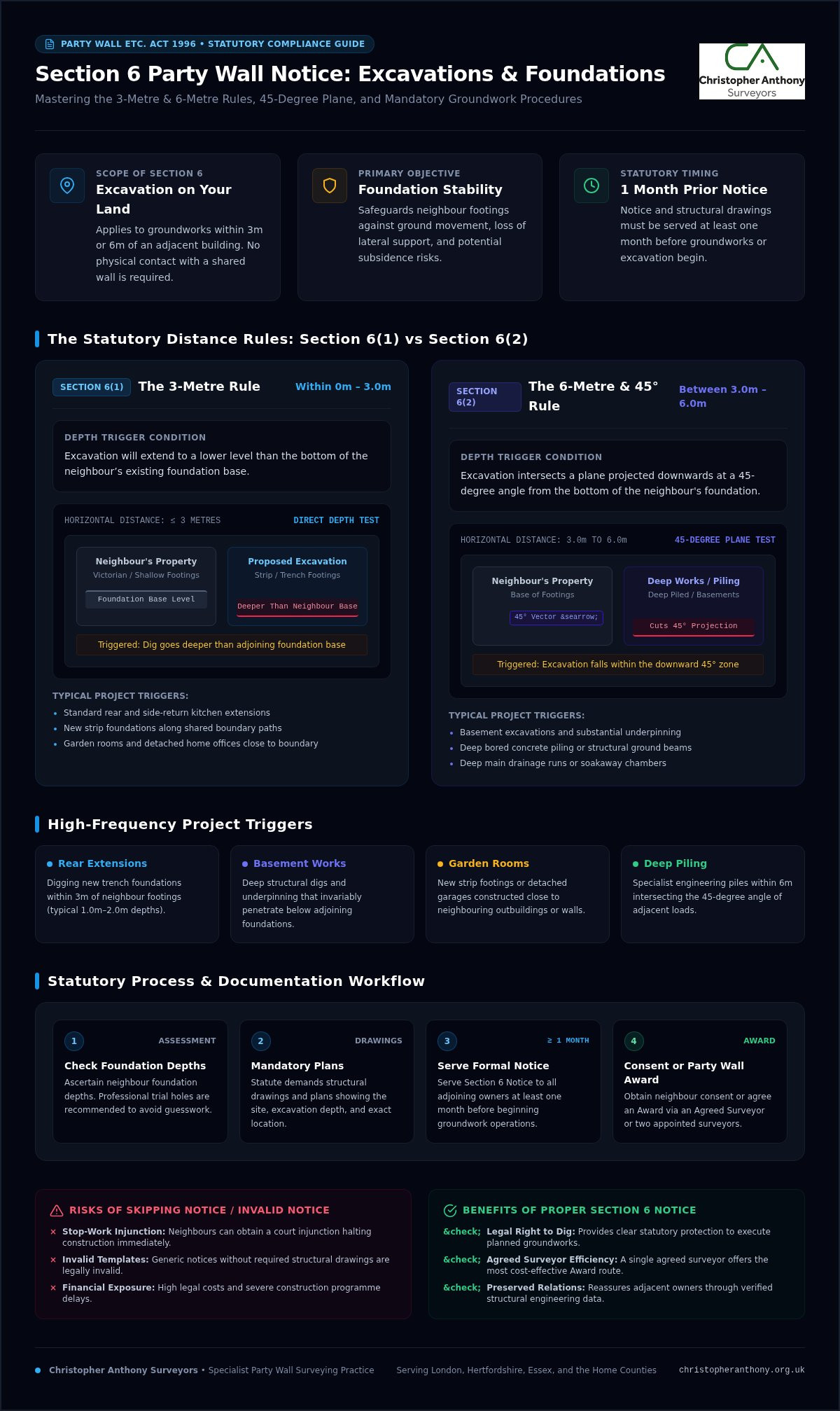
Serving a section 6 party wall notice requires strict adherence to statutory timelines and documentation rules. You must serve this notice at least one month before your planned excavation work begins. Skipping this step or serving an incomplete notice leaves your project vulnerable; if a neighbour takes legal action, an invalid notice can halt your building project instantly through a costly high court injunction. You also need to identify all affected property owners, which includes both the adjoining freeholders and any long leaseholders with a lease term longer than one year.
Unlike other party wall notices, Section 6 has a unique mandatory drawing requirement. Section 6(6) of the Act states that the notice is only valid if accompanied by plans and sections showing the site, exact position, and depth of the proposed excavation. Standard architectural planning drawings rarely satisfy this structural requirement because they lack the necessary engineering data regarding foundation depths. You should obtain your structural engineer's foundation design drawings before serving a section 6 party wall notice to ensure the paperwork is legally watertight.
Appoint a Building Owner Party Wall Surveyor to prepare your statutory notices today.
Receiving a section 6 party wall notice often causes immediate concern for homeowners in London and Essex. It's vital to respond pragmatically. We often suggest appointing an agreed surveyor to streamline the process. This single-professional route maintains momentum and reduces administrative friction whilst ensuring both parties receive fair, expert guidance. It's an efficient way to resolve matters swiftly without the complexity of coordinating multiple firms.
Consenting to a notice doesn't mean you've waived your right to have damage repaired later. It simply means you're happy for the work to proceed without a formal Award. However, if you feel the excavation risks are high, a dissent triggers mandatory statutory protection. This is why many neighbours choose to appoint an adjoining owner party wall surveyor. It ensures their property's specific interests are documented by a professional who understands the unique risks of London's clay soils and shallow foundations.
A formal Party Wall Award provides concrete safeguards. It includes detailed method statements, restricted working hours, and sometimes security for expenses for high-risk digs. Crucially, a schedule of condition survey acts as a vital insurance policy. By establishing a photographic baseline before any soil is moved, it protects building owners from unfounded damage claims and ensures adjoining owners have proof if cracks appear. If you're planning an excavation, consulting a building owner party wall surveyor early ensures your project stays on track without unnecessary neighbourly friction.
Securing your build starts with technical precision, not just architectural vision. We've explored how foundation depths and horizontal distances dictate your legal duties under the Act, ensuring you stay compliant whilst protecting your neighbour's property. A valid section 6 party wall notice is your primary shield against project delays and neighbourly friction. Omitting mandatory drawings or miscalculating the 45-degree rule invites unnecessary risk that can stall your groundworks indefinitely.
With over 20 years of specialist experience, Christopher Anthony Surveyors provides the authority you need to move forward. Our fixed-fee solutions offer complete budget certainty, ensuring your project across London, Hertfordshire, Essex, or Kent stays on track. We'll handle the procedural complexity so you can focus on the construction.
Your construction project deserves a smooth path to completion. We're here to provide the clarity you need to dig with confidence. Let's ensure your excavations are handled with the professional care they require.
Your neighbour cannot legally stop you from carrying out your project, but they can refuse to give written consent to the notice. If they dissent or fail to respond within 14 days, a statutory dispute is deemed to have arisen. This requires the appointment of a party wall surveyor to resolve the matter via a formal Award. This document protects both parties by detailing how and when the excavation occurs.
Proceeding without serving a valid section 6 party wall notice is a high-risk strategy that often leads to a court injunction. Your neighbour can legally halt your project, resulting in significant delays and mounting legal costs. Without a formal Award or Schedule of Condition, you also lose the protection against unfounded damage claims. It's always safer to follow the statutory procedure to ensure your London or Essex build remains legally watertight.
You must serve a Section 6 notice at least one month before your planned excavation work begins. This statutory period allows your neighbour time to review your engineering drawings and seek professional advice. If you miss this deadline, your construction programme could be pushed back, as work cannot legally start until the notice period expires or an Award is served. Planning ahead prevents these avoidable bottlenecks in your project timeline.
In almost all residential cases, the building owner who initiates the project is responsible for paying all reasonable party wall surveyor fees. This includes the costs for their own surveyor and the neighbour's chosen professional. By appointing an agreed surveyor, you can often reduce these expenses whilst maintaining a smooth process. Our fixed-fee solutions provide budget certainty for owners across Hertfordshire and Kent, ensuring no hidden surprises during the dispute resolution process.
You typically don't need a notice for shallow landscaping or standard fence posts, as these rarely involve significant excavation. However, if your project involves substantial retaining walls or deep foundations within three metres of a neighbour's structure, the Act likely applies. If your dig goes deeper than the bottom of their foundations, a section 6 party wall notice is mandatory. We recommend checking your specific plans with a professional to avoid accidental non-compliance.