Protecting Your Property During a Neighbour’s Building Work: The 2026 Checklist

Imagine waking up to the rhythmic thud of a jackhammer vibrating through your living room wall. It is a Tuesday morning, and your neighbour’s long-awaited extension has finally begun. While you want to be supportive, the sight of new hairline cracks appearing in your cornicing is enough to cause genuine anxiety. You shouldn't have to cross your fingers and hope for the best. Learning how to protect property during neighbours building work is not about being difficult. It is about establishing a professional safety net that works for everyone.

We know that the Party Wall Act often feels like a maze of confusing jargon when you just want to keep your home intact. It is a stressful position to be in. This guide provides a proactive 2026 checklist to safeguard your property, decode your legal rights, and ensure the building owner remains responsible for the costs. We will walk you through the essential steps, from understanding statutory notices to the vital protection of a Schedule of Condition. You deserve a clear plan and the peace of mind that your home is in safe hands before the heavy machinery arrives.

Key Takeaways

  • Understand your statutory rights under the Party Wall etc. Act 1996 and how to ensure your neighbour follows the correct legal process.
  • Discover the essential steps to protect property during neighbours building work, including the importance of verifying Party Wall Notices before construction starts.
  • Learn why a professional Schedule of Condition is your most powerful tool for proving damage and ensuring repairs are handled at no cost to you.
  • Identify the critical monitoring techniques to use during high-impact phases like basement excavations or loft conversions.
  • Gain a clear strategy for resolving disputes and damage through your appointed surveyor, avoiding direct conflict with on-site builders.

When a neighbour decides to renovate, it can feel like your home is suddenly under threat. You aren't powerless. The Party Wall etc. Act 1996 is a statutory framework specifically designed to manage these situations. It acts as a legal shield, ensuring that works like loft conversions, extensions, and basement excavations don't compromise your property's integrity. Most importantly, it mandates that any damage caused by the project must be repaired at the Building Owner's expense. This is the first and most vital step to protect property during neighbours building work.

Your Rights as an Adjoining Owner

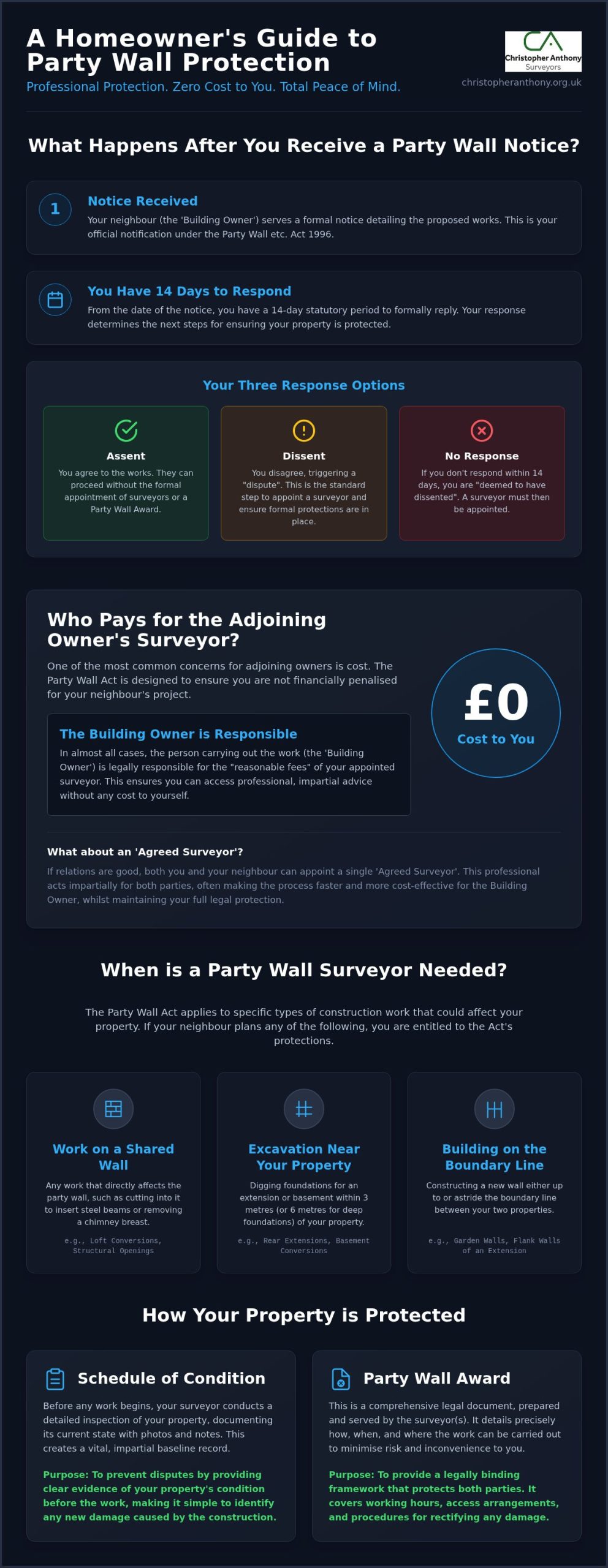
As the "Adjoining Owner", the law grants you specific protections. You have the right to appoint your own adjoining owner party wall surveyor to act as a protective guide throughout the process. A common misconception is that this will cost you a fortune. In reality, the Building Owner is almost always responsible for paying your surveyor's professional fees. If the project involves high-risk activities, such as deep basement digging, you can even request "security for expenses" to ensure funds are set aside should the project stall or cause significant issues.

Responding to a Party Wall Notice

The process usually starts with a formal notice landing on your doorstep. You have 14 days to respond. If you are worried about potential damage, dissenting to the notice is often the smartest move. It doesn't mean you're being a "bad neighbour" or stopping the work entirely. Instead, it triggers a dispute resolution process where surveyors create a Party Wall Award to safeguard your home. For simple projects, an Agreed Surveyor might suffice, but for complex builds, having your own independent expert ensures your interests remain the priority.

Pre-Construction Checklist: Essential Safeguards Before Work Starts

Preparation is the difference between a smooth renovation and a structural nightmare. Before a single brick is removed, you must ensure your home is legally and physically documented. This is the most effective way to protect property during neighbours building work. You shouldn't rely on verbal promises; the legal process exists to provide a clear, enforceable framework for both parties.

Start by verifying that your neighbour has followed official government guidance regarding statutory notice periods. For excavation projects, they must give you at least one month’s notice. For works directly to the shared wall, it is two months. Don't let work start until a formal Party Wall Award is signed and served. This document outlines exactly how and when the works will take place, protecting your rights from day one.

The Schedule of Condition: Your Ultimate Insurance Policy

A schedule of condition survey is the single most important document in your arsenal. It provides a detailed photographic and descriptive record of your property's current state. Our surveyors meticulously document internal walls, ceilings, and external masonry, noting every existing hairline crack or blemish. It serves as your home's "before" picture in high resolution.

Without this baseline, proving that a new crack was caused by your neighbour’s builders is almost impossible. It becomes your word against theirs. A professional schedule removes the guesswork, ensuring that any new damage is clearly identifiable and must be repaired at the neighbour’s expense. If you're concerned about your home's safety, you can view our transparent fee structure for this essential service.

Reviewing the Proposed Building Plans

Your surveyor does more than just take photos. We vet the contractor’s method statements and structural drawings to identify potential risks. We specifically look for "Special Foundations" or intrusive works that could undermine your home's stability. If your neighbour needs to enter your garden to complete their project, we ensure they have the correct licences for access. This technical oversight prevents issues before they even begin on-site.

Protecting Your Property During a Neighbour’s Building Work: The 2026 Checklist

Monitoring and Protection During the Construction Phase

Once the builders arrive, your role shifts from administrative preparation to active vigilance. The most intrusive phases, such as demolition, piling, and structural alterations, carry the highest risk of movement. To effectively protect property during neighbours building work, you should maintain a simple log of any unusual vibrations or excessive noise. If something feels wrong, it usually is. Don't hesitate to check that the contractors are adhering to the specific working hours laid out in your Party Wall Award.

Vibration and Movement Monitoring

For high-impact projects like basement excavations, we often recommend professional monitoring. This isn't just about peace of mind; it's about data. We can install electronic sensors or traditional glass "tell-tale" markers to track structural movement in real-time. These standards align with the professional guidance from the Royal Institution of Chartered Surveyors, ensuring that any shifts are caught early. If movement exceeds pre-agreed safety limits, the Award can mandate an immediate halt to the works until the method is reviewed.

Managing Dust, Debris, and Access

Construction is inherently messy, but it shouldn't be your mess. Your neighbour's contractor is responsible for installing adequate hoarding and dust sheets to contain the site. We also ensure that your gutters and drains are shielded from construction runoff, which can lead to long-term damp issues. Remember, while the Act allows access for certain works, builders must usually provide 14 days' notice before entering your land. If they jump the fence without warning, they are in breach of the Award.

Appoint a surveyor to monitor your property today

Practical Advice from Christopher Anthony Surveyors

If you spot a fresh hairline crack or a patch of damp whilst the project is underway, don't panic. This is the moment your preparation pays off. Refer immediately to your Schedule of Condition. This document is the definitive proof you need to protect property during neighbours building work. Instead of engaging in a stressful confrontation with the builders on-site, contact your appointed surveyor. We are trained to handle these disputes professionally and dispassionately.

The party wall damage claim process is designed to be efficient. It bypasses the slow and expensive court system. Under the Act, the Building Owner is legally required to either "make good" the damage (repair it to its original state) or provide a financial payment in lieu of repairs. This choice often rests with you, the Adjoining Owner, ensuring you maintain control over how your home is restored.

Final Inspections and Signing Off

Once the dust has settled and the scaffolding is down, your surveyor will return for a formal re-inspection. We compare every room and external wall against the original photographic record. If new defects are found, we determine the necessary remedy and its associated cost. The file isn't closed until all repairs are agreed upon or compensated. This methodical approach ensures that no "hidden" damage is left for you to deal with months later.

Why Professional Guidance is Essential

Terraced houses in London and Hertfordshire present unique structural challenges. A loft conversion in a Victorian terrace is vastly different from a basement dig in a modern detached home. You shouldn't rely on generic online templates; they lack the legal weight of a bespoke Party Wall Award. Christopher Anthony Surveyors brings over 20 years of experience to your project. We act as your protective guide, providing the authority needed to ensure your home remains a safe, undamaged asset. Every property is unique, and we treat your home with the individual attention it requires to remain protected.

Securing Your Home’s Future Before the First Brick is Laid

Navigating a neighbour's construction project doesn't have to be a source of constant worry. By following the 2026 checklist, you transform from a passive bystander into a proactive property owner. The Party Wall etc. Act 1996 exists to protect your interests. It ensures that structural risks are managed and that damage is repaired at no cost to you. Expert knowledge of the Act is your best defence when builders move in next door.

A professional Schedule of Condition remains your most powerful tool to protect property during neighbours building work. It provides the undeniable evidence needed to resolve disputes quickly and fairly. We provide fixed-fee transparency for all residential projects across London, Hertfordshire, Essex, and Kent. You deserve the peace of mind that comes with professional authority and real-world experience. Our team is here to act as your protective guide throughout the process.

Request a Fixed-Fee Quotation for Your Party Wall Project

Don't leave your property's safety to chance. Take the first step today to ensure your home remains a secure asset for years to come.

Frequently Asked Questions

Can I stop my neighbour from building on the party wall?

You cannot legally prevent a neighbour from exercising their rights under the Act, provided they follow the correct statutory procedures. The Party Wall etc. Act 1996 is an enabling piece of legislation that allows work to proceed whilst protecting your interests. By dissenting to a notice, you ensure that a professional surveyor is appointed to draft an Award. This document regulates how and when the work is done to minimize the risk to your home.

Who pays for the surveyor if my neighbour is doing the work?

In the vast majority of residential cases, the neighbour carrying out the work is responsible for paying all surveyor fees. This includes the costs for their own surveyor and the fees for your independent surveyor. The principle is that an Adjoining Owner shouldn't be financially burdened by a project they didn't initiate. We maintain clear, fixed-fee transparency so that everyone understands the professional costs involved before the project begins on-site.

What happens if my neighbour starts work without serving a Party Wall Notice?

If your neighbour starts construction without serving a formal notice, they are in breach of their statutory duty. You have the legal right to seek an injunction to stop the works until they comply with the Act. This is a vital step to protect property during neighbours building work. Without a notice or an Award in place, you lose the automatic right to have damage repaired at the neighbour's expense under the Act's framework.

How much vibration is "normal" during a neighbour’s loft conversion?

Expect some vibration during intrusive phases like steel beam installations or chimney breast removals. However, these vibrations shouldn't be severe enough to cause structural cracks or move household objects. If the project involves heavy machinery, we can include specific vibration monitoring clauses within the Party Wall Award. This sets clear, measurable limits for the contractor, ensuring the work stays within safe parameters and providing you with documented evidence if those limits are exceeded.

Does the Party Wall Act cover damage to my garden or fence?

The Act covers damage to any part of your property, including gardens, paths, and fences, provided the damage results from the notified works. If a contractor damages your patio or knocks down a garden fence whilst excavating for a rear extension, they are legally required to make it good. In such cases, engaging professional services like Cleveland Fencing Ltd can ensure your property boundaries are correctly and safely reinstated. We always recommend that your external areas are included in the professional Schedule of Condition. This ensures every part of your property is documented and protected before the builders arrive.

Article by

Tony Neilson MRPSA MFPWS

Building Owner Party Wall Surveyor: A 2026 Guide to Protecting Your Project

Did you know that party wall disputes in the UK have surged by 40% in 2026, often stalling ambitious home improvements before the first brick is even laid? If you're planning an extension or loft conversion, you're likely feeling the weight of potential neighbour objections or the stress of complex legal paperwork. It's a completely natural concern. Appointing a specialist building owner party wall surveyor is the most effective way to dismantle these hurdles; ensuring your project remains on track and fully compliant with the Party Wall etc. Act 1996.

We understand that you want a project that starts on time without the shadow of a legal dispute or unexpected fees. This guide will show you how expert representation secures your timeline, manages procedural requirements, and provides a legally robust Award to protect your property from spurious damage claims. From navigating the latest RICS guidance to serving valid notices, we'll explain how to move from uncertainty to a clear, actionable path forward for your construction.

Key Takeaways

  • Understand how a specialist building owner party wall surveyor acts as an impartial professional to uphold the Act whilst ensuring your project remains legally compliant.
  • Learn the critical steps of identifying notifiable works and why serving valid notices is the foundation of a successful construction project.
  • Discover why initiating informal conversations with neighbours and serving notices at least two months in advance prevents costly delays and maintains goodwill.
  • Gain insights into managing your budget through fixed-fee structures and the importance of local expertise for navigating London's complex property boundaries.

The Essential Role of the Building Owner Party Wall Surveyor

Many homeowners view the party wall process as a bureaucratic obstacle. In reality, your building owner party wall surveyor is your project's legal safeguard. Their primary responsibility is to administer the Party Wall etc. Act 1996; a piece of legislation designed to facilitate construction whilst protecting the interests of all parties. At Christopher Anthony Surveyors, we view this role as project management for your legal risks.

The Role of a Party Wall Surveyor is unique because their first duty is to the Act itself, not the person paying their fees. This impartiality is what gives a Party Wall Award its legal weight. Appointing a professional early provides several critical advantages:

  1. Forensic identification of all affected adjoining owners, including leaseholders and freeholders.
  2. Validation of structural drawings to ensure they meet the technical requirements of the Act.
  3. Prevention of "stop-work" injunctions by ensuring every legal notice is served correctly.

One of the first decisions you'll face is whether to use an Agreed Surveyor or have your own dedicated professional. The table below outlines the primary differences to help you decide which route suits your project's complexity.

Feature Agreed Surveyor Separate Surveyors
Representation One surveyor acts for both owners. Each owner appoints their own professional.
Cost Generally lower; only one set of fees. Higher; Building Owner usually pays for both.
Complexity Best for straightforward extensions. Recommended for basement or complex works.

When Must You Legally Appoint a Surveyor?

The law triggers the need for professional involvement when "notifiable works" are planned. This includes common residential improvements such as cutting into a party wall for a loft conversion, removing a chimney breast, or excavating for a rear extension. Crucially, you cannot act as your own surveyor. The Act requires professional distance to ensure the process remains fair. If a neighbour dissents or fails to respond to a notice, an appointment becomes a statutory requirement to move the project forward.

Protecting Your Project Timeline

Timing is everything in construction. A specialist building owner party wall surveyor ensures that every notice is served with 100% accuracy the first time. Even a minor clerical error can invalidate a notice, forcing you to re-start the clock on statutory notice periods. Your surveyor also manages the 14-day response window, ensuring that if a neighbour doesn't respond, the secondary 10-day notice is served promptly to prevent your builder from standing idle on site. Understanding exactly what happens if a neighbour ignores a party wall notice is essential knowledge for any building owner planning construction work.

How Your Surveyor Manages the Party Wall Process

The management of your party wall process follows a rigorous four-step sequence. First, your building owner party wall surveyor performs a forensic review of your structural drawings to isolate every notifiable action. This might include cutting into a shared wall for a loft conversion or excavating foundations for a new extension. Once the scope is clear, the surveyor serves the formal notices. This second step is the legal trigger that begins the statutory notice period.

The third stage involves conducting a comprehensive Schedule of Condition. This is a high-resolution photographic and written record of the neighbouring property. Finally, your surveyor negotiates and serves the Party Wall Award. This document is the final legal agreement that governs how works are executed. If you're managing a tight budget, reviewing our fixed-fee party wall costs can provide the financial clarity you need before starting this process.

Serving Valid Party Wall Notices

Precision is mandatory when serving notices. DIY templates often fail to meet the strict requirements of Official Government Guidance, which can lead to costly delays. For loft conversions, you must account for specific steel beam placements. Similarly, rear extensions require detailed excavation notices if you're digging within three or six metres of a neighbour's structure. Getting this right the first time prevents the notice period from resetting and keeps your construction programme on schedule.

The Importance of a Schedule of Condition

A Schedule of Condition Survey acts as your project's insurance policy. Many period properties in London and Hertfordshire already have minor settlement cracks or damp issues. Without a professional record, you're vulnerable to claims that your construction caused these pre-existing defects. By recording the exact state of the adjoining property before work begins, your building owner party wall surveyor can easily distinguish between new damage and old issues. This protects you from potentially thousands of pounds in fraudulent or mistaken damage claims.

Building Owner Party Wall Surveyor: A 2026 Guide to Protecting Your Project

Selecting a Surveyor for Your London or Home Counties Project

Selecting the right building owner party wall surveyor is a decision that directly impacts your project's bottom line. In high-density areas like London and Hertfordshire, local expertise is not a luxury; it's a necessity. You need a professional who holds comprehensive indemnity insurance. You need membership in recognised surveying bodies. This provides a layer of security that generic online services simply cannot match. It ensures your matters are handled with the speed and precision required in a fast-paced construction environment.

The Benefits of Fixed-Fee Surveying

Budget control is often the primary concern for homeowners. Traditional hourly billing can lead to unpredictable costs, especially if a neighbour becomes particularly difficult. By choosing a fixed-fee structure, you gain total transparency from the outset. This approach eliminates the conflict of interest inherent in hourly rates and ensures your surveyor is motivated by efficiency and resolution. You can view our transparent Party Wall Surveyor Prices to see how we help you maintain control over your construction budget.

Get a fixed-fee quote for your party wall project

Why Local Knowledge Matters

Local knowledge extends beyond geography. It involves a deep understanding of the specific soil conditions in Essex or the unique foundation types of London's Victorian terraces. A surveyor who understands the technical risks of basement excavations can draft an Award that addresses these specific engineering challenges. This level of detail is supported by the official government guidance on the Party Wall Act, which emphasises the importance of resolving disputes through professional expertise. Familiarity with common neighbour objections in urban areas allows for smoother negotiations and faster project starts.

Practical Advice from Christopher Anthony Surveyors

Success in any construction project depends on early preparation and clear communication. Appointing a specialist building owner party wall surveyor early in the design phase is the most effective way to mitigate the rising trend of project disputes. We always advise serving notices at least two months before your intended start date. This accounts for the full statutory period and provides a necessary buffer for any technical queries from your neighbours or their appointed surveyors.

Goodwill is a valuable asset. Before that official brown envelope arrives, have an informal chat with your neighbours about your plans. It reduces anxiety and often prevents a knee-jerk dissent. You should also ensure your structural engineer provides detailed sections for all excavations. Vague drawings are a primary cause of delays during the Award negotiation process. Most importantly, never start work without a signed Award or written consent. Proceeding without legal cover risks a court injunction that could mothball your site for months and lead to significant legal costs.

Avoiding Common Project Delays

Project momentum often stalls due to three recurring issues: incomplete structural data, failing to identify all legal owners (including leaseholders), and simple postal delays. If a neighbour ignores your notice entirely, the law provides a clear path forward. After the initial 14-day window, they are "deemed to have dissented". For a detailed breakdown of the exact legal steps involved, read our comprehensive guide on what happens if a neighbour ignores a party wall notice and how to keep your project moving. Your building owner party wall surveyor will then serve a secondary 10-day notice under the Act. This allows for the appointment of a surveyor on their behalf, ensuring your project timeline isn't held hostage by silence.

To keep your programme moving, we recommend a proactive approach to document management. Ensure all party wall notices are sent via a trackable postal service and keep a clear log of all correspondence. This evidence is vital if a dispute arises regarding the service of documents. By staying organised and transparent, you demonstrate a commitment to the Act that often encourages neighbours to act more cooperatively throughout the construction phase.

Secure Your Project's Future Today

Christopher Anthony Surveyors brings over 20 years of expertise to your doorstep, specialising in the unique residential architecture of London, Hertfordshire, and Essex. Our fixed-fee guarantee provides the budget certainty you need to manage your construction costs effectively. We take the weight of the Party Wall Act off your shoulders, allowing you to focus on the transformation of your property.

If your property transformation is part of a larger commercial venture, it is often wise to explore Marketing Strategy with specialists like Brand Central to ensure your business identity grows alongside your physical space.

Request Your Fixed-Fee Party Wall Quotation

Your home improvement journey should be a rewarding milestone, not a source of legal stress. With the right professional guidance, you can move forward with confidence, knowing your project is protected and your neighbours are managed with professional care.

Frequently Asked Questions

Who pays for the building owner party wall surveyor?

The building owner undertaking the construction work is almost always responsible for all reasonable costs associated with the process. This includes the fees for their own building owner party wall surveyor and the fees for any surveyor appointed by the adjoining owner. In rare cases where work is necessary due to the neighbour's failure to maintain their property, costs might be shared, but the default expectation is that the person benefiting from the project pays.

Can I use the same surveyor as my neighbour to save money?

Yes, you can appoint a single professional known as an "Agreed Surveyor" to act impartially for both you and your neighbour. This is a highly efficient way to manage residential projects like loft conversions or extensions, as it significantly reduces total fees and streamlines communication. Whilst this is often the preferred route for simple works, your neighbour maintains the legal right to insist on their own independent surveyor if they feel it's necessary.

How long does the party wall process take for a building owner?

The process typically takes between four and eight weeks, though this depends entirely on the complexity of the project and the neighbour's response time. Statutory notice periods are either one or two months, but an Award can be served much sooner if all parties are proactive and the drawings are clear. We recommend starting the process at least three months before your builder is due on site to ensure your project timeline remains secure.

What happens if my neighbour refuses to appoint a surveyor?

If a neighbour dissents to your notice but refuses to appoint a surveyor, they cannot stop your project indefinitely. The Party Wall etc. Act 1996 allows your building owner party wall surveyor to appoint a surveyor on the neighbour's behalf after a 10-day follow-up notice has expired. This ensures that the legal process continues and a Party Wall Award is served, protecting your right to build whilst ensuring the neighbour's property is still professionally recorded.

Do I need a party wall surveyor for a simple garden wall or fence?

You only need a surveyor if you're working on a "Party Fence Wall", which is a masonry wall built astride the boundary line. The Act doesn't apply to ordinary timber fences or garden walls built entirely on your own land. However, if your garden project involves digging foundations within three metres of a neighbour's building or structure, you must still serve a notice and follow the statutory procedure to ensure legal compliance.

Need Advice About Your Project?

If you're ready to secure your construction timeline and ensure full legal compliance, getting professional eyes on your plans is the next logical step. You can request a fixed-fee quotation to ensure complete budget certainty from the outset, or use the Christopher Anthony Party Wall Assistant tool for instant guidance tailored to your specific project needs.

Request Your Fixed-Fee Party Wall Quotation

About Christopher Anthony Surveyors

Christopher Anthony Surveyors is a specialist practice serving London, Hertfordshire, Essex, and the Home Counties. We bring over 20 years of experience to every project, providing homeowners, architects, and developers with the expertise needed to navigate the Party Wall etc. Act 1996 with confidence. Our firm is built on a foundation of transparency and efficiency, offering fixed-fee services and a proactive approach that ensures your construction remains on track. We pride ourselves on being a modern, accessible alternative in the surveying industry, valuing our clients' time and peace of mind above all else.

Article by

Tony Neilson MRPSA MFPWS