What if the biggest threat to your construction project wasn't a budget blowout or a rogue contractor, but a simple piece of paper left on a neighbour's doorstep? It's a valid concern. One that homeowners across London and Hertfordshire face daily. You've likely spent months planning a loft conversion or extension, only to find that you need an expert party wall surveyor to manage complex statutory requirements. We know that the fear of project delays and the anxiety of potential neighbour disputes can be genuinely overwhelming.
This guide explains how a specialist surveyor acts as your proactive shield, protecting your property interests whilst ensuring your project remains legally compliant and on schedule. You'll discover how to comply with the Party Wall etc. Act 1996 without the stress of hidden fees or unexpected damage claims. We'll break down the essentials of notices, awards, and schedules of condition, providing a clear path to a successful build. By the end, you'll have the expert insight needed to move your project forward with total confidence and precision.
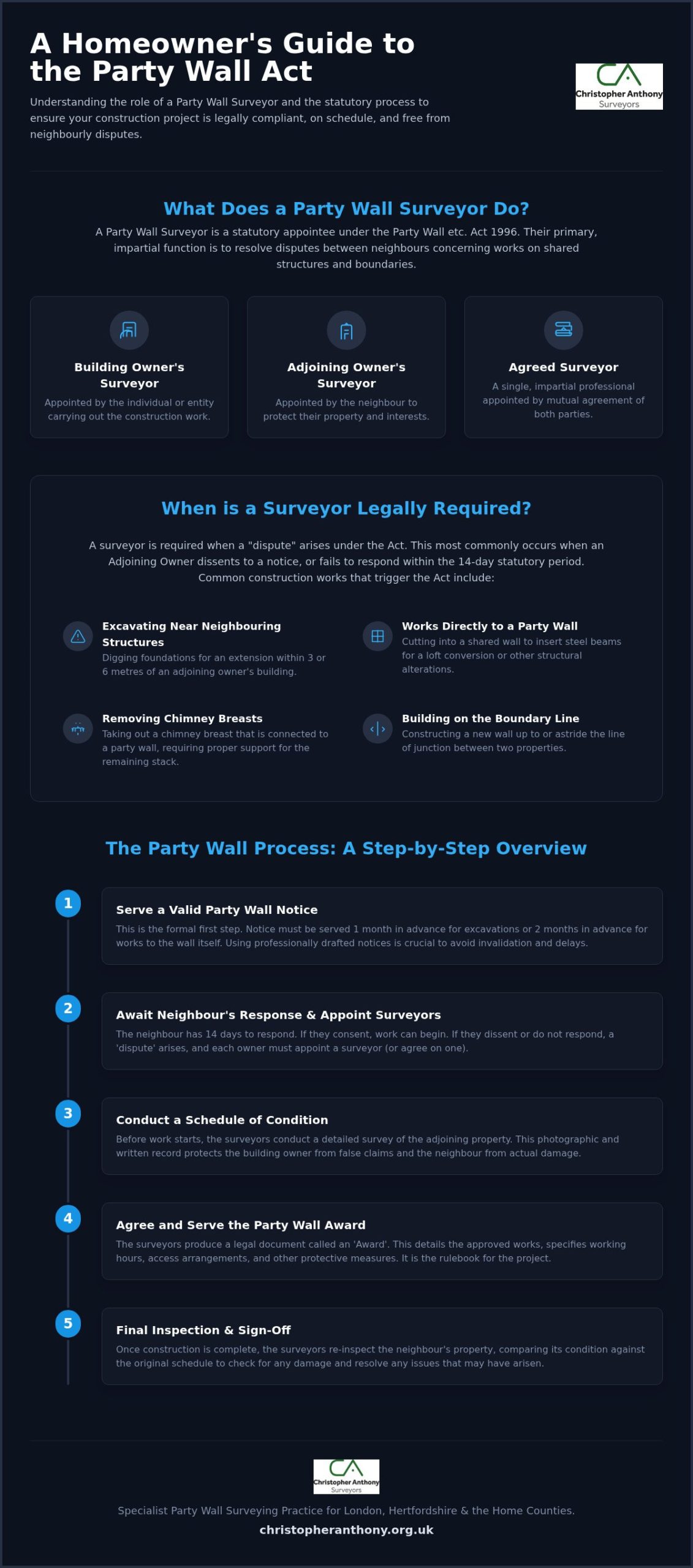
A party wall surveyor is far more than a technical consultant; they're a statutory appointee with a specific legal mandate. Their primary function is to resolve disputes between neighbours regarding shared structures and boundaries. This entire process is strictly governed by the Party Wall etc. Act 1996. To understand the basics, one might ask What is a Party Wall? In short, it's a structure that separates buildings or sits on a boundary line.
There are three main ways a surveyor can be appointed:
Legally, you need a surveyor once a "dispute" is deemed to have arisen. This usually happens if a neighbour dissents to your notice or fails to respond within 14 days. Common triggers include digging foundations within 3 or 6 metres of a neighbour's structure, cutting into a shared wall for steel beams during a loft conversion, or removing chimney breasts. Without an award in place, these works could be halted by a legal injunction.
These professionals don't "represent" their appointing owner in the same way a solicitor does. They have a quasi-judicial duty to the Act itself. Their goal is to ensure building works proceed safely without causing unnecessary inconvenience to either side. This professional integrity is vital for maintaining long-term neighbourly relations, as it ensures decisions are based on technical facts rather than personal friction.
The process follows a structured timeline designed to prevent project delays. The Party Wall Act process starts officially when you serve notice. This isn't a casual conversation; it's a formal document that must contain specific details to be valid. Once the notice is served, your appointed party wall surveyor will manage the transition from a "dispute" to a legal agreement.
Timing is everything. For works directly affecting a shared structure, you must serve a Party Wall Notice at least two months before starting. If your project involves excavations within 3 or 6 metres of a neighbour, the notice period is one month. Don't rely on generic online templates. These often lack the precise wording required by the Act, which can render your notice invalid and force you to restart the statutory clock.
Before any work begins, a schedule of condition survey is carried out. This is a detailed photographic and descriptive record of the neighbouring property. It serves as the only definitive proof in a damage claim, protecting the building owner from pre-existing issues and the neighbour from new damage. It's a proactive step that settles arguments before they even start.
The final legal milestone is the Party Wall Award. This document acts as the rulebook for your project, specifying working hours and access rights. Once the builders have finished, a final inspection confirms that no damage has occurred. If you're feeling uncertain about the paperwork, you can always request a fixed-fee quotation to get your project moving safely. This ensures every legal box is ticked without the stress.
Every construction project brings unique challenges. In our experience across London and Hertfordshire, specific works carry higher risks for neighbour disputes. For loft conversions, cutting into the wall to insert steel beams is a standard requirement. However, without careful management, this structural change can cause vibration damage or noise nuisance. Chimney breast removals also require precise documentation; ensuring the remaining stack is properly supported prevents structural failure and future liability.
Rear extensions often trigger the Act due to foundation depths. The "3-metre and 6-metre rules" dictate when you must notify your neighbour. If your excavation is deeper than their foundations and within these distances, you're legally bound to act. Basement excavations are even more complex, often involving underpinning. These high-stakes projects require a specialist party wall surveyor who understands the intricate soil conditions and structural densities found in London.
Early communication is your best tool for avoiding conflict. We always suggest speaking to your neighbours before serving a formal notice. This transparency often leads to the appointment of an Agreed Surveyor. Using one impartial professional instead of two reduces costs and streamlines the entire process. It transforms a potentially adversarial situation into a collaborative one.
Timing is the difference between a smooth build and a legal nightmare. You should appoint your surveyor during the planning stage. Waiting until builders are on-site is a recipe for disaster. If you ignore the Act, your neighbour could seek a court injunction. This stops work immediately and can cost thousands in legal fees. Following the official government guidance on the Party Wall Act is a start, but professional oversight is what keeps your timeline intact.
Get a fixed-fee quotation today
Choosing a professional to handle your property matters shouldn't be a gamble. In the dense urban environments of London or the varied postcodes of Hertfordshire and Essex, local knowledge is indispensable. A party wall surveyor with geographic expertise understands the specific building archetypes of the Home Counties, from Victorian terraces to modern developments. Opting for a boutique firm ensures you get direct access to a lead expert rather than being passed to a junior staff member. This personal touch fosters clearer communication and faster resolution times; indeed, many such practices rely on Yellow Rose Consultants for specialist administrative and business development support to maintain this level of client focus.
We focus on speed, precision, and plain English advice. With over 20 years of experience, we've navigated thousands of projects across the Home Counties. Our goal is to demystify the Act, providing you with a clear roadmap that avoids technical jargon. When you appoint a specialist party wall surveyor, you're investing in the security of your build and ensuring your professional is experienced in every nuance of the 1996 Act.
Understanding surveyor costs is crucial for project budgeting. Many traditional firms still use hourly rates, which can lead to unpredictable final bills. We advocate for a transparent, fixed-fee model. This provides peace of mind, knowing exactly what your legal compliance costs will be from the outset without any hidden surprises.
| Fee Model | Budget Certainty | Potential Risk |
|---|---|---|
| Fixed Fee | High; costs are agreed upfront. | None; fee remains static. |
| Hourly Rate | Low; costs can escalate. | High; invoices grow with project complexity. |
Navigating the complexities of the Party Wall etc. Act 1996 doesn't have to be a source of stress. By appointing a specialist party wall surveyor early in the planning stage, you protect your property and maintain vital neighbourly relations. We've explored how statutory notices and detailed schedules of condition provide the legal framework for a successful project. These steps aren't just administrative hurdles; they're essential safeguards for your home and your budget.
Whether you're planning a loft conversion in London or a rear extension in Hertfordshire, professional guidance ensures you remain compliant whilst avoiding costly delays. Our boutique firm offers over 20 years of experience and a fixed-fee guarantee, giving you the certainty you need to focus on the build itself. We provide the precision and clarity your project deserves.
Take the first step toward a hassle-free construction journey and ensure your interests are fully protected from the moment you break ground.
Usually, the Building Owner pays all reasonable costs associated with the process. This includes their own fees and the fees for the Adjoining Owner's surveyor. However, costs might be shared if the work benefits both parties, such as repairing a dilapidated shared wall. Our boutique firm provides fixed-fee quotations to ensure you have complete budget certainty, preventing the stress of escalating costs during your London or Hertfordshire project.
If your neighbour refuses or fails to appoint a surveyor within 10 days of a formal request, you have the legal right to appoint one on their behalf. This ensures that a non-responsive neighbour cannot indefinitely delay your construction. The Act provides this mechanism so that the process remains efficient while ensuring the neighbour's property still receives professional protection through a statutory appointment, keeping your project moving forward legally.
You cannot act as your own surveyor. The Act requires the appointee to be someone who is not a party to the works to maintain strict impartiality. Whilst the law doesn't define specific qualifications, it's vital to appoint an experienced party wall surveyor. This ensures your award is legally sound and that technical matters, such as structural supports for loft conversions, are handled with professional precision and authority.
The timeframe typically ranges from four to six weeks once a neighbour has dissented to a notice. This period allows for the party wall surveyor to conduct a schedule of condition and draft the formal award. Complex projects involving basement excavations or multiple neighbours in London may take longer. Appointing a specialist during your planning phase is the most effective way to prevent these statutory periods from clashing with your builder's start date.
Standard timber garden fences are not covered by the Act. The legislation specifically applies to "party structures" like shared brick walls or walls built astride a boundary. However, if you're replacing a fence with a brick wall on the boundary line or excavating foundations within 3 metres of a neighbour's building, the Act likely applies. We recommend seeking professional advice to clarify your obligations before you begin any boundary work.