
What if a neighbour's refusal to sign your Party Wall Notice isn't actually a "stop" sign for your project? Many homeowners panic when they receive a dissent, fearing their loft conversion or extension is headed for a costly legal battle. We understand the anxiety that comes with potential delays and the stress of deteriorating relations next door. However, a dissent is rarely the disaster it first appears to be. It's simply a statutory trigger that moves your build into a more structured, protective legal framework.
This guide explains exactly what happens if my neighbour dissents to a party wall notice, showing you how to progress safely whilst maintaining your timeline. We'll walk you through the 14-day response window, the appointment of surveyors, and how a Party Wall Award provides the fixed-fee certainty you need to start construction with total peace of mind. You'll discover a clear legal path that secures your project's future without the need for endless confrontation. Our goal is to replace your uncertainty with a methodical plan that keeps your builders on site and your costs under control.
Many homeowners fear that a neighbour's "no" is a permanent stop sign for their building project. In the legal framework of the Party Wall etc. Act 1996, a refusal is officially termed a "dissent". It isn't a disaster. It's a statutory trigger that moves your build from a simple handshake into a formal, regulated process designed to keep things moving whilst protecting everyone involved.
If you are asking what happens if my neighbour dissents to a party wall notice, the answer is simple: the law creates a structured path forward. The Act is specifically designed to prevent project paralysis. It grants you the legal right to carry out your works, provided you follow the dispute resolution steps. This means that even if your neighbour is being difficult or simply ignores the paperwork, your project can still proceed safely and legally.
Skipping the formal route for "informal" consent is a significant risk that we often advise against. Without a professional schedule of condition survey, you're building on shaky ground. If a neighbour claims your extension caused a crack in their ceiling six months later, you'll have no evidence to prove the defect was already there. Handshakes don't hold up in court; documented evidence does.
Consent allows work to start immediately. It's the fastest route, but it leaves you vulnerable to unverified damage claims. Dissent requires a formal Party Wall Award. This document acts as a legal shield, detailing exactly how and when work is done. It provides a definitive record of the property condition before work begins, ensuring you aren't held liable for pre-existing damage. For most London projects, this certainty is far more valuable than a few saved days.
The 14-day response window is the first critical milestone in your project timeline. Once your notice is served, your neighbour has exactly 14 days to respond in writing. If they sign and return the notice, you're clear to proceed. But what happens if my neighbour dissents to a party wall notice or simply ignores it? Silence is legally treated as a dissent. On day 15, a statutory dispute is "deemed" to have arisen, and the process shifts from a private agreement to a regulated procedure.
To keep your build on track, you must then issue a Section 10(4) notice. This serves as a final 10-day warning, requesting that they appoint a surveyor. This step is vital for momentum. Understanding what happens if my neighbour dissents to a party wall notice allows you to prepare for these statutory steps without panic. It ensures that a neighbour cannot stall your extension or loft conversion indefinitely by simply doing nothing. By following this sequence, you maintain control over the programme whilst staying strictly within the law.
If the 10-day warning period expires without a response, the Act grants you the power to appoint a surveyor on your neighbour's behalf. This isn't a hostile act; it's a procedural necessity to move the project toward an Award. You cannot act as your own surveyor, even if you're a qualified professional, as the role requires total impartiality.
Often, the most efficient route is to propose an agreed party wall surveyor. This single professional acts for both parties, significantly reducing costs and administrative friction. This route is particularly popular for straightforward projects like chimney breast removals or rear extensions. If you're unsure about the next step in your timeline, you can request a fixed-fee quotation to see how we can streamline the process for you.
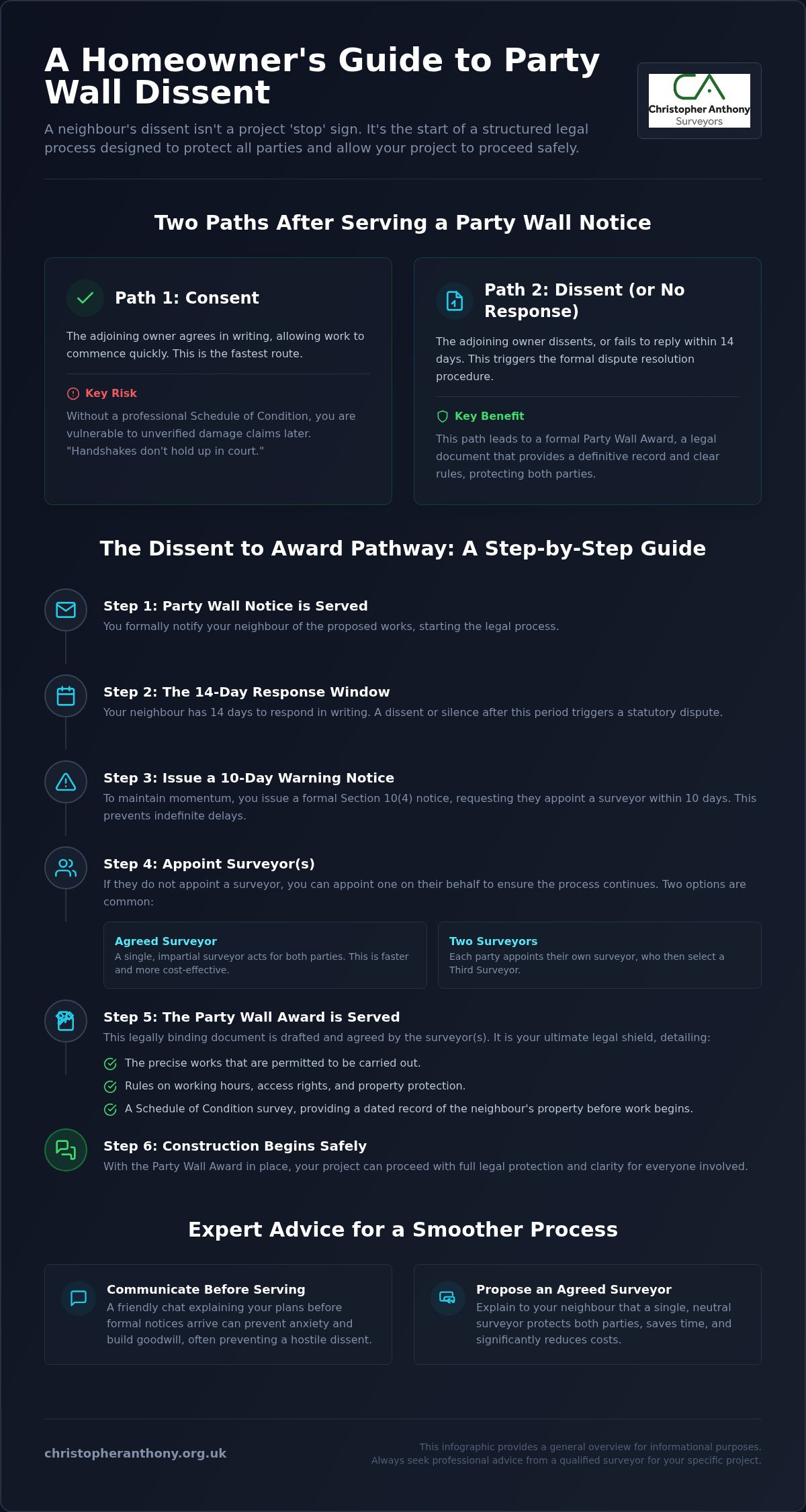
We always recommend a friendly conversation before serving a formal party wall notice in London. Surprising your neighbour with legal paperwork can trigger an emotional reaction. A quick chat explains your plans and shows respect. If you're wondering what happens if my neighbour dissents to a party wall notice, it's often because they feel uninformed or anxious about potential damage. Addressing these fears early can prevent a "hostile" dissent from occurring.
Presenting the Agreed Surveyor option is a brilliant way to lower costs whilst providing neutral expertise. Explain to your neighbour that a single surveyor protects both parties equally. It's faster and avoids the "them vs. us" mentality of two separate appointments. This collaborative approach keeps your budget intact and your timeline moving forward.
For difficult neighbours, let us act as the professional buffer. We take the emotion out of the room. We focus on the technical facts and the law, which prevents personal disagreements from stalling your build. Documenting everything from the start is your best defence against future spurious claims. We ensure every detail is recorded, leaving no room for ambiguity once the builders arrive.
Get a transparent fixed-fee quotation for your project today
A common myth is that a neighbour can "veto" your project using the Party Wall Act. This is incorrect. The Act is an enabling piece of legislation. Whilst you need to know what happens if my neighbour dissents to a party wall notice, remember they cannot stop the work. They can only influence the timing and how the work is executed to minimise disruption to their daily life. Your planning permission remains valid regardless of their dissent.
The Party Wall Award is the final, legally binding resolution to a statutory dispute. It's the "gold standard" for project security, providing a comprehensive framework that governs how your build is executed. Whilst some homeowners view the process as a hurdle, the Award is actually a powerful legal shield. It dictates specific working hours, sets out access rights for your contractors, and details exactly how your neighbour’s property will be protected. Understanding what happens if my neighbour dissents to a party wall notice is key to realising that the resulting Award is your best defence against future litigation.
Once the Award is served, you have the legal right to commence the notified works. It provides a level of finality that an informal agreement simply cannot match. Investing in professional building owner party wall surveyor services is a vital risk management strategy. It ensures that every technical detail is vetted by an expert, protecting you from spurious damage claims and ensuring your contractors can work without interruption. Knowing what happens if my neighbour dissents to a party wall notice allows you to move into this phase with total confidence.
In almost all standard cases, the building owner is responsible for paying all reasonable surveying fees. This includes the costs for both their own surveyor and the surveyor appointed by the adjoining owner. Whilst this might seem like an additional burden, it's a necessary cost for securing your project's legal standing and preventing expensive delays.
To avoid budget surprises, we recommend opting for fixed-fee party wall services. This provides total cost certainty from the outset, allowing you to allocate your funds to the construction itself rather than unpredictable professional fees. By choosing a transparent fee structure, you remove one of the biggest anxieties of the party wall process, ensuring you can focus on your build whilst we handle the procedural complexities.
A neighbour's refusal to sign a notice is simply a transition into a more formal, protective legal framework. It doesn't mean your loft conversion or extension has to stop. By understanding exactly what happens if my neighbour dissents to a party wall notice, you can navigate the 14-day window and the statutory appointment of surveyors with total confidence. The resulting Party Wall Award acts as your ultimate legal shield, defining working hours and protecting you against future damage claims.
With over 20 years of London expertise, we specialise in resolving these disputes efficiently. Our fixed-fee transparency means you'll never face hidden costs whilst our Expert Party Wall Assistant tool helps you manage the process with precision. You have the legal right to progress your build; you just need the right professional guidance to keep the momentum going.
Take the next step today and move your project from paperwork to construction. We're here to ensure your build proceeds safely, legally, and without unnecessary delay.
No, your neighbour cannot legally stop your extension by refusing to sign. When asking what happens if my neighbour dissents to a party wall notice, remember that the Act facilitates development whilst protecting adjoining properties. A refusal simply triggers the statutory dispute resolution process. This results in a Party Wall Award that outlines how the work will proceed. Whilst they can influence construction timing, they don't have a veto.
If a neighbour ignores your notice for 14 days, they are legally deemed to have dissented. At this stage, you must serve a final 10-day warning under Section 10(4) of the Act. If silence continues, you gain the right to appoint a surveyor on their behalf. This ensures the statutory process continues and prevents a non-responsive neighbour from indefinitely stalling your build programme in London or the Home Counties.
When considering what happens if my neighbour dissents to a party wall notice, you must factor in the professional fees. As the building owner, you're typically responsible for all reasonable costs, including the adjoining owner’s surveyor. Using an Agreed Surveyor is often the most cost-effective route. To maintain budget certainty, we offer fixed-fee quotations for our services across Hertfordshire and Essex, protecting you from escalating hourly rates.
Yes, appointing a surveyor is a legal requirement once a neighbour dissents or fails to respond. You cannot draft an Award yourself, even if you're professionally qualified; the Act requires an impartial expert. You can either appoint separate surveyors or, more efficiently, use an Agreed Surveyor to represent both parties. This professional ensures that all works are documented correctly and that a formal Schedule of Condition is completed.
The timeline typically extends by four to six weeks once a dissent is recorded. This includes the initial 14-day notice period and the subsequent 10-day warning if they remain silent. Once surveyors are appointed, they must inspect the properties and draft the Award. Whilst this adds time to your pre-construction phase, it provides the legal certainty needed to avoid long-term delays or expensive damage claims during the build.