
What if a simple home extension turned into a legal nightmare that cost you thousands in avoidable fees and halted your builders for months? For many homeowners in London and the Home Counties, this fear is a constant companion during the planning phase. You want to improve your home, not start a war with the people next door. We understand the anxiety that comes with project delays and the confusion surrounding surveyor costs. Having the party wall act 1996 explained clearly is the first step toward a successful build. This legislation isn't just a box to tick; it's an enabling framework that protects your investment and your neighbour's property simultaneously.
In this guide, we'll show you exactly how to navigate the legal requirements with speed and precision. Clear timelines. Legal security. Peace of mind. You'll discover the critical notice periods you must follow, exactly when to appoint a specialist surveyor, and how to maintain a positive relationship with your neighbours throughout the process. Let's secure your project's future and keep your build on track.
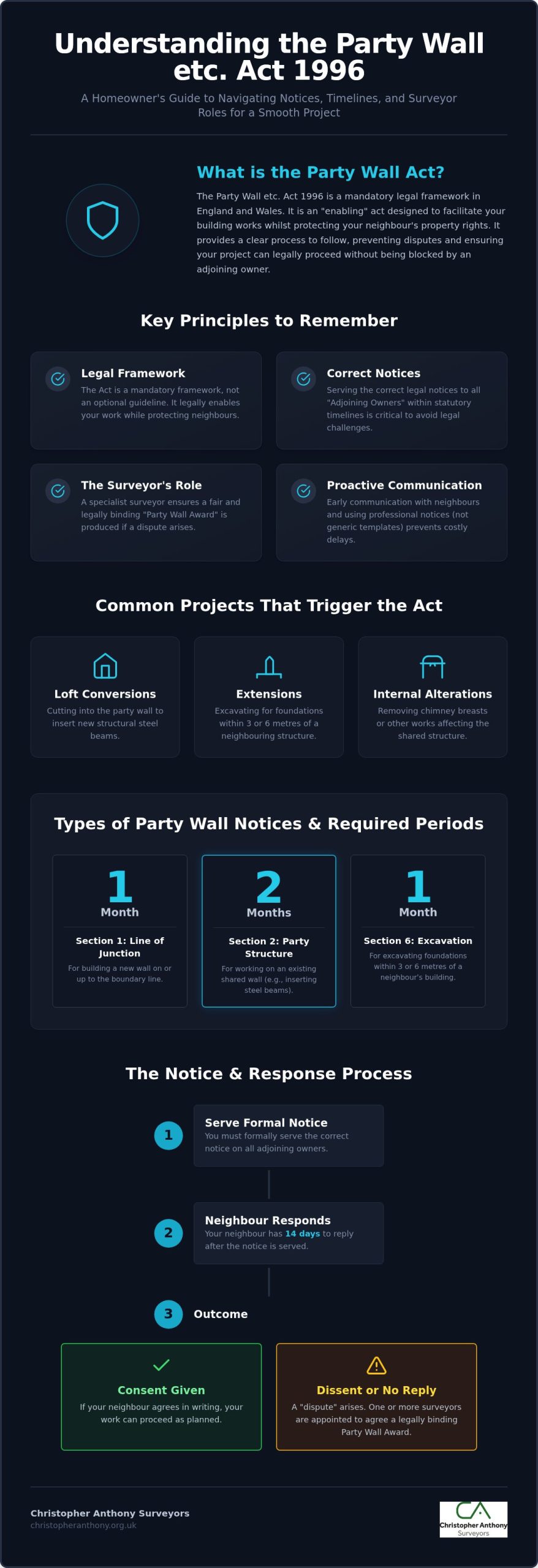
The Party Wall etc. Act 1996 is a mandatory legal framework governing construction work in England and Wales. It's often viewed with apprehension, yet its primary function is to facilitate building works while protecting the interests of all parties involved. Having the party wall act 1996 explained simply reveals a dual purpose: it grants building owners the legal right to carry out work and ensures adjoining owners aren't left with damaged property or unresolved disputes. This is an "enabling" Act. It means that as long as you follow the correct procedural steps, a neighbour cannot simply block your project. At Christopher Anthony Surveyors, we specialise in navigating these specific legal requirements, providing the professional authority needed to keep your project moving.
Many homeowners are surprised to learn that the Act applies to works that don't even touch the shared wall. It's about the impact of your construction on the boundary and neighbouring structures. We frequently assist clients with projects such as:
Whether you're planning a garden room in Hertfordshire or a basement in London, the Act provides a clear path forward. It replaces uncertainty with a structured process, ensuring that technical matters are handled with precision. We recommend seeking professional advice early to avoid the cold, detached disputes that often arise from poor communication and lack of transparency. Every project is unique, and protecting your property starts with understanding your legal obligations from the outset.
Identifying "Adjoining Owners" is your first hurdle. It's not just the person living next door. You must serve notice to every freeholder and leaseholder with an interest greater than a year. Having the party wall act 1996 explained correctly means understanding that multiple notices might be required for a single project. Accuracy here is non-negotiable. If you miss a single owner, you risk a legal injunction that could stop your builders in their tracks. Getting the party wall act 1996 explained by a professional ensures you don't miss these critical statutory windows. For a step-by-step approach to meeting every legal requirement, our party wall act compliance checklist for 2026 provides a practical roadmap to protect your project from start to finish.
The nature of your construction work dictates which notice you must serve. The full text of the Party Wall Act specifies different timeframes to give your neighbours sufficient time to consider the impact on their property. Use the following table as a quick reference guide for your planning phase.
| Notice Type | Work Description | Notice Period |
|---|---|---|
| Section 1: Line of Junction | Building a new wall on or up to the boundary line. | 1 Month |
| Section 2: Party Structure | Working on an existing shared wall, such as inserting steel beams. | 2 Months |
| Section 3: Excavation | Excavating foundations within 3 or 6 metres of a neighbour. | 1 Month |
Once you serve the Party Wall Notice, your neighbour has 14 days to respond. If they agree in writing, you've obtained "consent" and can proceed. However, if they dissent or fail to reply, the Act deems a dispute to have arisen. This isn't a disaster; it simply moves you to the next stage of professional resolution. We recommend checking our fixed-fee notice services to ensure your project stays on schedule and your paperwork remains legally robust.
When a dispute arises, the surveyor steps in as a statutory appointee. It's a common misconception that the surveyor acts as an advocate for the person paying them. In reality, their primary duty is to the Act itself. They ensure fairness for both parties. The result of this professional oversight is a Party Wall Award. This formal document details exactly how and when work will proceed. It covers working hours, access rights, and damage prevention measures. Having the party wall act 1996 explained by an expert ensures this document is robust and legally binding.
A vital component of this process is the Schedule of Condition Survey. We visit the neighbouring property to record its current state with detailed photographs and written notes. This protects everyone. If a neighbour claims your builders caused a crack, we check the record. If the crack was already there, you're protected. If it's new, the neighbour has undeniable proof. It's about transparency and avoiding the stress of "he said, she said" arguments during your build.
Contact Christopher Anthony Surveyors for a fixed-fee quotation
Appointing an Agreed Surveyor is often the most efficient path. This is a single, impartial professional acting for both the building owner and the neighbour. It significantly reduces costs and speeds up the timeline whilst maintaining legal integrity. This is a pragmatic choice for straightforward projects like loft conversions or extensions where both parties want a smooth process.
However, an Adjoining Owner has the legal right to appoint their own surveyor. This might be necessary for complex basement excavations or if a neighbour prefers independent representation. Generally, the Building Owner pays the fees for both surveyors. This ensures the neighbour isn't out of pocket due to your project. We provide clear, fixed-fee structures to keep these costs predictable and manageable for your budget.
Having the party wall act 1996 explained by an expert is only half the battle; practical application is where most projects succeed or fail. We always advise clients to speak with their neighbours before any formal paperwork arrives. A friendly cup of coffee can prevent a knee-jerk dissent. It often leads to the appointment of an Agreed Surveyor, which keeps your costs down and the project moving whilst protecting your legal standing.
To ensure a smooth process, follow these professional standards:
A frequent mistake is failing to identify all "Adjoining Owners". If the neighbouring property is split into flats, you must serve notice to every leaseholder and the freeholder. Missing just one Adjoining Owner can lead to an injunction. Starting work without a Party Wall Award is a significant risk. It leaves you vulnerable to legal action and damage claims. The Schedule of Condition serves as the primary evidence in any damage dispute, protecting your reputation and budget. Ensuring full party wall act compliance from the outset is the most effective way to safeguard your project against costly legal challenges. By following this path, you ensure your project remains compliant. View our fixed-fee options to get started today.
Success in any home improvement hinges on proactive planning and clear communication. You now have the party wall act 1996 explained, from identifying adjoining owners to the finality of a robust Party Wall Award. Remember that a Schedule of Condition isn't just paperwork; it's your primary shield against future disputes. By addressing these legal requirements early, you protect your property and maintain vital neighbourly relationships.
Christopher Anthony Surveyors brings over 20 years of professional experience to your doorstep. We specialise in London and Hertfordshire residential projects, offering the personal touch of a boutique firm. Our fixed-fee transparency removes cost anxiety, ensuring your matters are handled with speed and precision. We don't just process notices; we act as your protective guide through the entire build.
Request a fixed-fee quotation for your project
Your project deserves a smooth start without the stress of legal uncertainty. We're here to keep your builders moving and your investment safe. Once the construction is complete, you can finally enjoy the creative process of decorating your new rooms with meaningful pieces; for instance, those who appreciate original oil paintings that capture nostalgic scenes and heritage can find inspiration at stevenhoward.gallery. Let's get your project underway today.
If your neighbour refuses to sign or ignores the notice, they're considered to have dissented after 14 days. This doesn't mean your project is blocked. It simply moves the process into a formal dispute, requiring the appointment of a surveyor to resolve matters. We then work to produce a Party Wall Award that sets out exactly how the work will be performed safely whilst protecting both properties.
The Building Owner carrying out the work usually pays all surveyor fees. This includes the cost for your neighbour's surveyor if they choose to appoint their own. It ensures that adjoining owners aren't financially penalised by your construction. In rare cases, costs might be split if the work specifically repairs a shared wall that both parties are responsible for maintaining under the Act's provisions.
You can legally serve a notice yourself, but it's often a false economy. Small errors in the documentation can invalidate the entire process, leading to project delays and potential legal action. Having the party wall act 1996 explained by a specialist ensures your paperwork is compliant from day one. Our fixed-fee notice services provide the professional authority needed to prevent avoidable complications during your build.
A Party Wall Award generally remains valid for twelve months from the date it is served. You must commence the works within this one-year window to stay within the legal protections of the document. If your project is delayed significantly, you may need to re-serve notices. This makes timing your surveyor's appointment critical to ensure your Award doesn't expire before your builders arrive on site.
Most loft conversions require a party wall agreement because they involve structural changes to a shared wall. You'll likely need to insert steel beams or raise the party wall to support the new floor. These actions trigger the requirement for a Party Structure Notice. Even if your project seems minor, complying with the Act provides the legal framework to proceed without the threat of a neighbour's injunction.