
What if a single overlooked letter could halt your extension before the first brick is even laid? For many homeowners across London and Hertfordshire, the fear of project delays and spiralling legal costs is a constant shadow over their construction plans. You likely feel that the legislative process is a minefield of complex jargon and potential neighbour disputes. It's a common frustration. You want to start your loft conversion, not spend weeks untangling property law. Fast results. Clear steps. No hidden complications.
This guide simplifies everything. We've designed a definitive checklist for party wall act compliance in 2026 to protect your project and your property. By following these professional steps, you'll master the complexities of the Party Wall etc. Act 1996 and ensure a smooth construction programme. We'll examine the latest notice requirements, explain how to manage adjoining owner concerns, and provide the practical roadmap you need for legal protection and total peace of mind.
Achieving party wall act compliance isn't about ticking boxes; it's about following a statutory framework that protects your legal right to build. In England and Wales, this legislation is mandatory for specific works that could impact your neighbour's property. You can find a detailed overview of the Party Wall etc. Act 1996 on Wikipedia. Essentially, compliance requires you to serve formal notice before starting work on existing structures, building new walls on boundaries, or excavating within 3 or 6 metres of a neighbour. If you're the one planning the work, appointing a building owner party wall surveyor ensures you meet every legal obligation from the start.
Ignoring the Act is a significant risk. Neighbours can obtain an immediate injunction, halting your contractors and blowing your budget. Fast results. Legal safety. Total transparency. These are only possible when you follow the rules. Beyond the build, non-compliance creates legal "clouds" on your property title, making it difficult to sell or remortgage later. For those looking to ensure their property legalities are in order, you can discover Triangle Legal Services Limited to help with conveyancing and residential property matters. A clear compliance record, often backed by a professional schedule of condition survey, provides a framework for resolving damage claims fairly without expensive litigation. It keeps your programme moving and protects your investment.
In the dense streets of London and Hertfordshire, walls are rarely just yours or theirs. A party structure is usually a wall separating buildings, whereas a party fence wall stands on the boundary but isn't part of a building. Whether you're in a Victorian terrace or a modern semi-detached, understanding these distinctions is crucial for party wall act compliance. Identifying whether a wall is shared or simply sits alongside the boundary determines which notices you must serve. Getting this right early prevents the procedural errors that lead to disputes and unnecessary costs.
Ensuring party wall act compliance requires a methodical approach. It's not just about the work; it's about the procedure. First, identify every Adjoining Owner. This includes freeholders and any leaseholders with more than a year left on their term. Missing one person can invalidate the entire process. Next, you must serve valid notices. Depending on the work, you'll need to give one or two months' notice before starting. If a neighbour dissents, you'll need to formalise the agreement through a Party Wall Award.
A notice isn't just a letter; it's a legal document. For it to be valid, it must contain specific details about the proposed works and the parties involved. Many homeowners use a party wall notice template UK to save time, but this is often a false economy. Small errors in a template can lead to legal challenges later. You should consult the Official Government Guidance on the Party Wall Act to understand your basic duties, but professional oversight is always safer. Don't forget that notices must reach all relevant parties, including neighbouring tenants who meet the leasehold criteria.
Before any tools are lifted, you need a "snapshot in time." A professional Schedule of Condition survey documents the existing state of the neighbouring property. Whilst not strictly mandatory by the letter of the Act, it's essential for party wall act compliance in a practical sense. It prevents fraudulent damage claims by proving what cracks were already there. If a neighbour dissents, this document becomes the foundation of your Party Wall Award, formalising the agreement and allowing work to proceed. If you're unsure about the costs involved, you can view our fixed-fee transparency for these essential surveys.
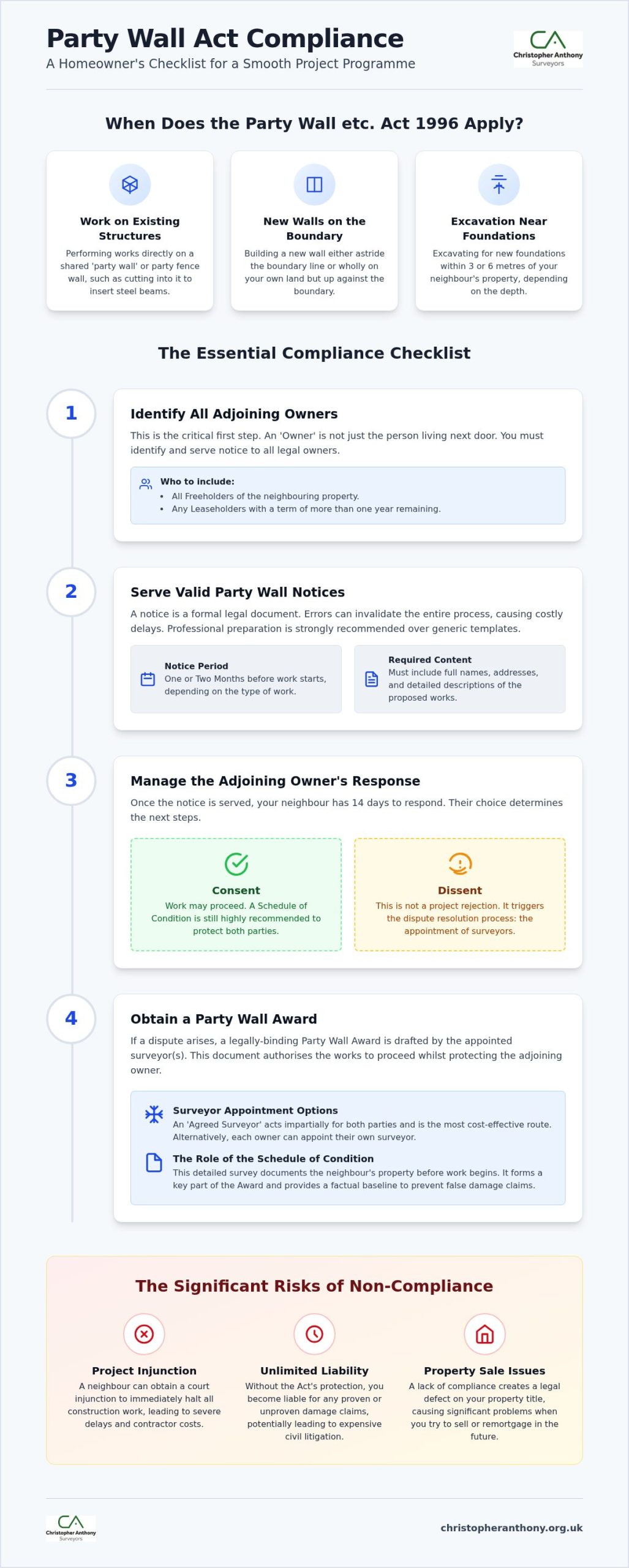
A common misconception amongst homeowners is that a "dissent" means the project is blocked. This isn't true. In the context of party wall act compliance, a dissent is simply a request for professional overwatch. It triggers the statutory dispute resolution process to ensure the work is carried out safely. For many projects, the most efficient path is appointing an Agreed Surveyor. This single professional acts impartially for both sides, reducing costs and delays. However, if your neighbour prefers their own representation, you'll usually be responsible for the fees of the Adjoining Owner Party Wall Surveyor. The process culminates in a Party Wall Award, the final document that authorises your work.
If a neighbour ignores your notice or refuses to sign, the 14-day rule applies. After 14 days, a dispute is "deemed" to have arisen. This doesn't stop your loft conversion or extension. The Act is an enabling piece of legislation. It's designed to allow work to proceed whilst protecting the neighbour's property from damage. You aren't asking for permission; you're following a procedure that facilitates construction whilst safeguarding rights.
In high-density areas across London and Hertfordshire, timelines are critical. If a neighbour remains uncooperative, you must follow the statutory process to appoint a surveyor on their behalf to prevent indefinite delays. Impartiality is the cornerstone of this process. Adhering to the RICS Guidance on Party Wall Procedures ensures the Award is legally robust and protects all parties involved. This professional oversight keeps your project programme on track without compromising on party wall act compliance.
Appoint a specialist Adjoining Owner Surveyor today
Every project presents unique challenges, but the core of party wall act compliance remains the same: identify the risk and mitigate it through procedure. Loft conversions typically involve cutting into the party wall to insert steel beams. This requires a Party Structure Notice. Basement excavations, particularly in London, involve deep digging that demands rigorous structural monitoring and complex Awards. Even simpler tasks like chimney breast removals require attention to structural stability and fire safety, as you're altering a shared vertical support.
When planning a loft project, your Building Owner Party Wall Surveyor will focus on the technical details of the beam insertions. For rear extensions, the priority shifts to Section 6 excavations. You must verify the foundation depths of neighbouring properties before you dig. A common mistake is assuming garden walls don't count; they are often the most vulnerable structures. Consider these points:
Ensuring your foundations don't undermine theirs is a critical part of party wall act compliance.
The biggest mistake is starting work before the statutory notice period ends or the Award is served. This is a direct breach of the Act. We always encourage early, informal engagement with your neighbours. It builds trust and often leads to a smoother, "friendly" compliance process. If you're worried about costs, our fixed-fee party wall surveyor services offer total transparency. Don't rely on assumptions or generic templates. Every brick you lay depends on the legal foundations you build first. Professional advice is the only way to ensure your compliance is watertight.
Achieving full party wall act compliance ensures your build stays on schedule and your neighbours remain on side. It's about moving from uncertainty to a structured, legal roadmap. You now understand how valid notices and detailed condition surveys protect your property and your budget. Whether you're planning a London loft conversion or a Hertfordshire extension, the right procedural steps prevent the disputes that derail construction programmes.
We provide over 20 years of specialist experience to guide you through every complexity. Our fixed-fee guarantee means you'll never face hidden costs or procedural surprises. You can focus on your new space whilst we handle the statutory requirements with precision and speed.
Request a fixed-fee quotation or use our Party Wall Assistant tool today.
Your project deserves a smooth start and a safe finish. Let's get your build moving forward with confidence and total peace of mind.
Yes, compliance is mandatory if your rear extension involves building a new wall on the boundary line or excavating foundations within 3 to 6 metres of a neighbour's structure. These works fall under Sections 1 and 6 of the Act. Even a simple extension can cause structural movement. Failing to follow the statutory procedure leaves you vulnerable to legal challenges and claims for damages from your adjoining owners.
The cost depends on the complexity of your project and whether neighbours appoint their own surveyors. In London, fees are generally higher due to property density and complex builds. As the Building Owner, you are typically responsible for all surveyor costs, including those of your neighbour's professional. Christopher Anthony Surveyors offers fixed-fee transparency for party wall act compliance to help you manage your budget without worrying about hidden hourly rates.
You can legally serve your own notice, but it is often a false economy. Small technical errors or missing information can render the notice invalid, forcing you to restart the statutory notice period. This leads to project delays and friction with neighbours. Professional party wall act compliance starts with a correctly drafted notice that includes all required plans, ensuring your legal right to build remains protected from the very beginning.
Starting work without compliance allows neighbours to apply for a court injunction to halt your project immediately. You'll likely be liable for their legal costs and your contractor's downtime. You also lose the protection of the Act for resolving damage disputes. Without a professional schedule of condition, you may struggle to defend yourself against fraudulent or exaggerated claims for cracks that existed before you started your project.
The timeline usually starts with a one or two-month notice period. If your neighbour consents quickly, you can often begin work as soon as the notice period expires. However, if a dispute is deemed to have arisen, appointing surveyors and drafting a Party Wall Award can take several weeks. We recommend starting the process at least three months before your planned start date to ensure all legal hurdles are cleared.