
A party wall dispute isn't a personal battle; it's a statutory safety net designed to protect your most valuable asset. If you're currently facing a disagreement, understanding the mechanics of party wall dispute resolution London is essential for your peace of mind. It's natural to feel anxious when a neighbour fails to respond or formally dissents to your notice. You're likely worried about escalating legal fees and the risk of significant delays in an increasingly tight London construction market. The 14-day response rule often creates more confusion than clarity for homeowners and developers alike.
This 2026 specialist guide explains how to navigate these challenges with precision. We'll show you how to protect your property rights whilst keeping your build moving without sacrificing neighbourly relations. By the end of this article, you'll understand how to secure a legally binding Party Wall Award and implement professional safeguards against property damage. We'll demystify the appointment of surveyors and provide a clear, actionable path from initial disagreement to a successful project commencement.
In the context of the Party Wall etc. Act 1996, a "dispute" isn't a sign of a failing relationship. It's a precise legal term. If a neighbour doesn't consent to your notice within 14 days, the Act deems a dispute to have arisen automatically. This statutory trigger is the starting point for party wall dispute resolution London. It moves the project from a private agreement to a professional, surveyor-led process. Rapid results. Legal certainty. Clear boundaries.
London's high-density housing makes this scenario the norm. With terraced houses and converted flats sharing structural boundaries, protecting individual property rights is paramount. This is where an Adjoining Owner Party Wall Surveyor plays a vital role. They ensure a neighbour's interests are professionally represented while allowing the building owner’s project to proceed safely. Efficiency is key in a market where delays are expensive.
Dissenting isn't an act of aggression. It's often a pragmatic choice to ensure a Schedule of Condition is recorded and a formal Award is served. The Act provides a robust framework to move past this dissent without needing expensive court intervention. It replaces personal friction with professional oversight. This ensures party wall dispute resolution London remains efficient and legally sound for all parties involved.
Certain projects in the capital are more prone to dissent due to their structural impact. Every project is unique, but common triggers include:
Ensuring Party Wall Act compliance throughout these triggers prevents project injunctions. It keeps your timeline on track and your budget predictable.
Efficiency in party wall dispute resolution London relies on strict adherence to statutory timelines. Once you serve a notice, the clock starts. If your neighbour doesn't respond within 14 days, the law deems them to have dissented. This isn't a dead end. It's a procedural shift. You must then serve a subsequent 10-day follow-up notice, requesting they appoint a surveyor. This structured approach ensures that a non-responsive neighbour cannot indefinitely block your development. Maintaining Party Wall Act compliance is the only way to avoid project injunctions that could halt your contractors on-site.
When a dispute arises, the building owner has a statutory duty to appoint a professional. If your neighbour continues to ignore correspondence after the 10-day notice, the "Section 10(4)" procedure becomes your most powerful tool. It allows you to appoint a surveyor on their behalf. This ensures the process remains impartial whilst keeping your project moving. Our team often acts as a Building Owner Party Wall Surveyor to manage these complex appointments with precision. If you're unsure of your next step, you can request a fixed-fee quotation to gain immediate clarity.
In cases where two separate surveyors are appointed, they must immediately select a "Third Surveyor". Think of this person as a final safety net. They rarely need to act, but their presence prevents deadlocks in complex London developments. If the two appointed surveyors cannot agree on a specific structural detail or cost, the Third Surveyor provides a binding decision. This hierarchy is designed to resolve technical disagreements quickly, ensuring that party wall dispute resolution London doesn't descend into a stalemate.
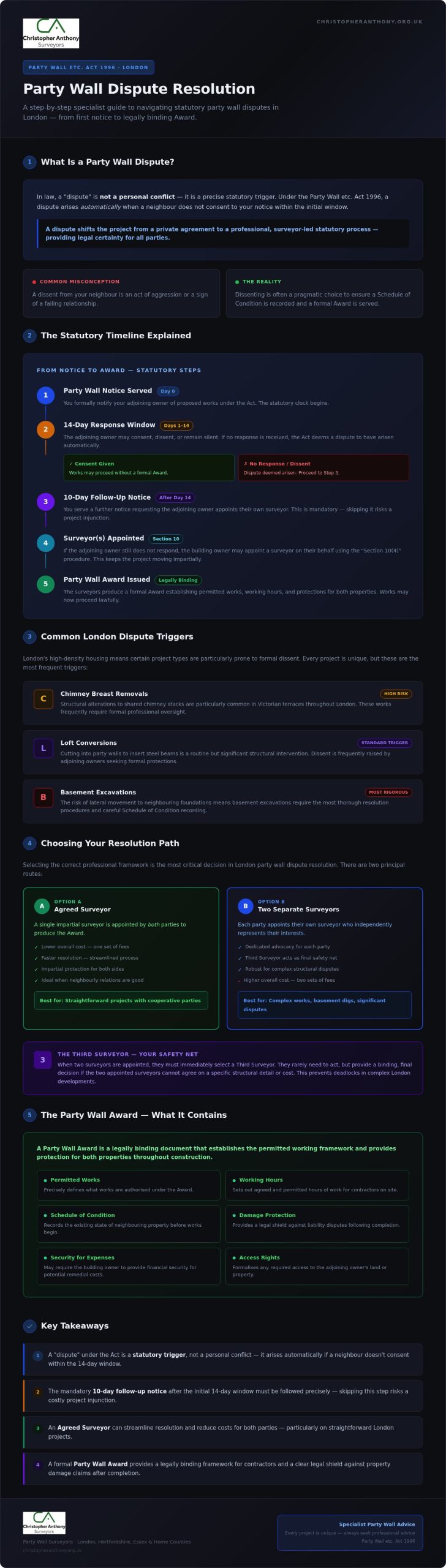
Selecting the correct professional framework is the most critical decision in party wall dispute resolution London. It directly dictates the momentum of your project and your total expenditure. An Agreed Party Wall Surveyor is an impartial statutory appointment rather than a representative of either party. Before choosing your path, always prioritise a Schedule of Condition survey. This document provides a photographic and descriptive record of the neighbouring property, acting as the essential foundation for any resolution. It protects you from spurious damage claims whilst ensuring your neighbour has a baseline for genuine repairs.
For standard London extensions or loft conversions, the Agreed Surveyor model is usually the most efficient choice. It streamlines communication and significantly accelerates the serving of the Award. Whilst the building owner typically pays the costs, this model reduces the total fee burden by using one expert instead of two. The following table highlights the strategic differences between the two paths:
| Feature | Agreed Surveyor Path | Two Surveyor Path |
|---|---|---|
| Efficiency | Faster; one professional handles all admin. | Standard; requires coordination between two firms. |
| Cost Burden | Lower; building owner pays one set of fees. | Higher; building owner typically pays for both surveyors. |
| Suitability | Best for loft conversions and rear extensions. | Recommended for deep basements or complex commercial sites. |
Professional surveyor-to-surveyor communication is designed to strip away the emotion that often complicates London projects. We focus on structural facts and statutory requirements, preventing personal friction from stalling your build. We recommend building owners prepare their neighbours with an informal conversation before serving formal notices. Discussing your plans over a coffee can demystify the process. When neighbours understand that the Act is there to protect their property rights, they are far more likely to consent to an Agreed Surveyor, further streamlining the party wall dispute resolution London process.
Find out if an Agreed Surveyor is right for your project
The Party Wall Award is the definitive conclusion to the party wall dispute resolution London process. It's more than a mere formality. It's a binding legal document that details exactly how, when, and where works can take place. By outlining specific working hours, methods of construction, and indemnity clauses, the Award provides a clear "rulebook" for your contractors. This level of detail prevents mid-project friction. It ensures that everyone on-site understands their obligations. Once the surveyors serve the Award, a 14-day appeal window follows. After this period, you can commence your project with the legal certainty that your property rights are fully protected.
In London's dense urban environment, protecting shared structural assets is a priority. The Award relies on the Schedule of Condition survey to settle any damage claims fairly and without litigation. For high-risk projects, such as basement excavations, the Award may include provisions for "security for expenses". This ensures funds are set aside to cover potential remedial works if a project stalls. This proactive measure provides peace of mind for adjoining owners and financial clarity for building owners.
The surveyor’s role doesn't end when the first brick is laid. Once your project is complete, a final inspection is often necessary to sign off the works. We compare the finished project against the original record to confirm no damage has occurred. Ensuring all obligations under the Party Wall etc. Act 1996 have been met is vital for more than just neighbourly peace. It protects future property sales by providing a clean legal trail for solicitors. A professionally managed party wall dispute resolution London ensures your investment remains secure long after the scaffolding comes down.
Mastering the statutory process is the only way to ensure your development stays on track without compromising your relationship with neighbours. We've explored how the Party Wall etc. Act 1996 provides a clear framework for resolving disagreements through professional appointments rather than litigation. By securing a robust Party Wall Award and recording a detailed Schedule of Condition, you create a vital legal shield for your property. This proactive approach to party wall dispute resolution London turns potential conflict into a manageable procedural step that protects every party involved.
Tony and the team bring over 20 years of experience to every instruction, focusing on the unique structural challenges of London's terraced and semi-detached properties. You deserve a specialist service that combines fixed-fee transparency with a personal, boutique approach to surveying. Don't let procedural confusion or non-responsive neighbours stall your project. Professional guidance ensures your build proceeds with the legal certainty you need to protect your investment for years to come.
Request a fixed-fee quotation for your London project today
We're here to help you move forward with confidence and clarity.
The timeframe for party wall dispute resolution London usually ranges between four and eight weeks. This schedule depends on three primary factors:
While the Act provides clear deadlines, professional cooperation is the most effective way to ensure your project remains on its original timeline.
Under the Party Wall etc. Act 1996, the building owner is typically liable for all professional fees. This includes the costs for their own surveyor and the reasonable fees of the neighbour's surveyor. This financial responsibility exists because the works are being undertaken for your benefit. However, we always ensure fees are fair and transparent, providing fixed-fee quotations to help you manage your project budget without any hidden surprises.
No, once a dispute is deemed to have arisen, you must appoint a surveyor to proceed legally. The Act is self-executing, meaning the resolution must follow the statutory path. Attempting to bypass this requirement by using informal agreements or online templates leaves you vulnerable to a project injunction. Professional surveyors provide the necessary legal bridge to move from a state of dissent to a valid, binding Party Wall Award.
A common misconception is that the neighbour must sign the Award for it to be valid. In reality, the document is signed and served by the appointed surveyors. Once served, the Award is legally binding, and the neighbour’s signature is not required. This ensures that party wall dispute resolution London remains efficient, preventing a single party from stalling the process simply by refusing to put pen to paper or acknowledging the document.
The Act is designed to facilitate building work, not prevent it. While a dispute may pause your commencement date while the necessary protections are put in place, it cannot permanently stop a project that is structurally sound and compliant. The process ensures that your right to develop your property is balanced against your neighbour’s right to structural security. Once the Award is served, you have the legal right to begin.