
Is saving a few pounds on a DIY template worth risking a five-figure legal injunction that halts your home extension indefinitely? It’s a valid concern for any homeowner. You’re likely already balancing architects and builders, so the last thing you need is the nagging fear that your party wall notice cost could spiral out of control. Many people feel overwhelmed by the legal requirements and the worry that a neighbour might use the process to block their project or demand unreasonable professional fees.
We understand that you want a predictable budget and a smooth start to your build. This guide will show you exactly how party wall notice costs are calculated, who is legally responsible for payment, and how fixed-fee services provide the certainty you need. We’ll preview the statutory timelines and explain how to avoid expensive disputes with your neighbours. Whether you’re planning a loft conversion in London or a basement in Essex, we’ll ensure your project stays on track without any hidden complications.
Serving a notice is the primary statutory requirement under the Party Wall etc. Act 1996. It's the mechanism that triggers the legal framework for your loft conversion, extension, or basement excavation. While you'll find plenty of "free" templates online, the real party wall notice cost isn't just the professional fee you pay a surveyor. It's the hidden price of getting the paperwork wrong. Viewing this step as a form of project insurance is essential for any homeowner in London or the South East.
Saving money on a DIY notice often backfires. A single administrative slip can invalidate the entire document, leaving your project vulnerable. Common errors we see include failing to identify all legal owners, such as long-leaseholders, or omitting mandatory excavation drawings required for Building Owner projects. If a neighbour discovers a technical flaw after you've started digging, they can secure a court injunction. This stops your builders instantly. The resulting delays and legal fees far outweigh the initial party wall notice cost of a professional service. Expert oversight ensures your project starts on a solid legal footing and helps prevent neighbours from dissenting out of pure confusion.
In the dense terraced streets of London and the Home Counties, project complexity varies. Some firms bill by the hour, which often leads to "fee creep" as administrative tasks or Land Registry searches pile up. We prefer a more direct approach. Opting for fixed-fee Party Wall Notices allows you to budget with total precision. You get the expertise of a specialist who handles the drafting, serving, and statutory follow-ups without the stress of an ever-increasing bill. It's about efficiency and keeping your construction timeline moving forward.
Location and density are the primary drivers of professional fees. In London and the South East, surveyors navigate complex property boundaries and high land values, which naturally impacts the initial party wall notice cost. The number of Adjoining Owners also dictates the workload; every neighbour with a legal interest requires a separate notice. If you live in a mid-terrace house with two neighbours, your administrative requirements double compared to a semi-detached project. It's about the volume of paperwork and the time spent identifying legal owners via Land Registry searches.
Specific project risks demand different levels of scrutiny. Loft conversions usually require work to the shared chimney or party structure, whereas rear extensions often involve excavation within 3 or 6 metres of a neighbour's foundation. Commercial projects carry higher liability and more intense documentation requirements. You should consult the GOV.UK guidance on party walls and building work to understand which statutory periods apply to your specific build. Each project type requires a tailored approach to ensure the notices remain legally robust.
Appointing a single Agreed Surveyor for both parties is the most effective way to manage your budget. This model can significantly reduce the total party wall notice cost by eliminating the need for two separate professional appointments. It ensures impartiality whilst protecting the interests of both property owners. Learn how an agreed party wall surveyor can streamline your project by acting as a neutral expert. If you're concerned about rising expenses, checking our fixed-fee pricing can help you plan with confidence. This streamlined approach prevents unnecessary delays and keeps your construction timeline on track.
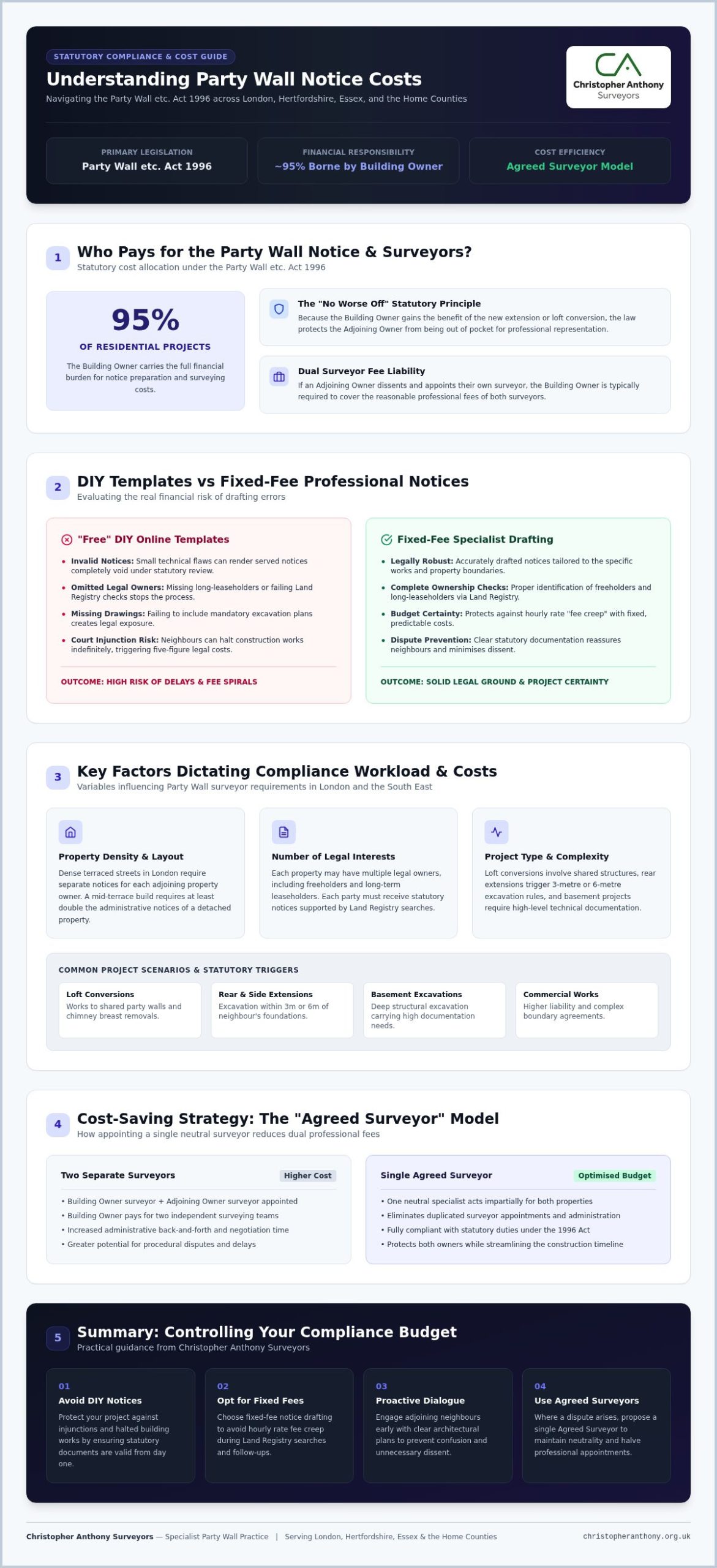
In approximately 95% of residential projects, the Building Owner carries the full financial burden. This means you are responsible for your own surveyor’s fees and the reasonable costs incurred by your neighbour’s chosen professional. The Party Wall etc. Act 1996 ensures an Adjoining Owner is "no worse off" because of your proposed works. Since you are the one gaining the new loft or extension, the law dictates you cover the compliance expenses. Understand the role of the Adjoining Owner Party Wall Surveyor to see how this protects your neighbour's property whilst allowing your project to proceed.
Statutory authority for these costs comes from Section 10 of the Party Wall etc. Act 1996. This section empowers surveyors to determine who pays what. While the initial party wall notice cost might be small, the total bill for professional awards is usually settled by the person initiating the work. It’s a protection mechanism that prevents neighbours from being financially penalised by your home improvements.
There are exceptional circumstances where costs are shared. If the work provides a mutual benefit, such as repairing a shared boundary wall that is in significant disrepair, the surveyor may apportion the fees between both parties. This is not a guess; it is a calculated decision based on the condition of the structure and the necessity of the work. The final Party Wall Award will detail this split, ensuring a fair outcome based on the specific facts of the case. Understanding these nuances helps manage your overall party wall notice cost expectations.
Get a fixed-fee party wall quote today
Managing your budget starts long before the formal paperwork is served. If you want to keep your party wall notice cost low, start with a friendly conversation. An informal chat with your neighbour can often prevent a formal dissent. This is the single biggest driver of professional fees. We also advise ensuring your architectural drawings are final. Serving notices based on draft plans leads to costly revisions and resets the statutory clock.
Always opt for a Schedule of Condition survey. It provides a baseline of your neighbour's property before work begins. This protects you against fraudulent or mistaken damage claims that could derail your finances. Why a schedule of condition survey is essential for cost protection is clear: it offers peace of mind for both parties and prevents expensive disputes later.
Precise notices reduce the time a surveyor spends on your file. When documents are clear and professional, neighbours feel more secure. This transparency often prevents them from appointing their own separate surveyor. Such a move would double your professional fee obligations. High-quality documentation is the foundation of a smooth, cost-effective process. It demonstrates that you are a responsible Building Owner who respects their property rights.
Timing is everything. The financial impact of starting work without an Award can be devastating. You risk court injunctions and significant legal fees. Plan for the statutory notice periods of one or two months. Rushing the process often leads to mistakes that invalidate your notice. By respecting these timelines, you ensure your party wall notice cost remains predictable and your project moves forward without expensive interruptions. Efficiency is the key to avoiding premium-rate services and keeping your build on track.
Managing a home renovation is complex. Don't let unexpected legal expenses add to the stress. By choosing a professional route, you ensure that your party wall notice cost remains a predictable part of your budget rather than a source of financial uncertainty. We've explored how early communication and accurate documentation prevent the dissent that leads to spiralling professional fees. Remember that a Schedule of Condition is your best defence against future claims. It provides essential clarity for both you and your neighbour throughout the build process.
Our RICS-regulated experts provide the fast turnaround and fixed-fee guarantees you need to keep your project on track. Whether you're based in London, Hertfordshire, or Essex, we offer the straightforward advice required to navigate the statutory requirements. You don't have to face these procedural hurdles alone. Our team is dedicated to protecting your interests and your timeline. We provide the expertise that turns a legal requirement into a simple step toward your new home.
Request a Fixed-Fee Quotation for Your Party Wall Notice
We look forward to helping you move your project from the planning stage to a successful completion without any hidden complications.
Yes, the Building Owner is typically responsible for paying the professional fees of both surveyors. This principle ensures the neighbour isn't financially disadvantaged by your project. If they choose their own surveyor instead of an Agreed Surveyor, you must cover those reasonable costs. Exceptions only occur if the work is for a shared benefit, such as repairing a dilapidated boundary wall that both parties share responsibility for maintaining.
Yes, a notice is almost always required for a loft conversion. Most projects involve cutting into the party wall to insert steel beams or removing shared chimney breasts. These are Section 2 works under the Act. Failing to serve notice before starting these structural changes is a breach of statutory duty. It can lead to your neighbour securing a court injunction, which will immediately stop all work on your site.
Your total budget depends on whether your neighbours consent or dissent. While the initial party wall notice cost is a small fixed fee, the total project budget should account for potential Award fees if a dispute arises. In London and the South East, costs vary based on the number of neighbours and project complexity. We recommend setting aside a contingency fund to cover these professional fees and any required Schedule of Condition surveys.
You can legally serve a notice yourself, but we don't recommend it for most projects. DIY notices often contain technical errors, such as incorrect owner names or missing excavation details. An invalid notice is a significant risk because it renders any subsequent Award void. Spending a small amount on a professional party wall notice cost ensures your paperwork is robust. This protects your timeline and prevents expensive legal challenges later.
If a neighbour doesn't respond within 14 days, they are deemed to have dissented from the works. This triggers a formal dispute under the Act. You must then serve a further ten-day reminder notice. If they still don't respond, a surveyor must be appointed on their behalf so the process can move forward. This ensures your project isn't held hostage by a non-responsive neighbour whilst still protecting their property rights.