
What if the most important difference between two schedule of condition cost quotations isn’t the fee, but what each surveyor will inspect and record? For a property in London or South East England, the scope can matter just as much as the figure on the page. A brief photographic record and a detailed inspection are not necessarily like-for-like services.
It’s understandable to want a clear price before work begins and to know which areas will be covered. The fee depends on the property and the record your project needs, so a generic price assumption may not help you compare options.
This guide explains what a schedule of condition survey can cover, which factors may affect a quotation, and what to check before appointing a surveyor. You’ll learn how to ask about access, inspection limits, photographs and reporting, so you can compare quotations on scope as well as cost and make an informed decision.
A schedule of condition is a dated record of a property’s visible condition before relevant works begin. It may include written observations and photographs, providing a point of comparison if the condition is reviewed later. For a fuller overview of what a schedule of condition is, see Designing Buildings Wiki.
There’s no universal tariff. The schedule of condition cost reflects the inspection and record agreed for the particular property and project. A larger property, more areas to inspect, restricted access or a request for more detailed recording may all affect the work involved. The survey documents condition. It does not prevent damage or decide who is liable if a problem arises.
The proposed works help identify which parts of the property may need documenting. For example, work close to a neighbouring wall may call for attention to relevant areas on that side of the property. The surveyor will also need to understand access arrangements and the extent of inspection requested. Before seeking a quotation, share the available plans, identify the property or areas that may be affected, and explain any access restrictions. These details help define the scope before you appoint anyone.
Two quotations may not describe the same service. Compare their inspection boundaries, level of written detail, photographic record and any assumptions or exclusions, rather than judging by the headline fee alone. A quotation covering readily accessible areas may differ from one that includes a wider inspection or more involved access arrangements. Check whether the report will identify the areas inspected and note any parts that could not be accessed.
The fee should reflect the agreed inspection scope, not an assumed standard rate. Ask each surveyor to clarify what the quoted work covers. Christopher Anthony Surveyors provides Schedule of Condition Surveys; the appropriate scope depends on the property and proposed works.
For Party Wall work, a schedule of condition records the visible condition of relevant parts of a neighbouring property before work begins. Written observations and photographs create a dated reference point. The record is separate from the Party Wall process itself: it documents condition rather than setting out how the works are to proceed.
The plans help identify which areas may be relevant, but no single inspection scope suits every project. A loft conversion may involve work to a party wall, while an extension or basement excavation may raise questions about nearby structures. Whether the Party Wall etc. Act 1996 applies depends on the work and property details. A surveyor can help clarify the inspection boundaries and any access limits. Don’t assume every project affects the same areas or requires the same record.
No. A schedule of condition records observed property condition. A Party Wall Award addresses relevant matters under the Party Wall procedure where that process applies. The documents serve different purposes and aren’t interchangeable. Christopher Anthony Surveyors provides Party Wall surveying services, including schedules of condition and Party Wall Awards. Ask for guidance on how a condition record may fit with the Party Wall process for your project.
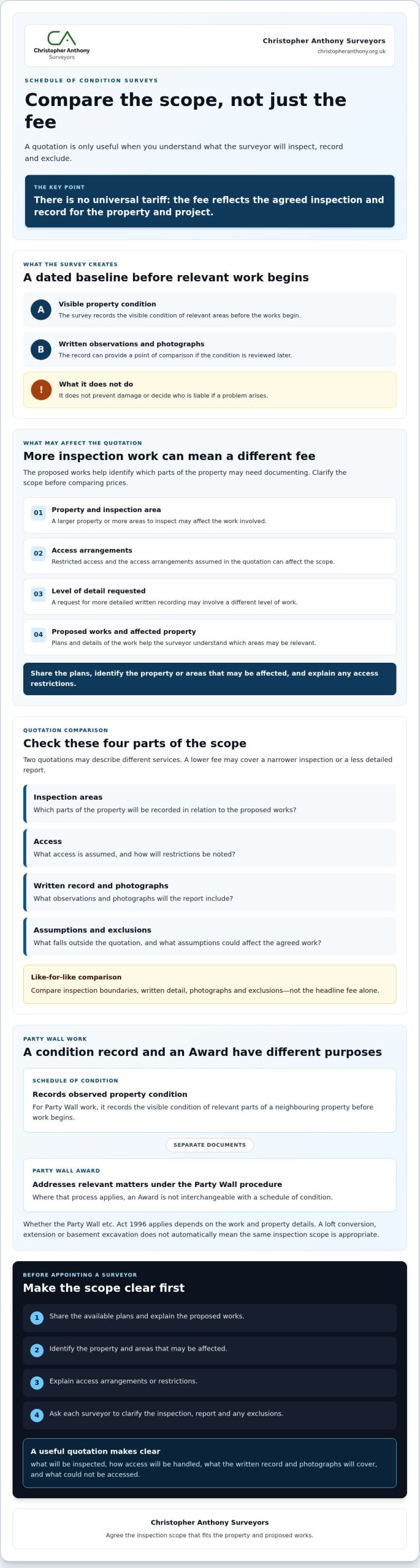
A lower fee may cover a narrower inspection or a less detailed report. Compare what each quotation includes, rather than treating the headline figure as a like-for-like comparison.
Use this checklist to clarify the scope:
Ask how the proposed inspection relates to your project and the affected property. RICS publishes guidance on surveying in the built environment, but the quotation should still explain the specific inspection and record being offered.
Ask which visible conditions and areas the surveyor proposes to record, what access is needed, and how inaccessible areas will be treated. Confirm what the written record includes and what is excluded. If the quotation refers to a photographic record, ask how it relates to the written observations and areas inspected. Clear answers help you judge whether the scope suits your property and the work planned.
Advice can help if you’re unsure whether you need a Building Owner surveyor, an Adjoining Owner surveyor or an Agreed Surveyor. The appropriate appointment depends on the circumstances and the Party Wall process relevant to the project. For wider fee context, see our Party Wall surveyor fees guide.
If you’re uncertain about the inspection scope or appointment, seek project-specific advice before proceeding. Christopher Anthony Surveyors offers Party Wall surveying services in London, Hertfordshire, Essex and Kent. More information about the practice is available on its website.
Before appointing a surveyor, share the proposed works, available plans and details of the property affected. Mention access restrictions or areas of particular concern. With this information, the surveyor can discuss a suitable inspection scope and explain what the quotation includes, including any limitations.
The right scope depends on the property, access and proposed work. A neighbouring property affected by an extension may call for a different approach from one near an excavation. Clarify uncertainties before proceeding, so you understand what the survey is intended to record and can compare quotations on a clear basis.
Christopher Anthony Surveyors provides Party Wall and schedule of condition services in London, Hertfordshire, Essex and Kent. Arrangements can vary with the property and project. Sharing the relevant details at the outset helps make the discussion and quotation specific to your circumstances.
You can request a fixed-fee quotation for your project and ask for confirmation of the inspection and reporting work it covers. Christopher Anthony Surveyors offers guidance on Party Wall surveying and schedules of condition. For service details, see the Schedule of Condition Surveys page. The appropriate scope depends on your property and proposed works.
Christopher Anthony Surveyors is an independent specialist Party Wall surveying practice established for over 20 years. The practice serves London and surrounding areas, including Hertfordshire, Essex and Kent, providing clear, practical guidance tailored to each project.
A useful schedule of condition is more than a set of photographs. It’s a dated record of visible condition, with an inspection scope that makes sense for the property, access and proposed works. That scope is what the schedule of condition cost should reflect.
Before appointing a surveyor, compare the areas included, reporting detail, access assumptions and exclusions. If two quotations differ, check whether they describe the same inspection and deliverables. Ask questions now, rather than relying on a generic price assumption or discovering later that an area you expected to be covered falls outside the agreed scope.
Christopher Anthony Surveyors provides specialist Party Wall surveying and schedule of condition services in London, Hertfordshire, Essex and Kent. Advice and survey arrangements depend on each property and project, so sharing your plans and clarifying uncertainties can help you decide what you need.
A clear scope is a practical first step. With the right questions answered, you can move forward with greater confidence in your appointment.
There’s no single fee that applies to every project. The schedule of condition cost depends on the property, the areas to inspect, access arrangements and the agreed reporting scope. For a meaningful quotation, provide details of the works and affected property, then check what inspection and reporting are included. This helps you compare proposals fairly, whether your project is in London, Hertfordshire, Essex or Kent.
The inspection area, property layout, access arrangements and level of recording requested can all affect the work involved. The proposed works matter too, as they help identify which parts of the property may be relevant to document. Ask the surveyor to explain the scope, assumptions and exclusions in the quotation. That gives you a clearer basis for comparing proposals for your particular property and project.
Don’t assume that every project requires a schedule of condition. It can provide a dated record of visible condition before relevant work, but whether it’s appropriate depends on the circumstances, including the proposed works and properties involved. A Party Wall surveyor can advise on your situation and explain how a condition record may fit into the wider process. Avoid relying on a generic template as a substitute for project-specific advice.
No. A schedule of condition records visible condition at the time of inspection; it doesn’t prevent building damage or guarantee a particular outcome. If concerns arise later, the record may help compare the property with its earlier documented condition. Its usefulness depends on the agreed inspection scope and what could be accessed and recorded, so check any access limitations and exclusions before the survey takes place.
No. The documents serve different purposes. A schedule of condition records the property’s observed condition, while a Party Wall Award addresses matters under the Party Wall procedure. They aren’t interchangeable. Depending on the proposed work and properties involved, you may need advice about one or both. A Party Wall surveyor can explain which documents may be relevant to your circumstances before you make arrangements.