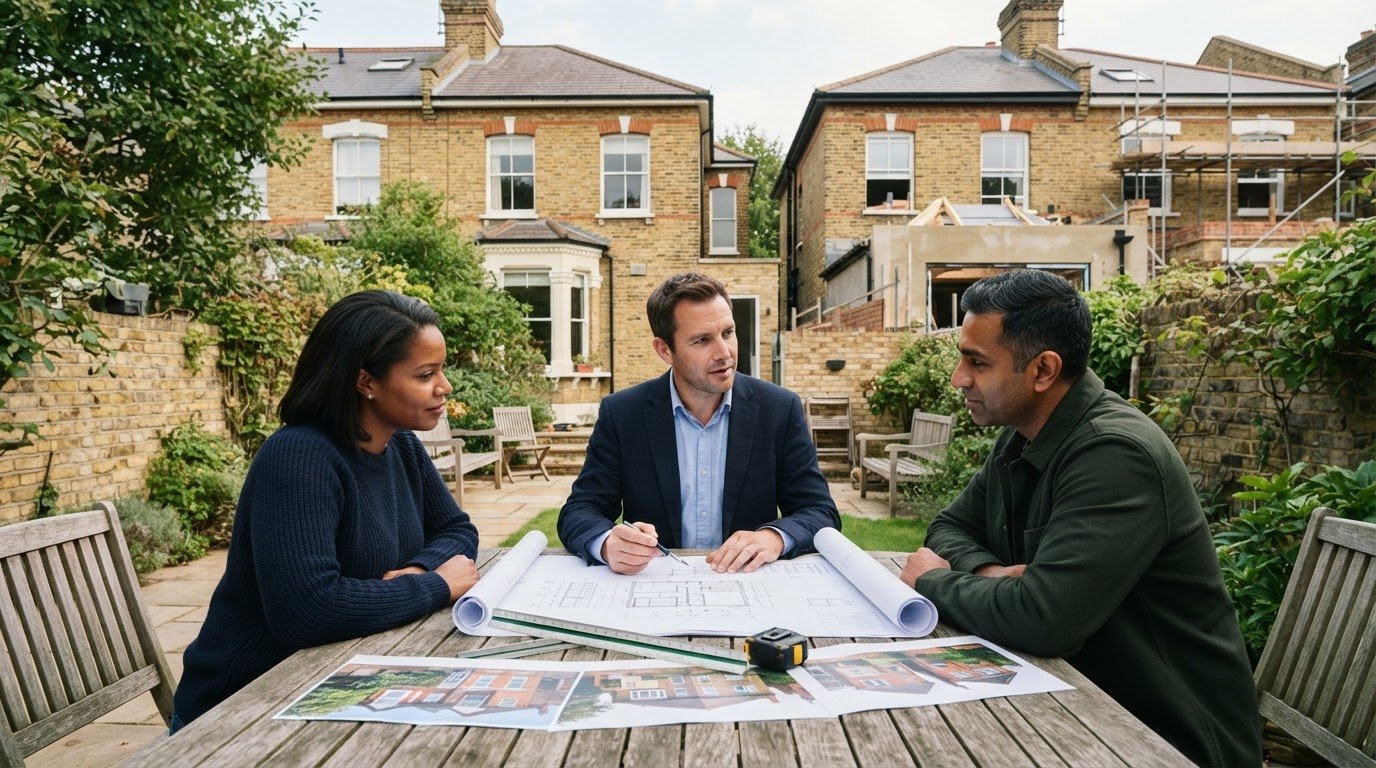
A party wall disagreement doesn’t have to bring a building project to a halt. In many cases, party wall dispute resolution follows a structured surveying process, giving both owners a way to address concerns without turning every difference into a court dispute.
If you’re unsure who appoints the surveyor, what happens when a neighbour dissents, or how concerns about possible damage are considered, it’s understandable to feel uncertain. The process can seem daunting when a loft conversion, extension or basement project is already being planned.
This guide explains the statutory route in plain English: how surveyors are appointed, what they consider and how an award can set out arrangements for the work. It also covers the information that can help the process run smoothly and how surveyor-led resolution differs from court proceedings. Every project is different, but understanding the steps can help you decide what to do next.
A party wall dispute arises when an adjoining owner dissents from a notice for work covered by the Party Wall etc. Act 1996, or when the statutory process otherwise requires surveyors to resolve matters. If an adjoining owner does not respond within the Act’s response period, that can also lead to the dispute-resolution process. The issue is specific: it concerns proposed notifiable work, rather than every concern or disagreement between neighbours.
A dispute under the Act does not automatically mean court proceedings. For relevant works, the Act provides a surveyor-led route to consider the proposed work and address matters within its scope. A disagreement about access, noise, boundaries or another property issue may need a different route if it is not connected to work covered by the Act. The details matter.
Surveyors consider the statutory issues impartially. They are not there to take sides in a wider neighbour dispute. Depending on the circumstances, owners may appoint separate surveyors or agree to use one Agreed Surveyor.
The project type alone does not determine whether the Act applies. The work’s position, design and relationship to neighbouring land or structures all matter. A loft conversion might involve work to a shared wall; an extension could involve building at the boundary or excavating nearby; and a basement may include substantial excavation. Removing a chimney breast can also involve work to a party structure. Each project needs to be considered on its own facts.
The Act provides a process for relevant work while taking adjoining owners’ rights into account. It does not decide every question about a building project, and planning or building control matters are separate. For broader background, see this overview of the Party Wall etc. Act 1996. If you’re unsure whether your project falls within the Act, seek advice based on the actual plans and site circumstances rather than relying on a generic template.
Once dissent or deemed dissent has triggered the statutory process, the next step is to appoint a surveyor or surveyors. They consider the proposed work and relevant circumstances, then determine matters within the Act’s remit. This is a structured process, not a negotiation in which either owner’s preferred outcome automatically prevails.
A surveyor acts impartially in the statutory role, rather than as an advocate for the owner who appointed them. Where each owner appoints a surveyor, those surveyors work together on the matters in dispute. If both owners agree to use one, the Agreed Surveyor acts for both within the process. The RICS guidance on Party Wall Legislation offers further professional context on procedure and the surveyor’s role.
A party wall award is the surveyors’ formal written determination of relevant matters arising from the proposed work under the Act. Depending on the project, it may set out how authorised work is to be carried out and relevant protections for adjoining property. Its scope depends on the statutory provisions and the facts; it does not resolve every neighbour or property issue. The award should reflect the Act and the specific circumstances, rather than copy wording from a generic template.
For tailored party wall dispute resolution, the right approach depends on the work and the surveyor appointment. Reviewing the notice, plans and specific point in dispute can clarify what needs to happen next.
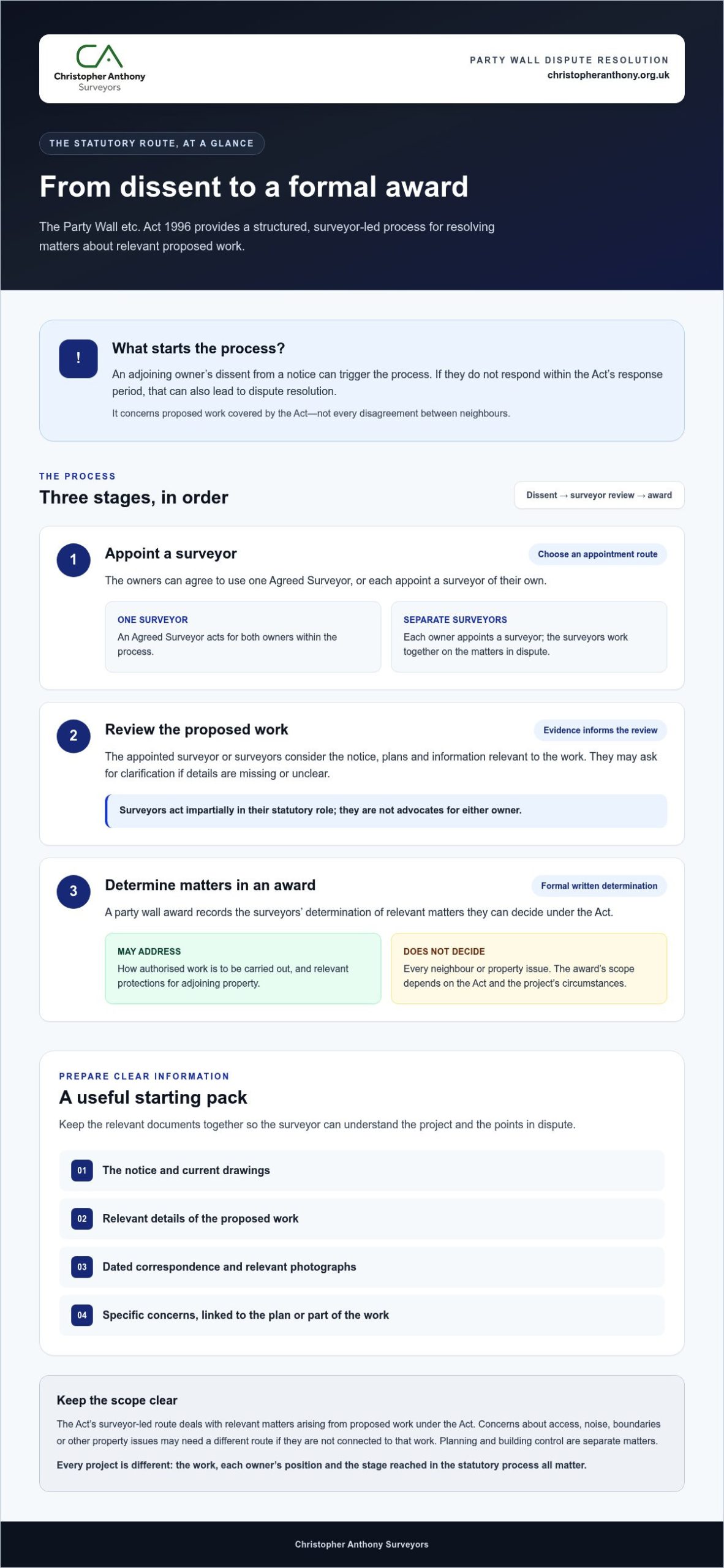
Good preparation helps the appointed surveyor focus on the work and the points in dispute. Keep the notice, current drawings, correspondence and relevant photographs together. When sharing information, identify which plan or part of the work relates to each concern. Keep messages calm and factual: describe the issue clearly and avoid assumptions about your neighbour’s intentions.
A useful starting pack includes the notice, current plans, relevant work details, dated correspondence and photographs that show the property’s condition or the concern being raised.
If you’re the building owner, organise the latest drawings and a clear description of the proposed work before discussions with the surveyor. Check that the documents show the current design. Out-of-date plans can make it harder to assess what is actually proposed.
If you’re the adjoining owner, write down specific concerns and when they arose. Photographs can help illustrate them. A Schedule of Condition Survey can record the property’s condition before relevant work begins, where appropriate to the project and circumstances.
Use dated, clearly labelled records. For example, distinguish photographs of existing cracks from images taken later, and note which room or area each image shows. Keep emails and letters in date order. Describe concerns precisely rather than making broad claims about possible damage. This gives the surveyor a clearer basis for considering the information alongside the proposed work.
Do not assume that work in dispute can proceed simply because the building programme is underway. Read the terms of any award and get project-specific advice before relying on an assumption about what may happen next. The party wall dispute resolution process does not have a guaranteed timetable. Provide information promptly, but avoid making commitments based on an expected decision date.
The right next step depends on the proposed work, each owner’s position and how far the statutory process has progressed. A building owner preparing for an extension may need different guidance from an adjoining owner responding to a notice. Avoid relying on a generic template or assuming that a neighbour’s response determines what happens next. Advice should be based on the project documents and the circumstances.
At Christopher Anthony Surveyors, we assist building owners and adjoining owners across London, Hertfordshire, Essex and Kent. Our fixed-fee party wall surveying services include guidance on notices, schedules of condition and awards, tailored to the project. We can help building owners understand their role in the process and support adjoining owners with guidance about their position.
If you’re the building owner, a building owner party wall surveyor can guide you through the surveying process for your project. The practical aim of party wall dispute resolution is to deal with matters within the Act’s scope, not to escalate a wider neighbour disagreement.
When seeking advice, share the notice, plans and a clear description of the issue. You can request a fixed-fee quotation or use the Christopher Anthony Party Wall Assistant tool to help identify a suitable next step. Advice should still be tailored to your individual circumstances.
Christopher Anthony Surveyors is a specialist party wall surveying practice established for over 20 years. We provide practical guidance and surveying support for building owners and adjoining owners across London, Hertfordshire, Essex and Kent, with advice tailored to each project and its circumstances.
The next decision need not solve every concern at once. Start with the issue that needs attention now: whether the statutory process applies, what information is missing, or how the current stage affects your plans. This keeps party wall dispute resolution focused on practical decisions rather than assumptions or a wider disagreement.
If you’re uncertain how to proceed, project-specific advice can help you understand your options and prepare for a constructive discussion. A clear next step can make a difficult situation feel more manageable.
With the right guidance, you can approach the process calmly and make informed decisions about what happens next.
Yes. Party wall dispute resolution is commonly handled through the surveyor process set out in the Act, without court proceedings. For example, surveyors may address concerns about how proposed work affects a shared wall and record their determination in an award. Court action may be relevant in some circumstances, particularly if an award is challenged. The right route depends on the issue, so seek advice if you’re unsure.
Yes. Where the statutory dispute process applies, you can appoint your own surveyor rather than rely on your neighbour’s appointment. The surveyors then work together on the matters they need to resolve. If you and your neighbour have already agreed to appoint one Agreed Surveyor, the position may differ. Explain your concerns and share the notice and project documents before making an appointment.
If you believe an award is wrong, do not ignore it or assume an informal objection will change its effect. The Act provides a route to challenge an award through the county court, and there may be a strict time limit. Get prompt advice on the award’s wording and your options. Keep the served award and related correspondence together so the details can be reviewed.
Do not assume that work covered by the dispute can proceed before the statutory process has reached the relevant stage. The answer depends on the work, the dispute and any award already in place. A project may include separate tasks, but that does not establish which can go ahead. Review the documents and seek project-specific advice before authorising or carrying out disputed work.
No. A party wall surveyor’s role is not to decide who is the better neighbour or assign blame for a general disagreement. The surveyor deals with matters within the Act’s remit, which can include considering a claim about damage connected with relevant works. That is different from deciding wider questions of negligence or liability. If your concern goes beyond the Act, you may need separate advice on that issue.